Movements
From Milan to Porto Ercole
- 1Milan1571–92Born and raised; apprenticed to Peterzano
- 2Venice?1592Possibly passed through on the way to Rome
- 3Rome1592–1606Del Monte, the Mattei, the great public commissions, the killing
- 4GenoaAug 1605Hides after wounding the notary Pasqualone
- 5Zagarolo / PalianoSummer 1606Hidden on Colonna estates after the duel
- 6 · 11Naples1606–07 · 1609–10Seven Acts of Mercy; later the Cerriglio ambush
- 7VallettaJul 1607 – Oct 1608Knighted, then jailed and escaped
- 8SyracuseOct–Dec 1608The Burial of St Lucy
- 9MessinaDec 1608 – mid 1609Lazarus, Adoration of the Shepherds
- 10PalermoSummer 1609Nativity for the Oratory of San Lorenzo
- 12Paloc.16 Jul 1610Arrested on landing; the boat sails on
- 13Porto Ercolec.18 Jul 1610Dies, aged 38
Chronology
Timeline of his life
- 29 Sep 1571
Milan
Born
Born on the feast of the Archangel Michael, just over a week before the Christian victory at Lepanto. His mother’s family is tied to the Sforza-Colonna, the start of Costanza Colonna’s lifelong protection.
- 1576–78
Milan
Plague
Plague kills about a fifth of the diocese. In October 1577 his father, grandfather and grandmother die within a day of each other.
- 1584
- 1590–92
Milan
Leaves Milan
His mother dies in 1590. He sells his inheritance, cuts ties with his siblings and leaves Milan for good at 21, possibly after a killing.
- Autumn 1592
Venice?
On the road
Possibly travels via Venice, where Tintoretto’s light and dark may have left a mark.
- 1592–93
Rome
Arrives in Rome
Paints cheap heads for Lorenzo Siciliano, meets Mario Minniti, lodges with “Monsignor Salad”.
- 1593–95
Rome
The Cesari workshop
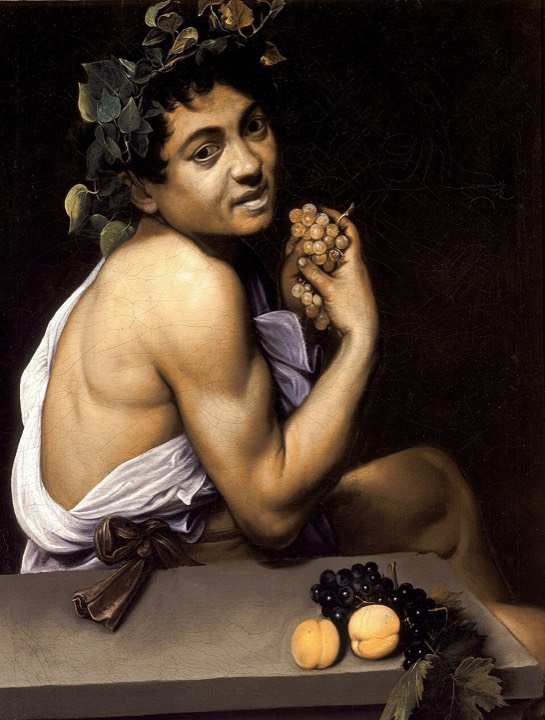
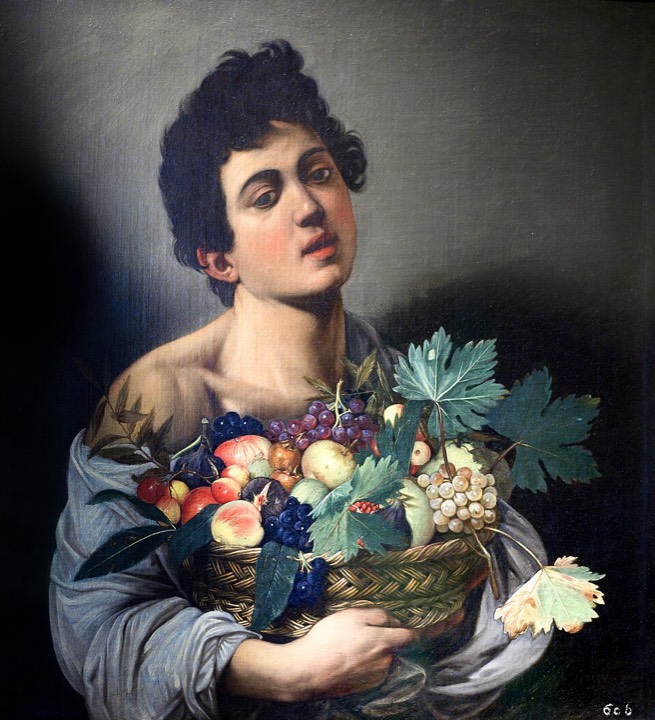
Paints flowers and fruit for Giuseppe Cesari. Early works include Self-Portrait as Bacchus and Boy with a Basket of Fruit. A horse kicks him and he never goes back.
- c.1595
Rome
Cardinal del Monte
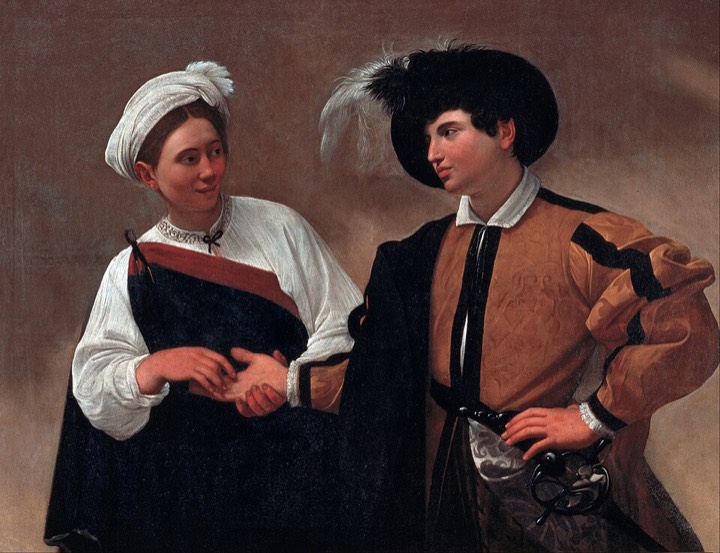
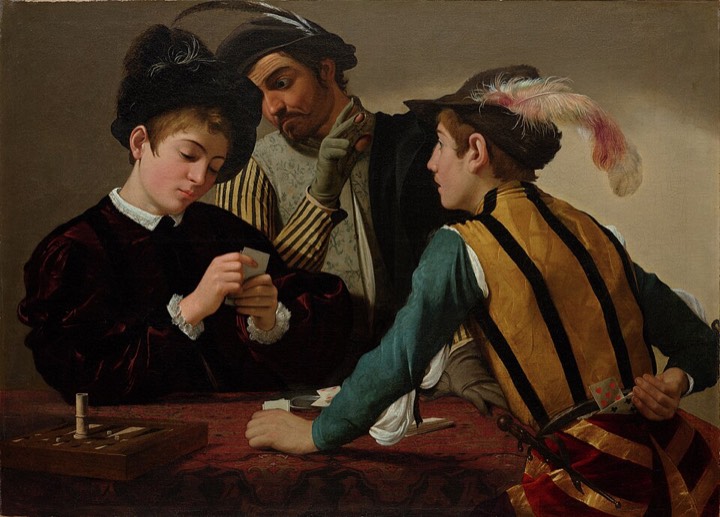
Del Monte buys The Fortune Teller and The Cardsharps and takes him into his household in autumn 1595.
- 1595–99
Rome
The del Monte years
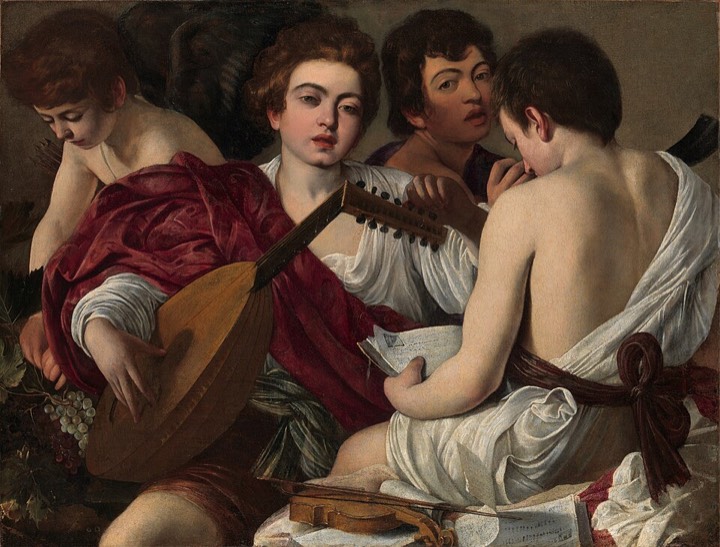
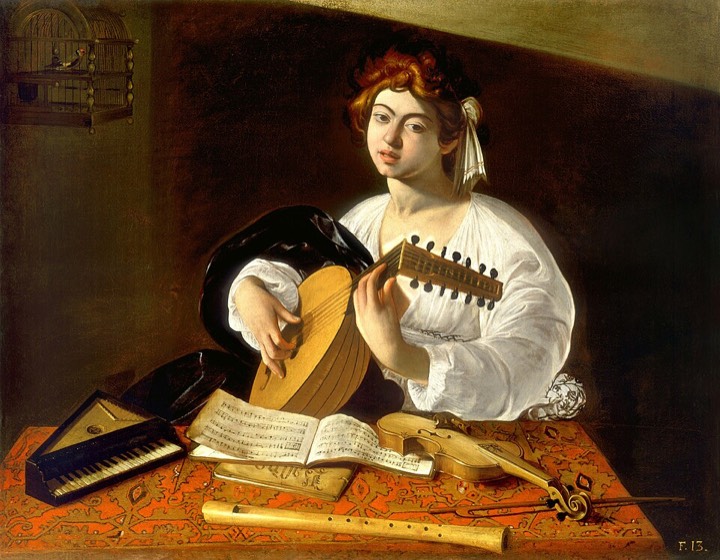
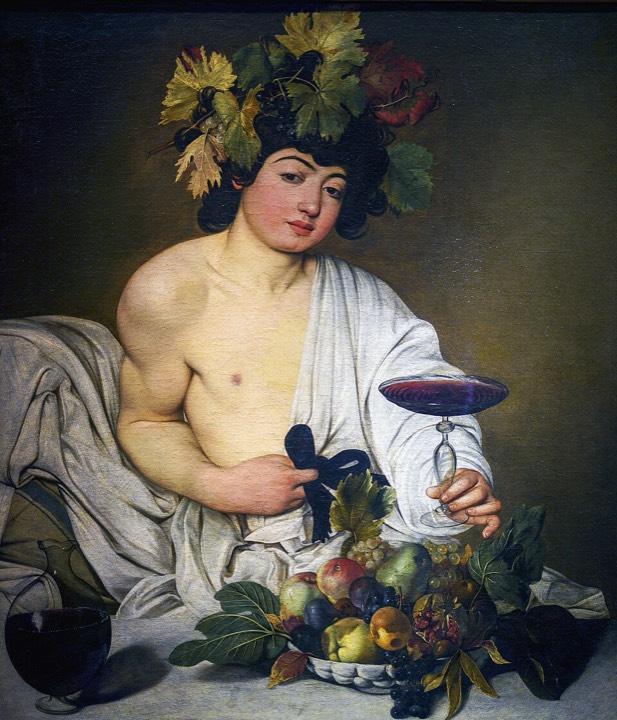
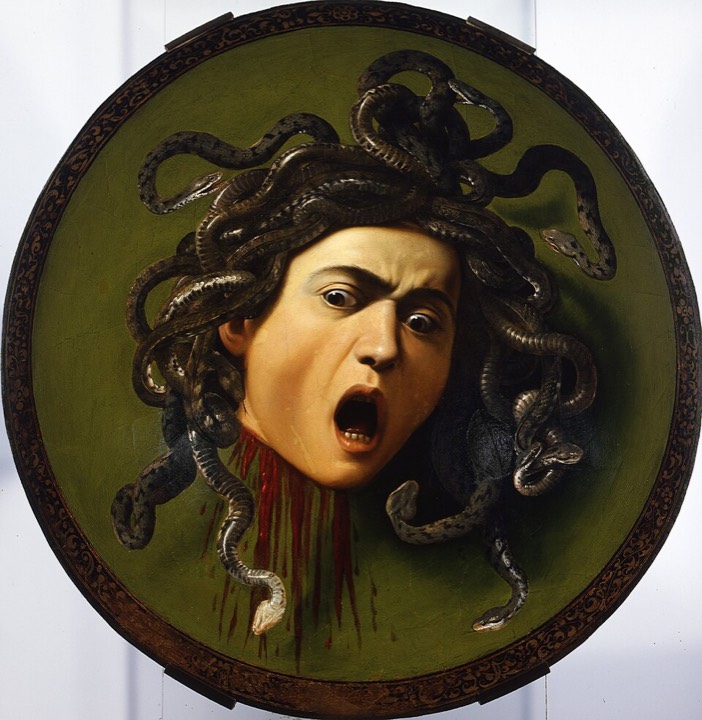
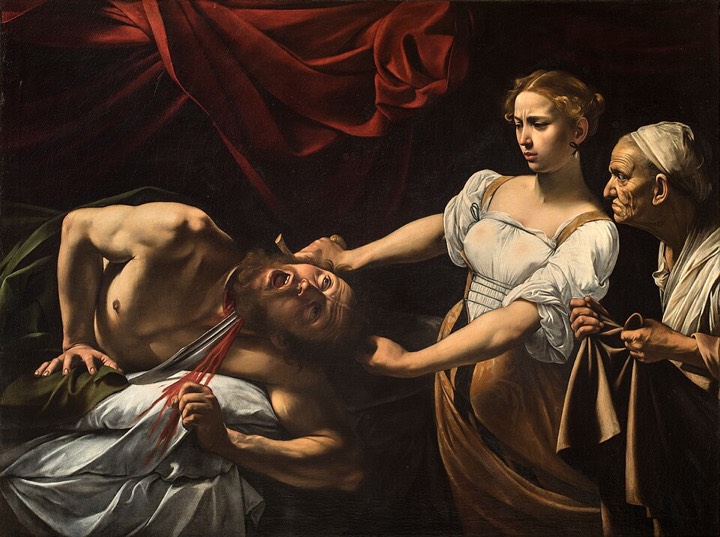
The Musicians, The Lute Player, Bacchus, Medusa, Judith Beheading Holofernes. Witness in a 1597 court case; arrested for carrying a sword in May 1598.
- Jul 1599 – 1600
Rome
The Contarelli Chapel
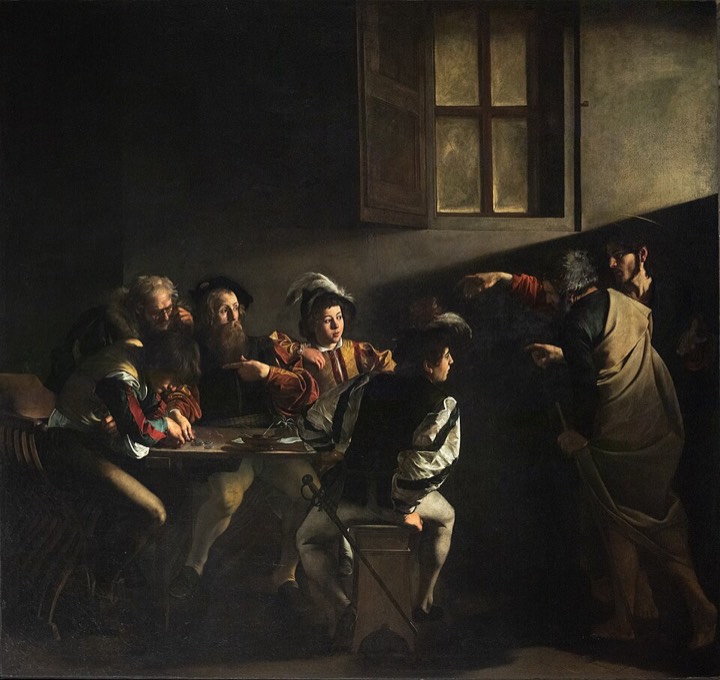
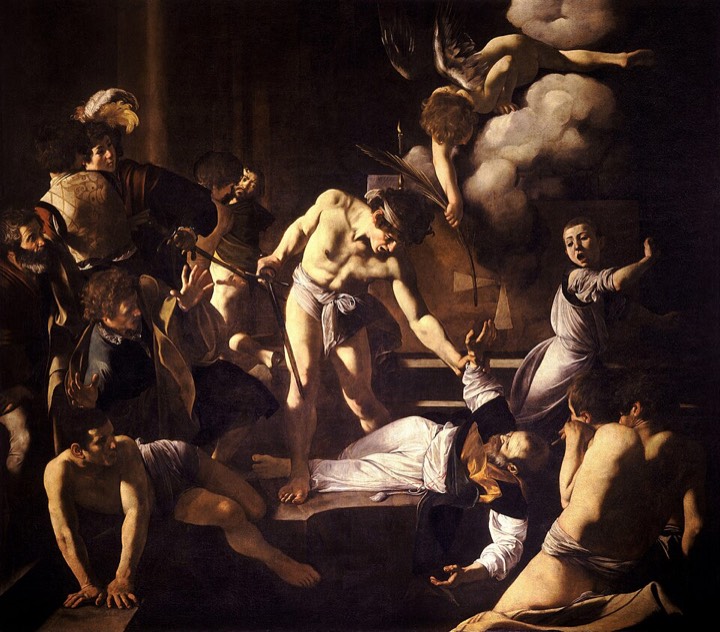
First public commission: The Calling of St Matthew and The Martyrdom of St Matthew. Fame follows, and so do brawls.
- 1600–01
Rome
The Cerasi Chapel
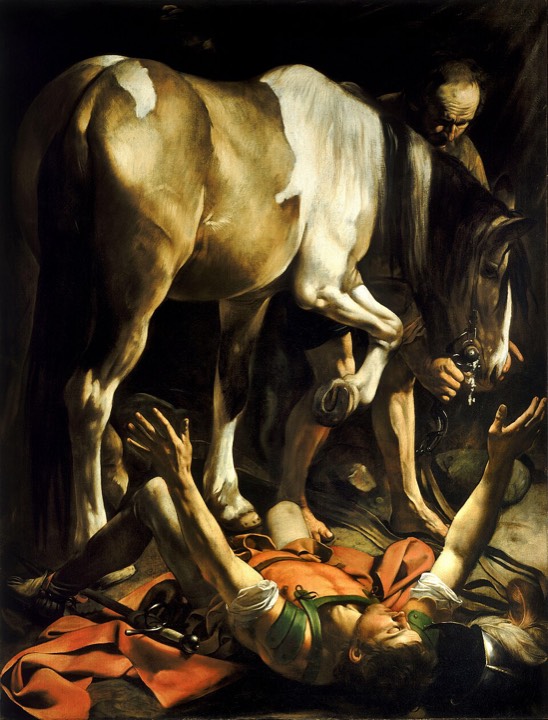
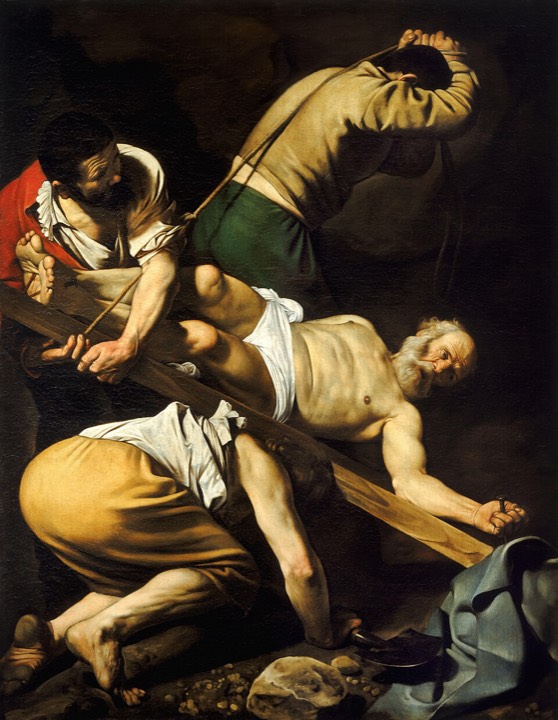
The Conversion of St Paul and The Crucifixion of St Peter for Santa Maria del Popolo, next to Carracci’s altarpiece.
- 1601–03
Rome
The Mattei palace
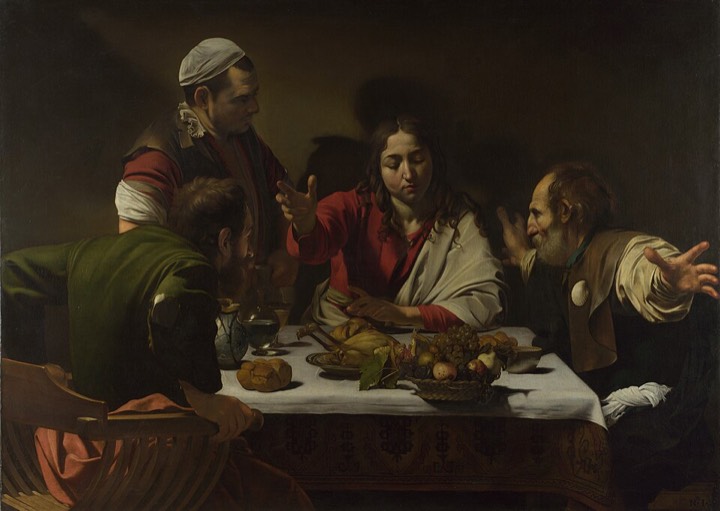
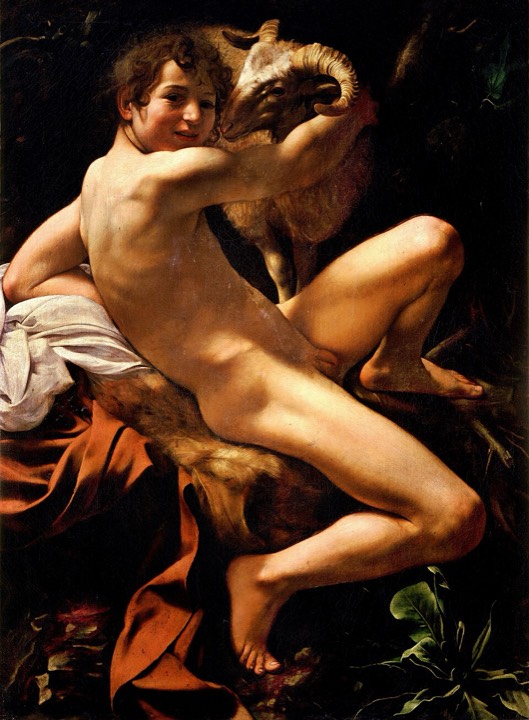
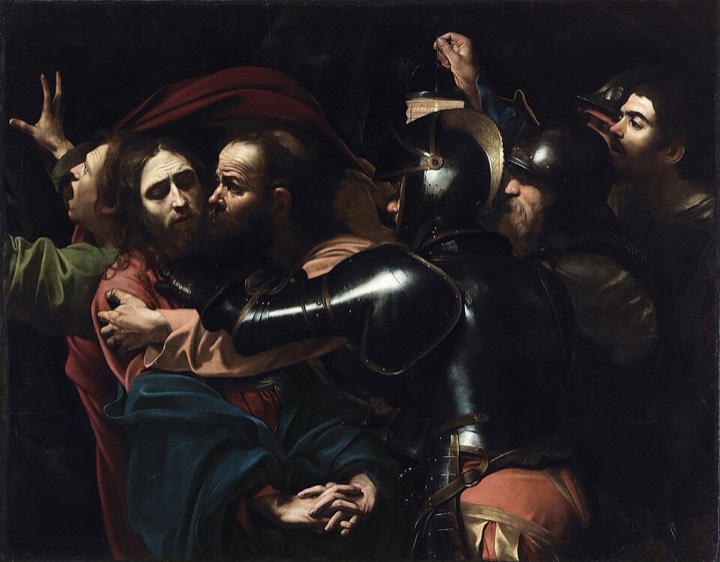
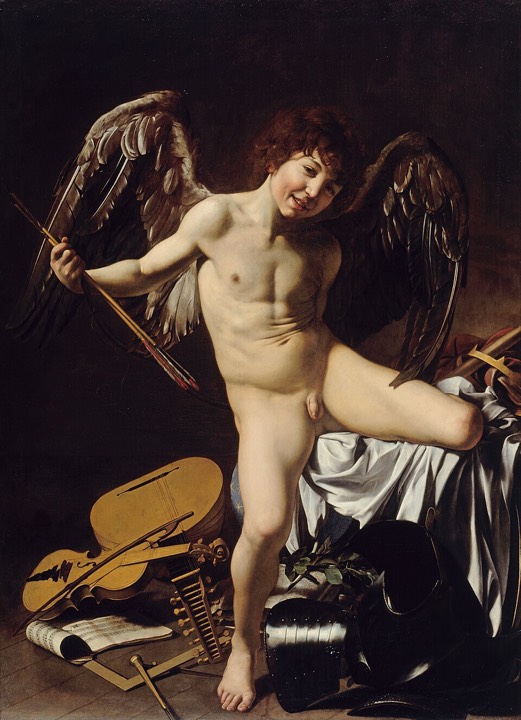
The Supper at Emmaus, St John the Baptist and The Taking of Christ. For Giustiniani, Omnia vincit amor.
- Aug–Sep 1603
- 1604
Rome
Artichokes and arrests
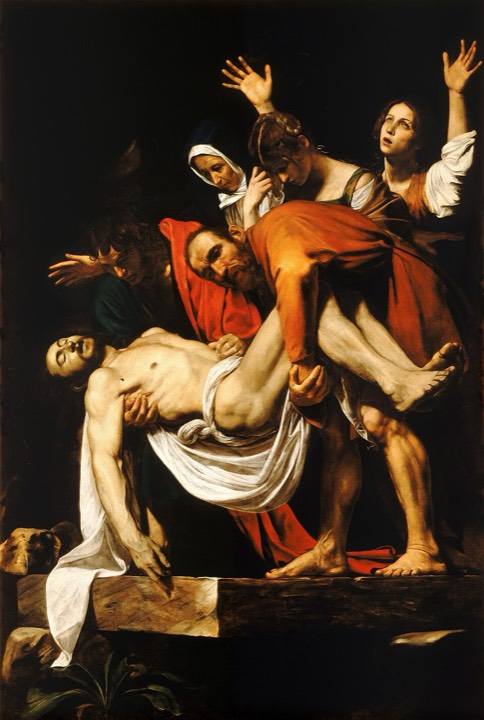
Throws a plate of artichokes at a waiter; arrested for stone-throwing and carrying weapons. The Entombment is finished.
- Jul–Aug 1605
Genoa
Flight to Genoa
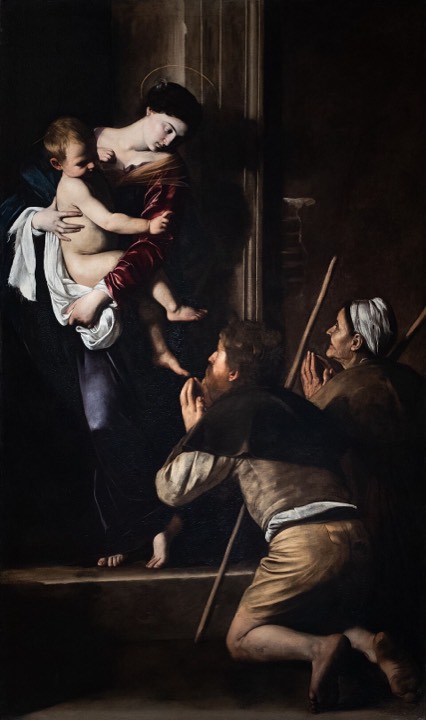
Wounds the notary Pasqualone over Lena and hides in Genoa until a written apology settles it. The Madonna of Loreto is unveiled around this time.
- 1605–06
Rome
Rejections
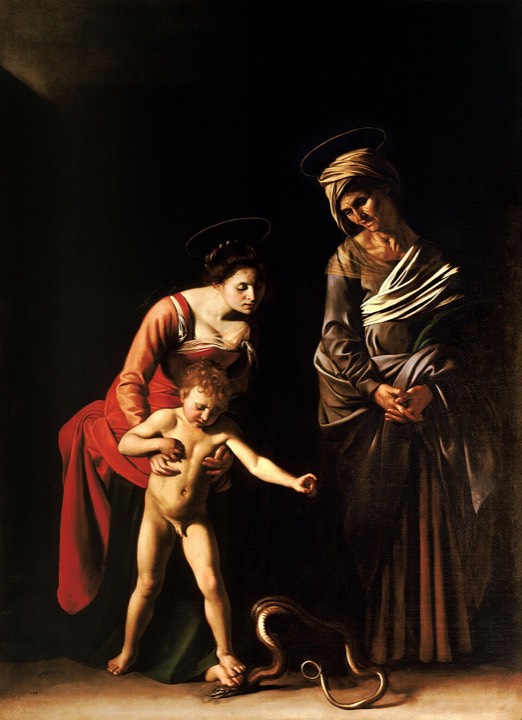
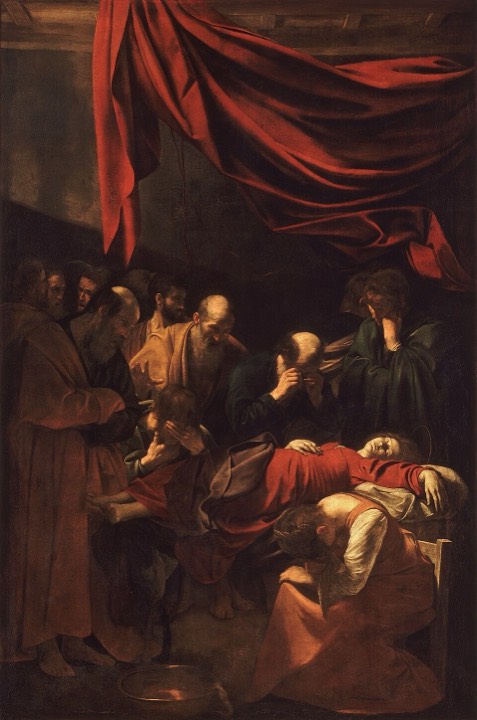
The Madonna of the Palafrenieri is removed from St Peter’s after two days; The Death of the Virgin is rejected.
- 28 May 1606
Rome
Kills Ranuccio Tomassoni
A prearranged duel on a tennis court. Condemned under a bando capitale: anyone may kill him on sight.
- Summer 1606
Alban Hills
In hiding
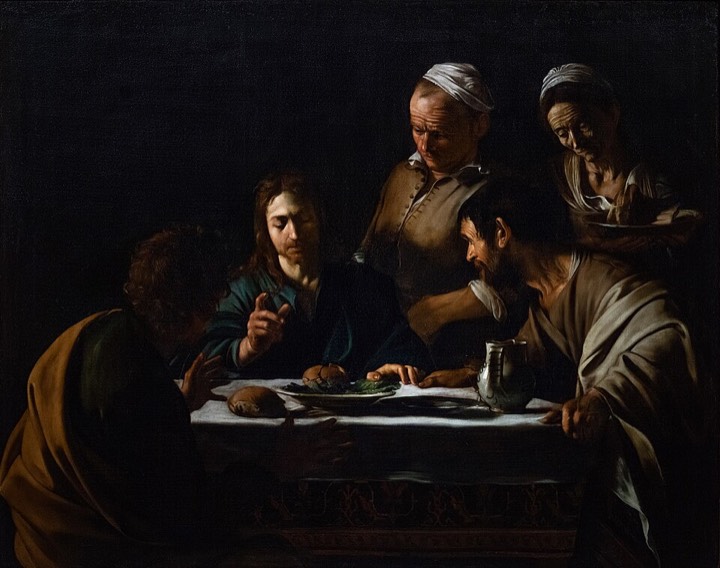
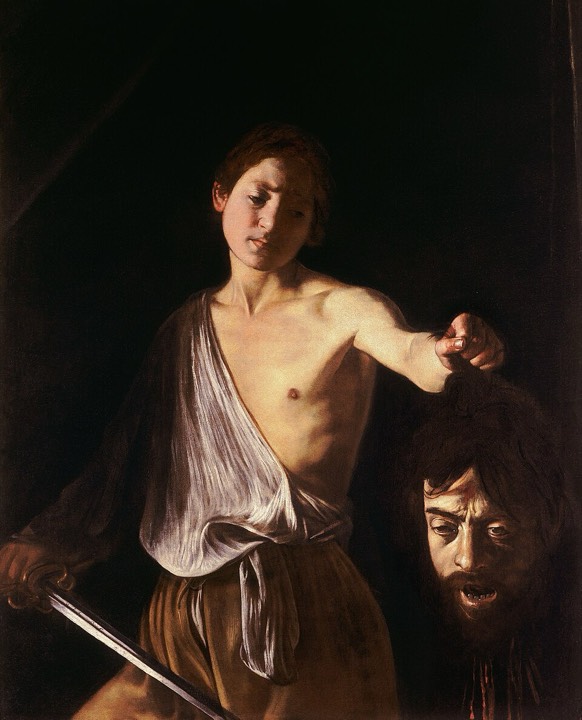
Sheltered on Colonna estates at Zagarolo and Paliano. Paints the second Supper at Emmaus and probably David with the Head of Goliath.
- Oct 1606 – Jun 1607
Naples
First stay in Naples
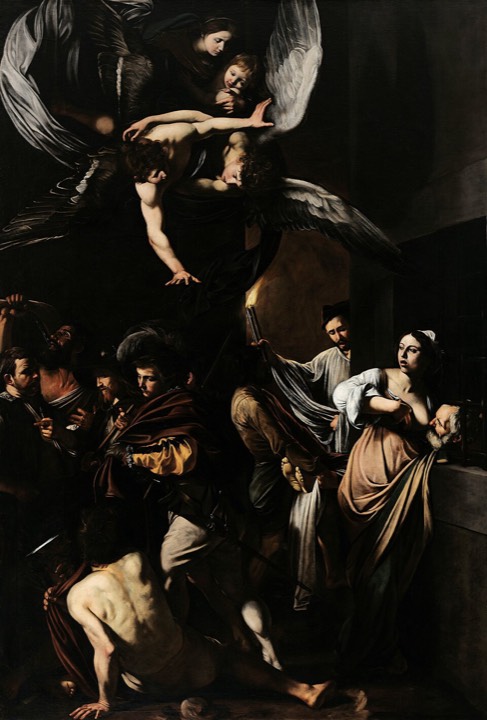
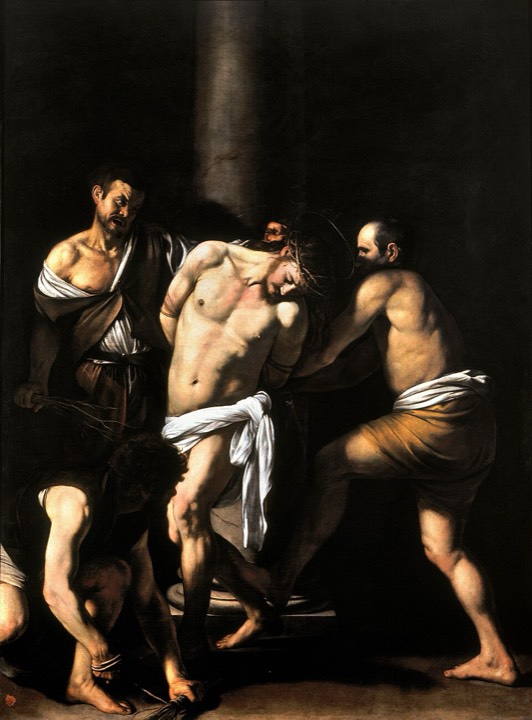
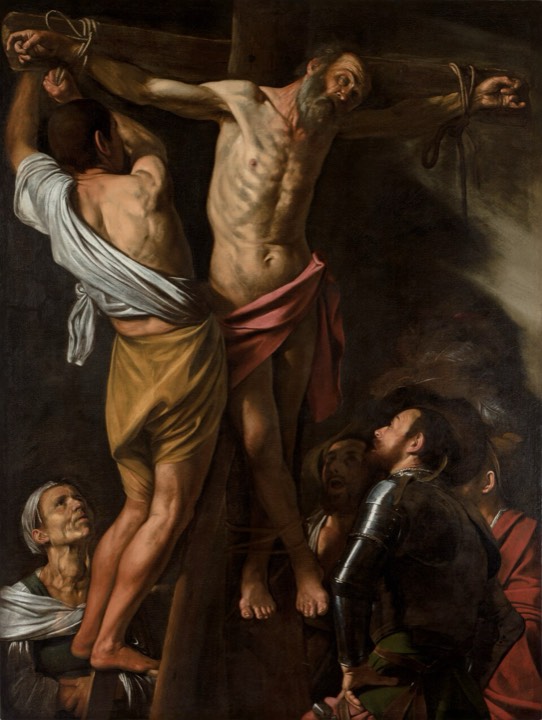
The Seven Acts of Mercy, The Flagellation and The Crucifixion of St Andrew.
- 12 Jul 1607
Malta
Arrives in Valletta
Sails from Naples on 25 June with the galleys of Fabrizio Sforza Colonna, hoping a knighthood will free him from the death sentence.
- 1607–08
Malta
Painter to the Knights
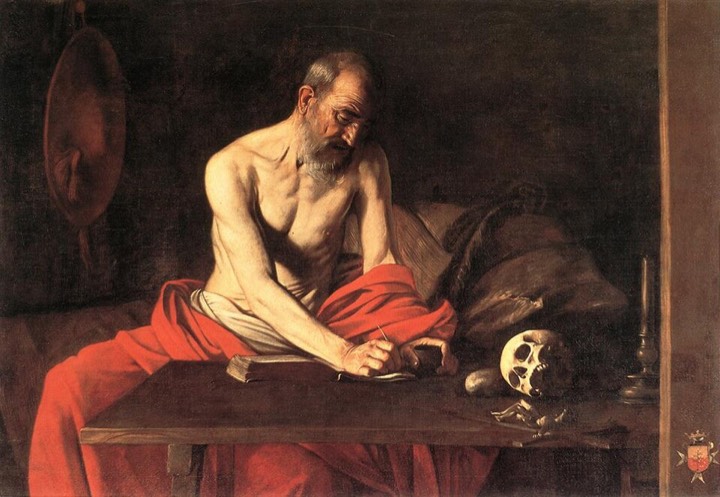
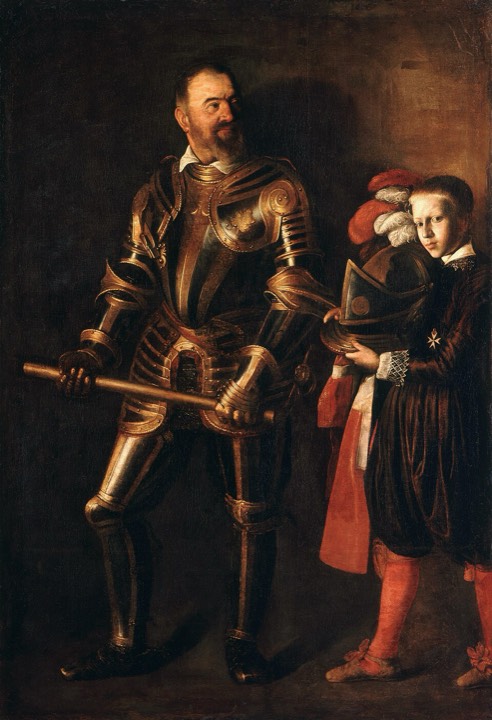
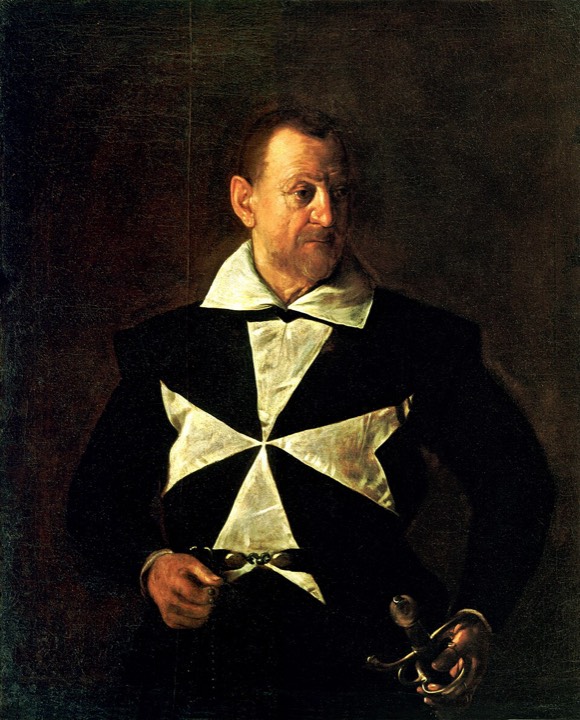
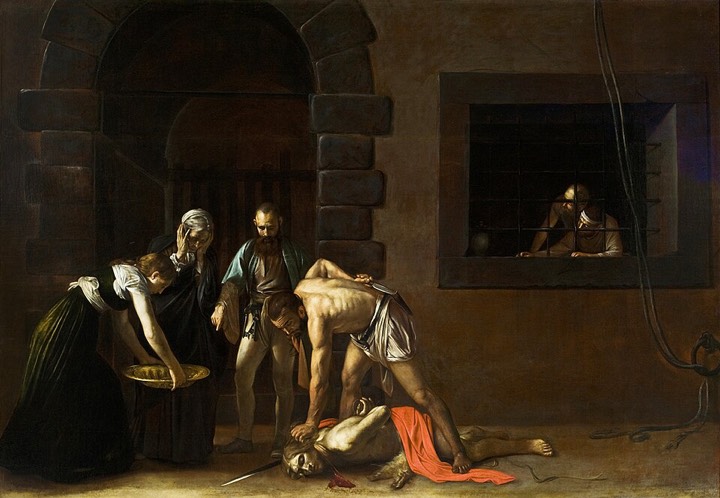
St Jerome Writing, Alof de Wignacourt, Fra Antonio Martelli, and his only signed work, The Beheading of St John.
- 14 Jul 1608
Malta
Knighted
Made a Knight of Magistral Obedience and compared to Apelles.
- Aug–Oct 1608
Malta
Jailed and escapes
Joins an assault on Fra Giovanni Rodomonte Roero, is jailed in the Castel Sant’Angelo on 28 August and escapes in early October.
- Oct–Dec 1608
- Dec 1608 – 1609
Messina
Messina
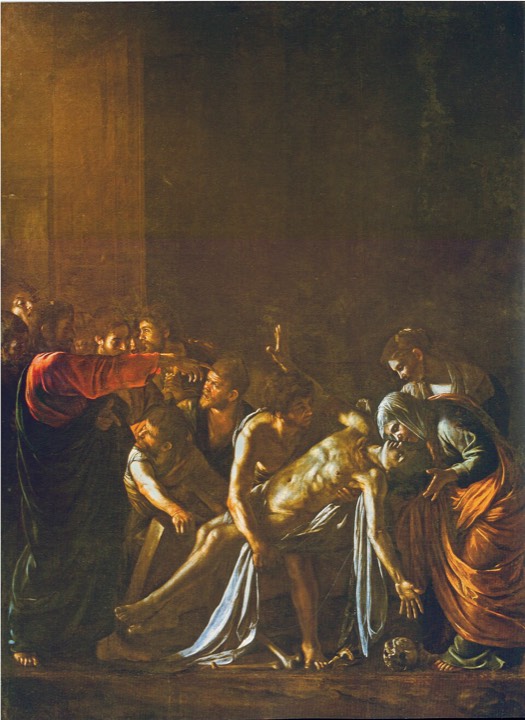
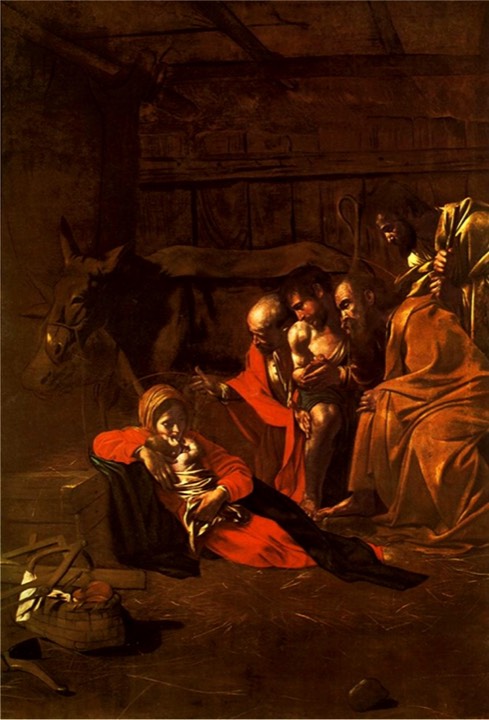
The Resurrection of Lazarus and The Adoration of the Shepherds. Sleeps armed and fully clothed.
- Summer 1609
- Oct 1609
Naples
Ambushed
Back under Colonna protection. Attacked outside the Osteria del Cerriglio and slashed across the face, probably Roero’s revenge.
- 1610
- c.9–16 Jul 1610
Palo
Arrested on landing
Sails for Rome with three paintings for Scipione Borghese. Held at Palo; the boat sails on without him.
- c.18–19 Jul 1610
Porto Ercole
Dies
Reaches Porto Ercole to recover his paintings and dies there, aged 38. Buried in an unmarked grave. News reaches Rome on 28 July.
Part One
Milan, 1571–92
The premise (Darkness and Light). Graham-Dixon compares Caravaggio’s life to his paintings: brief, brightly lit moments surrounded by darkness. Almost everything we know about him comes from police and court records, so the biographer has to work like a detective. He says Caravaggio’s sexuality has been over-used as the key to everything. The evidence suggests he slept with both men and women and settled with no one. The deeper wound, he argues, was being abandoned as a child.
The sources (Facts and Fictions). Three early biographies exist. Mancini was a doctor who knew Caravaggio but wrote very briefly. Baglione was a rival who once sued him for libel, yet he’s the most reliable on bare facts, just smug in his judgements. Bellori never met him and set up the lasting myth of an uneducated painter who could only copy what was in front of him. Graham-Dixon rejects that myth and calls Caravaggio a thoughtful, well-read artist.
Family and status (Modest Origins, Noble Connections). His father, Fermo Merisi, was a stonemason, not the architect Mancini claimed. His mother’s side was better connected. Her father was a land surveyor who worked for the Sforza-Colonna family, and her sister was wet-nurse to Costanza Colonna’s children. Costanza would protect Caravaggio for the rest of his life. His inflated sense of his own status would fuel many later quarrels.
His name (The Angel with Sword and Shield). He was born on 29 September 1571, the feast of the Archangel Michael, just over a week before the Christian victory at Lepanto. A Colonna led the papal fleet in that battle. The timing may help explain Costanza’s lifelong loyalty to him.
Milan and Borromeo (Town and City, Carlo Borromeo, ‘Ego te absolvo’). Milan was rich, Spanish-ruled and famous for its swordsmiths. Archbishop Carlo Borromeo dominated the city. He was an austere Counter-Reformation zealot with a private armed militia. He pushed through confession booths, separated men and women in church, informed on heretics, and tried, without success, to abolish Carnival.
Art and seeing (The Power of the Image, The Sacred Mountain). This is the book’s core argument about where Caravaggio’s style came from. Borromeo favoured direct, emotional, popular devotion: vivid visualising of Christ’s suffering, life-size painted terracotta figures, and the sacro monte at Varallo, chapels of staged Bible scenes. Graham-Dixon argues Caravaggio’s realism grew out of that tradition and not out of High Renaissance idealism. That includes the gore, the wrinkled faces, and scenes boxed into small stage-like rooms. He calls him “the first self-conscious primitivist”. He also links Caravaggio’s intense way of looking to Borromeo’s fear of the eye as the gateway to sin.
Plague (Plague). The plague of 1576–8 killed about a fifth of the diocese. Borromeo treated it as God’s punishment and staged barefoot penitential processions. Caravaggio was five when it began. In October 1577 his father, grandfather and grandmother died within a day of each other, and an uncle had died earlier that year. By six he had lost almost every man in his family.
Apprenticeship (The Bad Apprentice). In 1584, at 13, he was apprenticed to Simone Peterzano for four years, at an unusually high fee. Graham-Dixon dismisses Peterzano as a timid, mediocre painter and sees no trace of him in Caravaggio’s mature work. Caravaggio never painted a fresco, and no drawings by him survive. The author suspects he skipped much of the training and taught himself later.
The exit (‘They Committed a Murder’). His mother died in 1590. By 1592 he had sold off his inheritance, cut ties with his siblings and spent the money. Two marginal notes hint at what happened. Bellori wrote that he fled Milan after killing a companion. Mancini left garbled notes about a murder involving a prostitute, a gentleman and a policeman, and about a year in prison. Part One ends with him leaving Milan for good at 21, before he had painted a single known picture.
Main thread. Borromeo’s Milan, with its theatrical piety, obsession with sin and the eye, and the plague that took his family, shaped both Caravaggio’s art and his self-destructive personality.
Part Two
Rome, 1592–5
The culture of violence (Violent Times). The Part opens with two other artists slashing women’s faces in Rome: one forgotten painter, and later the sculptor Bernini. Graham-Dixon’s point is that Caravaggio’s violence was extreme but not unusual. Rome ran on a harsh code of honour, where any insult to a man’s reputation had to be repaid, often in blood. He wasn’t the monster his enemies described, or the rebel his admirers later made of him.
Arrival (In Rome). He reached Rome in autumn 1592, possibly via Venice. Bellori says he went there, and the author thinks Tintoretto’s dramatic light and dark is the one Venetian influence that shows in his work. Through Montaigne’s travel diary we see the city: poor, migrant-filled, suspicious, with customs officers searching books for heresy. Pope Sixtus V was rebuilding it as a showcase of Catholic triumph, with new avenues, obelisks and the finished dome of St Peter’s, and pagan antiquity was treated with open hostility.
The pope (Clement VIII). Clement, elected 1592, was more cautious and somewhat less militant. He relaxed the ban on pagan subjects in private commissions, which opened the way for Carracci’s erotic Farnese ceiling. He was still harsh: he burned Giordano Bruno, banned carrying weapons and duelling, made libel a capital crime, and ran a large night-time police force. He also personally inspected Rome’s churches, art included, which set the stage for Caravaggio’s later altarpieces being rejected for indecency.
Where he lived (In the Artists’ Quarter, City of Men, City of Whores). About 2,000 artists lived in a small district around the Piazza del Popolo, grouped by region and trading regional insults. Caravaggio moved about ten times in three years. Street knife-fights were punished with the strappado, a rope torture that dislocated the shoulders. Rome had a huge surplus of unattached young men, many prostitutes, and painters who hired women to pose nude, though nude models were illegal. Artists gathered at the colour-seller Antinoro Bertucci’s shop, a hub for gossip, rivalry and dodging curfew. Caravaggio first painted cheap heads for Lorenzo Siciliano, where he met the Sicilian painter Mario Minniti, who became his friend and model. He then lodged with a stingy priest he nicknamed “Monsignor Salad” after the meals he was given.
The Cesari workshop (The Brothers Cesari). In 1593 he joined the studio of Giuseppe Cesari (the Cavaliere d’Arpino), the pope’s favourite painter, and was put on flowers and fruit, the lowest rung in the hierarchy of subjects. He resented it. Mancini’s notes hint at an unexplained incident in which Cesari kept him hidden. Then a horse kicked his leg, he was taken to the hospital of the Consolazione, and he never went back.
The first surviving paintings (Self-Portrait as Bacchus, Boy with a Basket of Fruit). Graham-Dixon reads the “Sick Bacchus” as a defiant self-portrait. Its greenish skin is moonlight, not illness, and Bacchus stands for both inspiration and disorder. He reads the Boy with a Basket of Fruit not as a homoerotic picture of a rent boy, rejecting the Hibbard reading, but as drawn from the Song of Songs: a Christ-like figure, with ripe and rotting fruit standing for life and death.
Breaking out (Boy Bitten by a Lizard). By around 1595 Caravaggio had left Cesari. Bellori says pride drove him, and he cites the painter Prospero Orsi as an instigator. Graham-Dixon dismisses the legend that Caravaggio rejected all classical models, and he also rejects modern theories that he used lenses or mirrors. Boy Bitten by a Lizard shows a young man caught in a sudden emotion, a striking new idea. The author reads it as a warning painting: the bitten finger hints at the dangers of sex, such as venereal disease, giving clerical buyers a moral excuse to enjoy it.
The breakthrough (Gypsies and Rogues and a Cardinal Snared). At first his pictures didn’t sell. The dealer Costantino Spata then brought him to Cardinal Francesco Maria del Monte, who bought The Gypsy Fortune-Teller and The Cardsharps. The author credits these two with essentially inventing low-life genre painting, a fashion soon copied across Europe. He sets them against Rome’s panic about organised beggars and swindlers and its contempt for gypsies. Caravaggio’s tricksters come across as sympathetic and theatrical, drawn from comic stage stock-figures, and his gypsy is closer to a beautiful enchantress than a criminal. A madrigal by the poet Murtola compares her trickery to the painter’s own. Part Two ends in autumn 1595: Caravaggio is 24 and has been invited to live in del Monte’s palace.
Main thread. Caravaggio is down and out in a violent, heavily policed Rome. He turns his own life on the margins (gamblers, gypsies, rogues) into a new kind of painting, and that wins him his first real patron.
Part Three
Rome, 1595–9: the del Monte years
The patron (Francesco Maria Bourbon del Monte). Del Monte is the first father-figure in Caravaggio’s life. He was born in Venice in 1549, and Titian came to his baptism. He became the right-hand man of Ferdinando de’ Medici, who made him a cardinal in 1588 to look after Medici interests in Rome. Through the Medici he had links to Filippo Neri’s Oratory, and he backed France: he helped bring about Henri IV’s return to the Catholic Church, which is why Caravaggio’s first big public commission came from the French church, San Luigi dei Francesi. He was a huge collector (around 600 paintings), a music lover, a supporter of Galileo and a keen amateur alchemist. Graham-Dixon dismisses the story that del Monte was a decadent pederast surrounded by boys. It comes from Amayden, a hostile pro-Spanish writer, and the author argues it has distorted how Caravaggio’s paintings from this period get read. An eyewitness letter describes a thrifty, busy, rather modest household instead.
Music (‘If Music Be the Food of Love’). The Musicians shows four youths rehearsing, not performing. Caravaggio painted himself among them, and Mario Minniti is probably the lutenist. The author ties it to del Monte’s role in a musical revolution: solo song with simple accompaniment, the expressive new style that led to opera. He reads the painting as a picture waiting for its audience, the cardinal.
The Lute Player and the Basket of Fruit. The Lute Player was painted for the banker Vincenzo Giustiniani, and its sheet music, love madrigals, is still legible. The androgynous singer may be a castrato from del Monte’s household. The over-fussy flowers may have been added by Jan Bruegel. The Basket of Fruit, his only pure still life, was made for Federico Borromeo. Its worm-eaten apple and withering leaves turn it into a small drama about decay and redemption.
Devotional pictures (Paintings for Prayer and Devotion). In The Penitent Magdalen the same red-haired model sits low on a little chair, with her jewels thrown down: humility drawn from the kind of sermons he heard as a boy in Milan. In The Rest on the Flight into Egypt she is a worn-out refugee mother. The violin-playing angel in that picture is borrowed from Annibale Carracci’s figure of Vice and turned holy, a deliberate challenge to a rival. St Francis in Ecstasy is the first fully dark, dramatically lit picture, and the saint has Caravaggio’s own face. The author links it to the Counter-Reformation urge to make saints and miracles feel present, alongside the new discovery of the catacombs and Neri’s own ecstasies.
The book’s title (Between Sacred and Profane). Graham-Dixon argues Caravaggio was neither straight nor gay but attracted to both sexes, and that his early religious pictures deliberately blend piety with sensuality. A teasing 1603 letter from Cardinal Paravicino describes a Caravaggio painting as sitting between the sacred and the profane, which is where the subtitle comes from.
Bacchus and Medusa. The later Bacchus (Uffizi), modelled by Minniti, offers the viewer a glass of wine with eucharistic undertones, but the dirty fingernails show it’s a young man playing a part. It was sent to the Grand Duke and disappeared into storage for centuries. The Medusa, painted on a real shield, is another self-portrait made with a convex mirror. It challenged a famous lost Medusa by Leonardo, and it flattered the Medici, whose emblem was Perseus.
The ceiling (In the Laboratory of the Alchemist). Around 1599 he painted Jupiter, Neptune and Pluto on the ceiling of del Monte’s alchemy room. He used oil on plaster, more evidence he never learned fresco. The figures are steeply foreshortened, rather bawdy, and include more self-portraits. A Dutch writer of the time, Karel van Mander, summed him up as painting for two weeks, then swaggering about with a sword for a month or two.
The street life (Painters, Swordsmen and Whores). In a July 1597 court case over a wounded barber’s apprentice, Caravaggio picks up a dropped cloak. The barber’s testimony gives the best physical description of him: stocky, aged about 20–25, thin black beard, thick eyebrows, shabby black clothes. In May 1598 he was arrested for carrying a sword at night and protested that he was del Monte’s painter. His gang included the dangerous architect Onorio Longhi and the hot-tempered Orazio Gentileschi. Artemisia Gentileschi’s rape-trial testimony is used to show the violence of their world. Graham-Dixon describes their honour codes, such as attacking a person’s house as a stand-in for their body, and likens the gang to a debased Don Quixote chivalry.
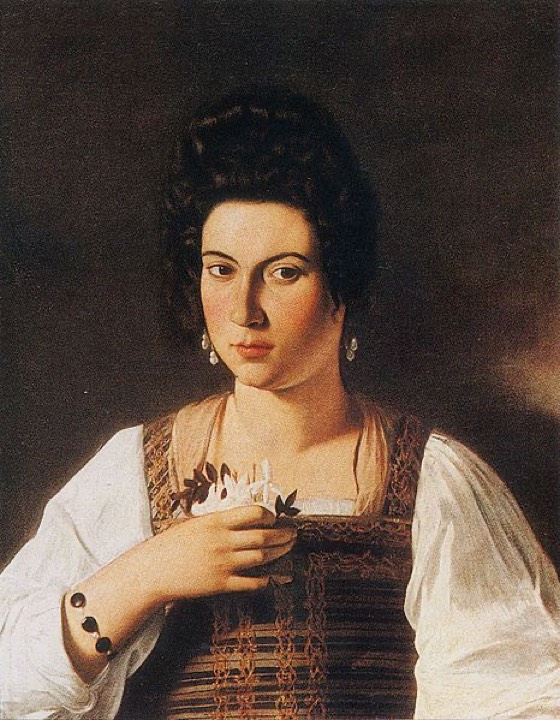
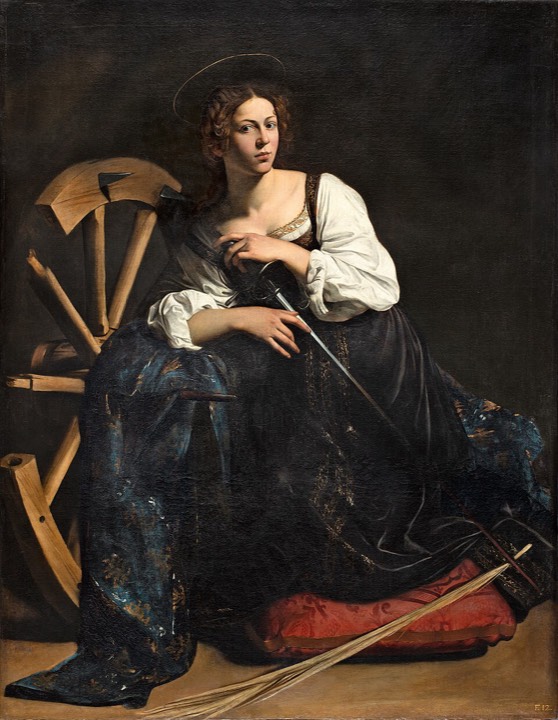
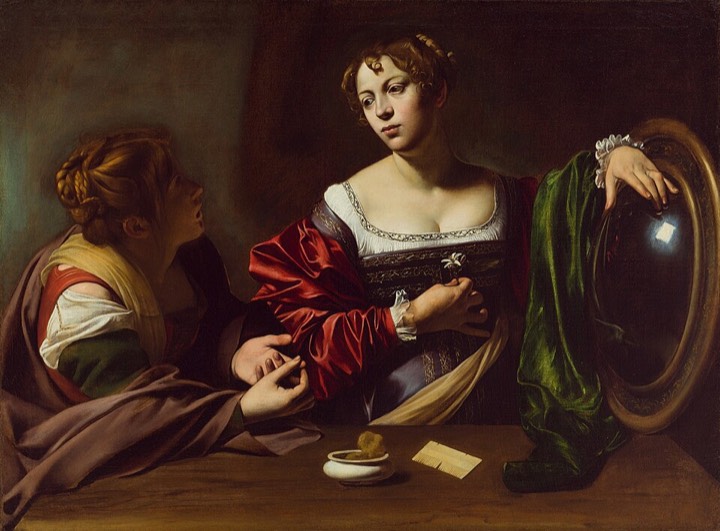
Fillide (Painting Fillide, ‘I’ll Get You Next Time’). Fillide Melandroni came from Siena and was working as a prostitute in Rome by 13. She became Caravaggio’s favourite model. Her portrait was destroyed in Berlin in 1945. A December 1600 court case shows her, knife in hand, attacking a rival over their pimp, Ranuccio Tomassoni, the man Caravaggio would later kill. She posed for Martha and Mary Magdalen, Judith and Holofernes and St Catherine. Graham-Dixon reads the Judith as a murder in a brothel; Carracci found it simply “too natural”. He reads the St Catherine as martyrdom imagined as desire. This section also covers Caravaggio’s working method:
- a dark ground
- painting wet-in-wet
- scoring lines into the canvas instead of making drawings
- a single high lamp in a closed room
- scenes staged with real props and models
Family (A Brotherless Man). He skipped his sister’s wedding. When his brother, a priest, visited him at del Monte’s palace, Caravaggio denied three times that he had a brother. Mancini tells the story in a way that echoes St Peter denying Christ. Part Three ends with Leoni’s portrait drawing of him: sullen, defiant and deeply lonely.
Main thread. Under del Monte’s protection Caravaggio becomes sophisticated and inventive, and he develops his signature dark style. At night he is still a sword-carrying brawler mixing with prostitutes and pimps, and those connections will later lead him to murder.
Part Four
Rome, 1599–1606
The breakthrough (The St Matthew Chapel). In July 1599, with del Monte’s help, Caravaggio got the commission for two big side paintings in the Contarelli Chapel at San Luigi dei Francesi. The chapel had sat unfinished for decades. He had never painted more than four figures in one picture, and these canvases were over ten feet wide. He painted in oil instead of fresco, so he could keep working from posed models.
- The Calling of St Matthew puts the scene in a dingy modern counting-room. Christ’s beckoning hand echoes Michelangelo’s Adam, which casts Christ as a second Adam.
- The Martyrdom of St Matthew was painted over: X-rays show a scrapped first version. In the final picture the nude figures are converts waiting for baptism, the setting recalls the immersion fonts of Borromeo’s Milan, and Caravaggio paints himself among the bystanders running away, which the author reads as a kind of confession.
Graham-Dixon calls these two pictures the turning point of European painting, without which Rembrandt, Ribera and La Tour are hard to imagine.
Enemies and brawls (A Back-Stabbing, and Other Misadventures). Federico Zuccaro, president of the painters’ academy, sneered that the pictures were just Giorgione warmed over, meaning crude realism. Caravaggio then ambushed Girolamo Spampa, a young academy student who had probably repeated that criticism, and beat him with a stick. He also wounded an ex-soldier in a sword fight. Court records already place him on the opposite side from Ranuccio Tomassoni.
The Cerasi Chapel (Two Paintings for Tiberio Cerasi). For Santa Maria del Popolo he painted a Conversion of St Paul and a Crucifixion of St Peter, while Annibale Carracci painted the altarpiece between them. His first versions, on wood panels, were rejected. The second Conversion is still and inward: Paul lies bathed in light under a patient carthorse. In the Crucifixion the executioners look like labourers hoisting a beam. Carracci’s sweet, idealised Assumption is presented as a deliberate rebuttal. The author suggests the horse’s rump pointing toward Carracci’s altarpiece is Caravaggio’s parting insult.
The Mattei years (In the House of the Mattei, Dirty Feet). He moved into Cardinal Mattei’s palace and painted:
- The Supper at Emmaus (London), set in a Roman tavern with a beardless Christ
- a laughing nude St John the Baptist, which reworks a Michelangelo nude as a Christian prophet
- The Taking of Christ, the one rediscovered in Dublin in 1990, with Caravaggio himself holding the lantern.
His first St Matthew and the Angel altarpiece was rejected because the saint’s bare, dirty feet were thrust at the viewer and he looked like an illiterate peasant. Vincenzo Giustiniani bought it, and Caravaggio painted a tamer second version. Bare feet, the author argues, were a deliberate statement of poverty and humility.
Giustiniani (Long Live V). For Giustiniani he painted Doubting Thomas and Omnia vincit amor (Love Conquers All). The author reads the second as a riotously sexual wedding picture, full of hidden V shapes standing for Vincenzo, and notes it was kept behind a green silk curtain and shown to visitors last.
The libel trial (The Black Wings of Envy). His rival Giovanni Baglione painted a Divine Love attacking Omnia vincit amor, then a second version that caricatured Caravaggio as the devil. Baglione also spread the rumour that Caravaggio’s boy model and assistant, Cecco, was his lover. When Baglione’s huge Resurrection for the Gesù flopped in 1603, obscene verses mocking him circulated. Baglione sued Caravaggio, Longhi, Gentileschi and Trisegni for libel. Caravaggio’s own testimony is curt and lofty: he lists the painters he rates and calls Baglione’s altarpiece the worst thing he had seen. After about two weeks in jail he was released on French diplomatic bail, almost certainly del Monte’s doing.
Living alone (A Dagger, a Pair of Earrings, a Worn-Out Belt). He rented a small house near the Palazzo Firenze with Cecco. The inventory taken when he was evicted shows how little he owned: weapons, ragged clothes, a guitar, a convex mirror and twelve books. The author argues the Church’s taste was moving toward grand Baroque splendour, which left no room for Caravaggio’s severe, poor-friendly piety.
The slide (A Plate of Artichokes, Stones Thrown and a Door Defaced, A Cackling of Geese).
- April 1604: he threw a plate of artichokes in a waiter’s face. The author reads it as anger at being treated like a provincial with no taste.
- The Entombment, which even Baglione called his best work.
- Arrests for stone-throwing, insulting a policeman and carrying weapons.
- The Tomassoni brothers showed their power in Rome during the riots after Pope Leo XI died.
- July 1605: a mother and daughter accused him of attacking their house.
- The Madonna of Loreto: two filthy-footed pilgrims kneel before a Virgin who appears in a doorway. Ordinary people flocked to it and academic critics despised it.
Lena (Lena Who Stays on Her Feet in the Piazza Navona). In July 1605 he struck the notary Mariano Pasqualone on the head from behind in a quarrel over Lena, a woman who worked the Piazza Navona, and was called “Michelangelo’s woman”. Graham-Dixon floats the provocative theory that Caravaggio was effectively a part-time pimp. That would explain the nights out with prostitutes, his ready supply of female models, and his rivalry with Tomassoni.
Genoa and the ceiling (The Case of the Damaged Ceiling). He fled to Genoa to escape the assault charges and turned down a large fresco commission there, probably because he couldn’t paint fresco. He made peace with Pasqualone through a grovelling written apology. His landlady seized his belongings for unpaid rent, partly over a damaged ceiling the author thinks he may have cut open to light his studio. He stoned her windows in revenge, and turned up wounded in the throat claiming he’d fallen on his own sword.
Two rejections (‘So Much Trouble’). Two major altarpieces were refused:
- The Madonna of the Palafrenieri for St Peter’s was removed after two days, probably because the Virgin, modelled on Lena, had too much cleavage and the Christ child was naked. Scipione Borghese bought it cheaply.
- The Death of the Virgin was rejected because the Virgin looks like a real, bloated corpse. Mancini says the model was a courtesan Caravaggio loved. Mancini later wondered if this rejection was what tipped him over.
The killing (Death on a Tennis Court). On 28 May 1606 he killed Ranuccio Tomassoni. Old accounts blamed an argument over a tennis game. From the archives, Graham-Dixon shows it was a prearranged duel: four men on each side, with seconds and witnesses, fought on a tennis court. Caravaggio wounded Tomassoni in the groin, cutting the femoral artery. Tomassoni’s brother then cut Caravaggio’s head open, and Petronio Toppa saved his life. Tomassoni bled to death. The witnesses all fled Rome.
The sentence (Bando Capitale). No witness explained the cause. The author’s best guess is an insult involving Tomassoni’s wife, Lavinia, which fits the groin wound as a deliberately shaming blow. The others received exile. Caravaggio was condemned as a murderer under a bando capitale: anyone could kill him on sight, and his severed head was enough to claim the bounty.
Main thread. Caravaggio’s public fame peaked as his art became more severe and more on the side of the poor, just as Rome’s taste turned toward Baroque grandeur. Rejections, feuds and street violence built up until the duel with Tomassoni, and he fled Rome with a price on his head.
Part Five
The exile years, 1606–10
Flight (On the Run). Wounded after the duel, Caravaggio fled to Costanza Colonna, who hid him on her family’s estates in the Alban Hills outside Rome, probably at Zagarolo and Paliano. There he painted a second Supper at Emmaus, much darker and more worn than the London version, and David with the Head of Goliath. Goliath’s severed head is a self-portrait. Graham-Dixon reads the painting as a plea to Scipione Borghese, the pope’s nephew, who held the power of pardon: in effect, keep my head in a painting, and let me keep the real one.
Naples (In the City of Beggars, The Seven Acts of Mercy, The Mechanics of Evil). Naples was Spanish-ruled, three times the size of Rome, and swollen with destitute migrants. He was in demand at once.
- The Seven Acts of Mercy was painted for a lay charity, the Pio Monte della Misericordia, in about seven weeks. It packs all seven acts of mercy into one dark street corner. The charity later refused to sell it at any price.
- The Flagellation and The Crucifixion of St Andrew followed. The author argues these transformed Neapolitan painting almost overnight and, through Naples, shaped Spanish painters such as Ribera and Zurbarán.
Rubens (Caravaggio and Rubens). The Madonna of the Rosary, probably an older picture he brought from Rome, ended up in Antwerp, bought for a church there by a group of artists that included Rubens. Rubens had also advised the Duke of Mantua to buy the rejected Death of the Virgin, which was put on public view in Rome for a week before shipping because painters were clamouring to see it. This is how Caravaggio’s influence reached northern Europe.
Malta (Flight from Naples, The Friars of War, The Isle of St John). Baglione accused him, from a distance, of sending an assassin after him. In July 1607 Caravaggio sailed to Malta, almost certainly arranged by Costanza Colonna, whose own son Fabrizio had redeemed a disgrace there in the same way. The idea was that a knighthood in the Order of St John would protect him from the death sentence and lift him above rivals like Baglione. The author gives a vivid picture of Valletta: a new fortress city, harsh law, and an order that tolerated brothels but punished brawling severely.
Knighthood (Signed in Blood, Competing with Michelangelo).
- He painted St Jerome Writing, a portrait of the old warrior Fra Antonio Martelli, and the Grand Master Alof de Wignacourt in armour.
- Wignacourt asked the pope for special permission to knight a man who had committed homicide, and got it.
- His fee for entering the order was The Beheading of St John, his largest painting, made for the oratory where novices trained. It is the only work he ever signed, with the letters spelled out in the saint’s blood. Graham-Dixon reads the signature as a declaration that he had been washed clean and reborn as a brother of the order.
- He was made a knight in July 1608 and compared to Apelles, the great painter of ancient Greece. He also painted a Sleeping Cupid, a learned challenge to Michelangelo.
The author adds a twist: under the order’s rules no knight could leave Malta without the Grand Master’s permission, so the knighthood was also a way to keep him on the island.
The fall (Apelles in Prison, ‘A Rotten and Diseased Limb’). Within weeks he joined a group of knights who broke into a house and seriously wounded a senior Knight of Justice, Fra Giovanni Rodomonte Roero. The archive record had been painted over; it was recovered by X-ray in 2002. He was imprisoned in an underground cell cut into the rock of the Castel Sant’Angelo in August 1608. The painting’s unveiling went ahead without him. In October he escaped, most likely with help from inside, and reached Sicily. In December the order expelled him in his absence, in a ceremony held beneath his own Beheading of St John.
Sicily (The Burial of St Lucy, The Tyrant’s Ear, Lazarus Rising, Adoration, Desolation). He worked in Syracuse, Messina and Palermo, sleeping armed and fully clothed, with a trick-performing black dog he named Crow. The late Sicilian altarpieces are bleaker, rougher and deliberately old-fashioned, drawing on Byzantine and folk traditions:
- The Burial of St Lucy: tiny figures overwhelmed by huge gravediggers and bare walls
- The Resurrection of Lazarus: Lazarus stiff as a cross, with Christ almost lost in shadow
- The Adoration of the Shepherds: Mary exhausted against a manger, with the shepherds unable to reach her. Graham-Dixon calls it the saddest of nativities and reads it as a memory of his own childhood losses.
His remark that the “Ear of Dionysius” cave in Syracuse was shaped for eavesdropping hints at paranoia. There are stories of erratic behaviour, including an attack on a schoolteacher who complained about him following his pupils.
The ambush (The Knight’s Revenge). Back in Naples in autumn 1609, under Colonna protection, he was attacked outside a tavern-brothel, the Osteria del Cerriglio. Four men held him and slashed his face. A sfregio like this was the traditional punishment for an insult. The author argues, from Baglione’s account and the Maltese records, that this was Roero’s revenge rather than anything ordered by Wignacourt or the Tomassoni family.
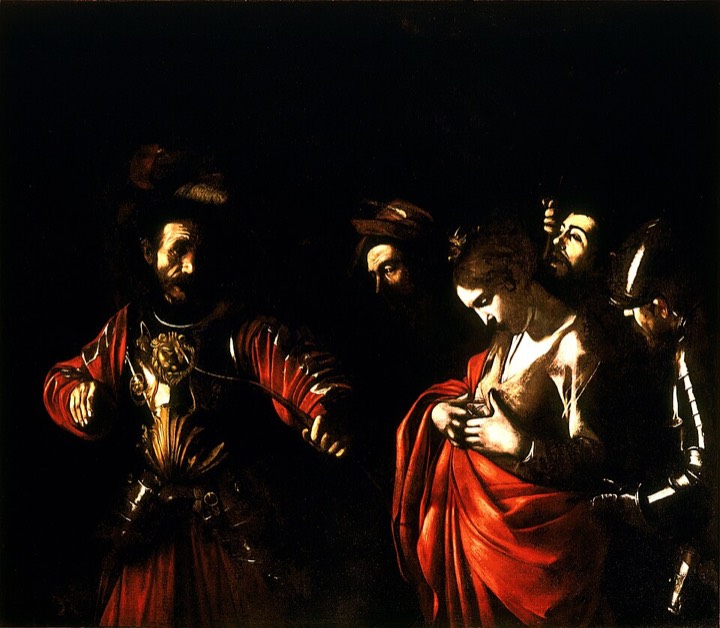
The last works (Two Last Paintings). He never fully recovered. The Denial of St Peter is shaky and crudely handled. The Martyrdom of St Ursula, his last picture, shows Ursula shot at close range, with Caravaggio’s own face looking on behind her.
Death (The Boatman’s Story). In July 1610, with a pardon being arranged through Scipione Borghese in return for paintings, he sailed north carrying three pictures meant for Borghese. At Palo he was arrested over some dispute, and the boat sailed on to Porto Ercole without him. After paying his way out, he rode to Porto Ercole to recover the paintings and died there, probably around 18 to 19 July, likely from his injuries, exhaustion and the summer heat. He was 38 and buried in an unmarked grave. Graham-Dixon dismisses the myth of a frantic run along the beach and the conspiracy theories about murder. He reconstructs events from a letter by the papal nuncio and argues its source was the illiterate boatman.
Aftermath. The Knights of Malta seized his last paintings, claiming they belonged to a deceased knight. The Spanish viceroy then held onto the St John the Baptist, and Borghese only received it a year later.
Legacy (Doing Jesus Like Caravaggio). Caravaggio taught himself and left no workshop, drawings or pupils. Academic critics such as Bellori and Poussin tried to blacken his name. Even so, his influence spread through Rubens, Velázquez, Rembrandt and the Caravaggisti, and later reached David and Géricault. He was rediscovered in the twentieth century after Roberto Longhi’s 1951 exhibition. The book ends with his influence on film, particularly Pasolini and Martin Scorsese, who drew on him for Mean Streets and The Last Temptation of Christ.
Main thread. Each refuge turns into a trap. The knighthood that was meant to save him becomes a cage, his violence costs him that too, and he is hunted until he dies on the road home. Meanwhile his painting becomes starker, more primitive and more personal.
A recurring motif
The red cloth
A real studio prop. Caravaggio painted from models posed in his studio with props he owned, so the same objects return from picture to picture: chairs, armour and lengths of drapery. A large red cloth was cheap to keep and easy to rearrange, which is one plain reason it keeps reappearing.
What holds the picture together. In the mature work most of the canvas is shadow. A swathe of strong red gives the eye somewhere to land and often binds the figures into one group.
- In The Taking of Christ, John’s red cloak arches over Christ and Judas, tying the three heads together. Graham-Dixon reads it as the outward sign of their turmoil, almost a scream.
- In The Death of the Virgin, a huge red curtain hangs over the scene like a theatre drape and turns the room into a stage.
- In the late Maltese and Sicilian pictures, a single red cloth is often the only colour in a field of browns and blacks.
Blood and martyrdom. Red is the colour of blood, so it gathers meaning wherever there is violence or sacrifice. In The Beheading of St John, Graham-Dixon describes the red cloth thrown over the saint as a sign of bloodletting in the dark, the one patch of colour in the prison yard, placed exactly where the killing happens. It plays the same part in The Burial of St Lucy, marking out the sacrificial victim.
Old religious colour codes. His patrons would have read red at once through long Christian tradition:
- The Passion and the Eucharist: Christ’s blood and sacrifice.
- Divine love and charity: the colour of caritas, which suits The Seven Acts of Mercy.
- Particular saints: St John the Evangelist and Mary Magdalen are traditionally dressed in red.
- Rank: cardinals wore red, so the red hat on the wall in St Jerome Writing identifies the saint.
The pigment itself. His reds came mainly from vermilion and red lake. Laid over dark grounds they glow, which is part of why the paintings seem lit from within. Red lake was expensive, so a large passage of rich red also told a buyer this was a costly, high-quality picture.
A late signature. As his style grew sparer in exile, the red cloth became more insistent, often the single bright note in an almost colourless painting. Some writers treat it as close to a personal signature; that is interpretation, not something he said.
Main thread. The red cloth starts as a practical prop and a way of organising a dark picture, then takes on the meanings of blood, sacrifice, love and the Passion, depending on the scene.
Faces that return
Recurring models
Caravaggio himself
He painted his own face throughout his career, from a young Bacchus made with a mirror to the onlooker behind St Ursula weeks before he died. Often he places himself at the edge of the action as a witness.
Mario Minniti
His Sicilian friend and lodger in the early Roman years. He is generally identified as the young man having his palm read, the lutenist in The Musicians and the Bacchus sent to Florence.
Fillide Melandroni
His favourite female model around 1597–1600: the lost portrait, St Catherine, Judith and the Magdalen beside Martha.
The red-haired woman
Graham-Dixon notes the same red-haired model as the Penitent Magdalen and the Virgin resting on the flight into Egypt. She is often named as Anna Bianchini, and the same face is usually seen as Martha.
Cecco Boneri
The boy who lived and worked with him around 1600–06. He is the grinning Cupid of Omnia vincit amor and, according to Graham-Dixon, the David holding Goliath’s head. Many scholars also see him in the laughing St John with the ram.
Lena
The woman of the Piazza Navona known as “Michelangelo’s woman”. She modelled the Virgin in both late Roman altarpieces, and the second one’s cleavage helped get it removed from St Peter’s.
One actor, two roles
Graham-Dixon points out that the disciple flinging his arms wide at Emmaus is the same model as the armoured soldier seizing Christ. Both pictures hung in Ciriaco Mattei’s palace.
The bald old man
A bald, bearded old model recurs as saints in the years around 1602–06. The identification rests on resemblance, not documents.
Painted twice, or more
Same subject, side by side
St Jerome
Three versions of the scholar-saint with a skull: two in Rome around 1605–06, and a third for the Knights in Malta.
St John the Baptist in the wilderness
From the laughing nude with a ram, to a brooding youth in red, to the languid figure in his luggage on the last voyage.
The head of John the Baptist
The execution itself in Malta, then two half-length Salomes holding the head on a platter, painted in his last years.
David with the head of Goliath
Three Davids over a decade. In the last, Goliath’s severed head is a self-portrait sent to the man who could pardon him.
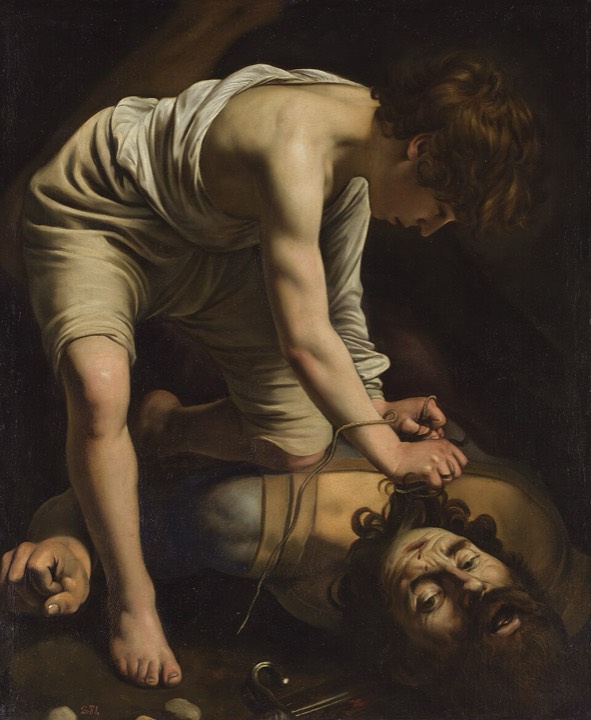
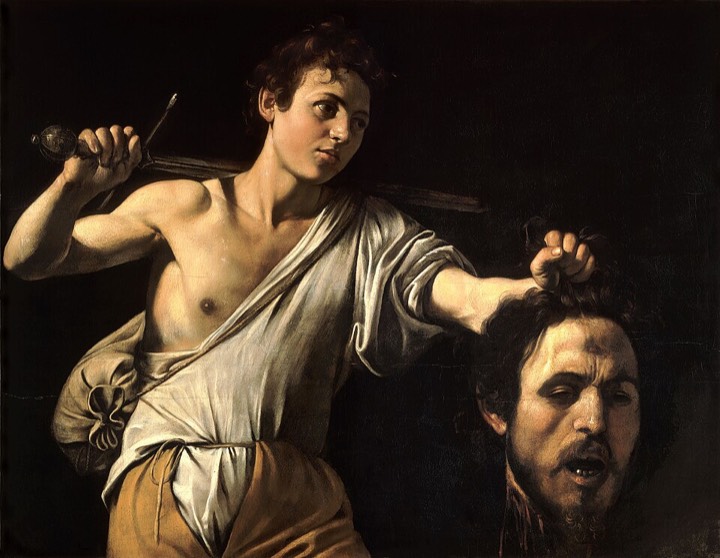
Judith and Holofernes
The Roman Judith modelled by Fillide, and the disputed canvas found in a French attic in 2014, claimed as his lost Naples version.
The Supper at Emmaus
The bright, theatrical London picture of 1601 and the darker, quieter version painted in hiding five years later.
The Conversion of St Paul
The rejected first version on panel, crowded and dramatic, and the still, inward canvas that replaced it in the Cerasi Chapel.
St Matthew and the Angel
The rejected first altarpiece with the saint’s dirty feet thrust at the viewer, and the tamer replacement still in the Contarelli Chapel.
The Fortune Teller
Two versions of the gypsy reading a young man’s palm, the picture that won him Cardinal del Monte.
The Lute Player
One for Giustiniani and one for del Monte, with different still-life details and music.
Boy Bitten by a Lizard
Two near-identical versions of the startled boy, now in Florence and London.
Bacchus
The sickly young self-portrait of his first Roman years, and the polished Bacchus offering wine, made for del Monte to send to Florence.
Who’s who
People in his story
Mario Minniti
Friend, model and fellow painter
A Sicilian painter Caravaggio met in his first months in Rome, probably in Lorenzo Siciliano’s workshop. They lodged together, and Minniti modelled for some of the early pictures, most likely the lutenist in The Musicians and the youth in Bacchus. Years later, when Caravaggio escaped from Malta, Minniti sheltered him in Syracuse and helped him win the Burial of St Lucy commission. He lived into his sixties in Messina and grew prosperous turning out mediocre altarpieces.
Cecco Boneri
Assistant and model
The boy who lived with Caravaggio from around 1600, ground his colours, ran errands and posed for him, most famously as the grinning Cupid in Omnia vincit amor. Baglione spread the rumour that he was Caravaggio’s lover. He disappears from Caravaggio’s side around the time of the flight to Malta, then built a modest career as “Cecco del Caravaggio” before sinking into obscurity.
Onorio Longhi
Closest friend and partner in brawls
A hot-tempered Milanese architect, a fellow Lombard in Rome and Caravaggio’s companion in most of his street fights. He was a co-defendant in the 1603 libel trial and acted as Caravaggio’s second in the 1606 duel with Ranuccio Tomassoni, for which he was exiled. He returned to Rome about a year after Caravaggio died and died of syphilis five years later.
Giovanni Baglione
Rival, enemy and biographer
A successful Roman painter, about five years older than Caravaggio, who borrowed his dark manner while despising him. Their feud ran for most of Caravaggio’s Roman career.
The paintings: Giustiniani’s Omnia vincit amor provoked Baglione into a reply, a Sacred and Profane Love in which a heavenly Cupid overpowers an earthly one. A second version went further and gave the devil Caravaggio’s features. Baglione also spread the rumour that Caravaggio’s boy assistant Cecco was his lover.
The verses and the trial: in 1603 Baglione’s large Resurrection for the Gesù was badly received, and crude verses mocking him, calling him among other things “Gioan Bagaglia” (Johnny Baggage), went round the studios. He sued Caravaggio, Onorio Longhi, Orazio Gentileschi and Filippo Trisegni for libel. Caravaggio’s testimony was curt and superior: he named the painters he respected, left Baglione off, and called the Gesù altarpiece the worst thing he had seen. He spent about two weeks in jail before French diplomatic pressure, almost certainly arranged by del Monte, got him out.
After the killing: in 1606, with Caravaggio in exile, Baglione was knighted as a Cavaliere di Cristo and elected head of the painters’ academy. That November he accused Caravaggio, in absentia, of sending the painter Carlo Piemontese to attack him with a sword on the steps of Trinità dei Monti, with Carlo Saraceni and Orazio Borgianni helping to plan it.
The last word: Baglione outlived him by more than thirty years and in 1642 published a short life of Caravaggio. It is hostile and smug, but on bare facts it is the most reliable early account, and it gave posterity its picture of Caravaggio dying miserably, just as he had lived. He died wealthy at nearly eighty, and is now remembered mainly through the man he hated.
Orazio Gentileschi
Painter friend
A Tuscan painter in Caravaggio’s circle who lent him props, joined in his quarrels and was a co-defendant in the 1603 libel trial. He took up Caravaggio’s style more successfully than almost anyone, and was the one friend who became a significant artist. He ended his career as court painter to Charles I and died in London in 1639.
Artemisia Gentileschi
Orazio’s daughter
She grew up around her father’s circle while Caravaggio was in Rome. Her testimony at the 1612 trial of Agostino Tassi, who raped her, is used in the book to show the violence of that world. She became one of the finest painters working in Caravaggio’s manner.
Family
Fermo Merisi
Father
A stonemason and builder from the town of Caravaggio who worked for the Sforza-Colonna family, not the architect Mancini claimed. He died of plague in October 1577, within a day of his own father and mother, when Caravaggio was six.
Patrons and protectors
Costanza Colonna
Lifelong protector
Costanza Colonna was the daughter of Marcantonio Colonna, the admiral who led the papal fleet at Lepanto, and the wife of Francesco Sforza, Marquis of Caravaggio. That made her the noblewoman of Caravaggio’s family’s home town.
Family ties: Caravaggio’s father, Fermo Merisi, worked for the Sforza household, and his mother’s sister was wet-nurse to Costanza’s children. Caravaggio was born a few days before Lepanto, which may help explain her lifelong interest in him. He had an inflated sense of his own status, and her patronage gave him a link to real nobility.
Protector in disgrace: after the killing of Ranuccio Tomassoni in 1606 the Colonna hid him on their estates in the Alban Hills at Zagarolo and Paliano. In Naples he was sheltered in the Colonna palace at Chiaia, on both his visits. The plan to win him a knighthood in Malta almost certainly came from her. Her own son Fabrizio had redeemed a disgrace there, and Caravaggio sailed to Malta in 1607 with Fabrizio’s galleys.
After Malta: when he came back to Naples in 1609 it was again to her palace. Graham-Dixon suggests that by then she must have come to some understanding with the Knights, since harbouring an expelled knight would otherwise have been impossible.
After his death: the paintings from his last voyage were brought back to her house in Chiaia, where the Knights of Malta’s prior came to claim them as the property of a deceased brother. She saw through the claim and protested, while the papal nuncio worked to secure the pictures for Scipione Borghese.
Fabrizio Sforza Colonna
Costanza’s son
Disgraced by an unnamed crime, he redeemed himself as a Knight of Malta and became general of the order’s galleys. Caravaggio sailed to Malta with his flotilla in 1607, following the same path to rehabilitation.
Cardinal Francesco Maria del Monte
First great patron
Francesco Maria Bourbon del Monte was born in Venice in 1549, with Titian among the guests at his baptism. He made his career as the trusted agent of Ferdinando de’ Medici, who had him made a cardinal in 1588 to look after Medici interests in Rome. Graham-Dixon presents him as the first real father-figure in Caravaggio’s life.
The man: a cultivated, curious churchman with around 600 paintings, a passion for music, links to Filippo Neri’s Oratory and an interest in science. He supported Galileo and kept an alchemical laboratory in his villa. Politically he leaned towards France and helped smooth Henri IV’s return to the Catholic Church. That French connection is why Caravaggio’s first public commission came from San Luigi dei Francesi.
The gossip: a hostile pro-Spanish writer, Theodor Amayden, painted him as a decadent surrounded by boys, and that picture has coloured readings of Caravaggio’s early paintings ever since. Graham-Dixon rejects it, pointing to an eyewitness description of a busy, thrifty, fairly modest household.
Patron: around 1595 the dealer Costantino Spata brought him The Fortune Teller and The Cardsharps. He bought both and took Caravaggio into his household at the Palazzo Madama, where he lived until about 1601. The pictures of those years were made in his orbit: The Musicians, the Lute Player, St Catherine, the Medusa and Bacchus sent as gifts to Florence, and the ceiling of his alchemy room.
Protector: he won Caravaggio the Contarelli Chapel commission in 1599. When the police arrested him for carrying weapons, Caravaggio’s defence was that he belonged to the cardinal’s household. In 1603 del Monte almost certainly arranged the French diplomatic bail that ended the libel imprisonment.
Afterwards: he kept Caravaggio’s pictures, and in 1624 inherited the Capitoline St John the Baptist from the Mattei. He died in 1626, and in 1628 his collection was sold, sending the Cardsharps, the Musicians and St Catherine to Cardinal Antonio Barberini.
Ferdinando de’ Medici
Del Monte’s master
Grand Duke of Tuscany, who made del Monte a cardinal. Del Monte sent him Caravaggio’s Bacchus and Medusa as gifts.
Vincenzo Giustiniani
Banker and collector
Del Monte’s neighbour and the most devoted collector of Caravaggio in his lifetime. He owned The Lute Player, Omnia vincit amor, Doubting Thomas and the rejected first St Matthew and the Angel.
Cardinal Girolamo Mattei
Host, 1601–03
Girolamo Mattei, the most senior of the three Mattei brothers, was a cardinal of the Curia and lived in the principal family palace in the cluster of Mattei houses near the Piazza Mattei.
Host: Caravaggio moved from del Monte’s household into his palace in 1601. A contract of June that year gives his address as the palace of the cardinal, and he probably stayed until early 1603. The move was not a break with del Monte, who was friendly with the Mattei. When Caravaggio was arrested for carrying a sword in October 1601, he still claimed to be on del Monte’s household roll.
Influence: Girolamo was closely tied to the strictest branch of the Franciscans, the Observants, and was known for his dislike of display. Graham-Dixon links his austere piety to the harsher, plainer style Caravaggio adopted in 1601. The Cerasi Chapel paintings were finished while Caravaggio lived under his roof, and the clasped, self-denying hands of Christ in The Taking of Christ echo the same Franciscan ideal.
Patronage: the paintings of these years were bought by his brothers, mainly Ciriaco, rather than by the cardinal himself.
Ciriaco Mattei
Patron
The middle Mattei brother, a Roman nobleman who died in 1614. He was one of the great collectors of his age and served as one of Rome’s Conservatori, its senior civic magistrates. He also supported other painters, among them Domenico Fiasella.
The villa: in 1582 he began the Villa Celimontana on the Caelian Hill, a garden villa he filled with ancient sculpture.
Caravaggio’s patron: a friend as well as a client. His account books record three purchases in under two years: The Supper at Emmaus, paid 150 scudi in January 1602; the laughing St John the Baptist with a ram; and The Taking of Christ, 125 scudi including its frame, paid by January 1603. He also commissioned the 1601 Villamena engraving of a Roman street fight that Graham-Dixon sees behind the composition of The Taking of Christ, and hung the Emmaus and the Taking of Christ in the same palace, where visitors could notice the same model in both.
His legacy: in his will he tried to keep the villa and its contents together for ever, but later generations had the restriction broken and the collection was dispersed. His account books survived in the family archive at Recanati, where Francesca Cappelletti and Laura Testa found the payment records that proved the Dublin painting’s identity. See the Ciriaco Mattei section on The Dublin Caravaggio page for more.
Ottavio Costa
Banker and patron
A Genoese banker in Rome who owned Judith Beheading Holofernes and bought the second Supper at Emmaus that Caravaggio painted in hiding.
Tiberio Cerasi
Patron
Treasurer-general to the pope, who commissioned the Conversion of St Paul and the Crucifixion of St Peter for his chapel in Santa Maria del Popolo.
Cardinal Federico Borromeo
Patron
Carlo Borromeo’s cousin and archbishop of Milan, who owned the Basket of Fruit and gave it to his Ambrosiana foundation.
Cardinal Scipione Borghese
Collector who held the pardon
Nephew of Pope Paul V and the most acquisitive collector in Rome. He confiscated Cesari’s early Caravaggios, bought the rejected Madonna of the Palafrenieri, and in 1610 was arranging Caravaggio’s pardon in exchange for paintings. David with the Head of Goliath reads as a plea to him.
Alof de Wignacourt
Grand Master of the Knights of Malta
He won papal permission to knight Caravaggio despite the homicide, sat for his portrait and accepted The Beheading of St John as his entry fee. Weeks later the order jailed Caravaggio, and after his escape expelled him.
Fra Antonio Martelli
Sitter
A veteran of the 1565 Siege of Malta and prior of the order in Messina, painted by Caravaggio in 1607–08.
Costantino Spata
Dealer
The picture dealer who brought Caravaggio’s early paintings to Cardinal del Monte’s attention.
Masters and the art world
Simone Peterzano
Master in Milan
The Milanese painter to whom Caravaggio was apprenticed from 1584 to 1588. Graham-Dixon finds no trace of him in the mature work.
Giuseppe Cesari (Cavaliere d’Arpino)
First employer in Rome
The pope’s favourite painter, who put Caravaggio on flowers and fruit in 1593–95. Scipione Borghese later confiscated Cesari’s collection, which is how the Sick Bacchus and Boy with a Basket of Fruit reached the Borghese.
Lorenzo Siciliano
Early employer
A hack painter for whom Caravaggio turned out cheap heads on arriving in Rome.
Antinoro Bertucci
Colour-seller
His shop was the meeting place of Rome’s painters, where gossip, rivalries and curfew-dodging started.
Prospero Orsi
Painter and promoter
Named by Bellori as the man who encouraged Caravaggio to leave Cesari and helped spread his reputation.
Annibale Carracci
Great contemporary rival
The Bolognese painter of the Farnese ceiling and the Cerasi Assumption, the classical alternative to Caravaggio’s realism. Caravaggio borrowed and turned his figures, and Carracci called the Judith simply too natural.
Federico Zuccaro
Academy president
Head of the painters’ academy, who dismissed the Contarelli paintings as Giorgione warmed over.
Peter Paul Rubens
Admirer
Advised the Duke of Mantua to buy The Death of the Virgin and later joined the artists who bought The Madonna of the Rosary for Antwerp, carrying Caravaggio’s influence north.
Carlo Saraceni and Orazio Borgianni
Painters in his faction
Followers of Caravaggio whom Baglione accused, with Carlo Piemontese, of plotting the 1606 attack on him.
Carlo Piemontese
Alleged assassin
The painter Baglione said attacked him with a sword at Trinità dei Monti in 1606 on Caravaggio’s orders.
Friends, lovers and models
Fillide Melandroni
Model
A courtesan from Siena who was working in Rome by about the age of thirteen, and Caravaggio’s favourite female model around 1597–1600.
Model: she sat for the portrait that later belonged to Giulio Strozzi and was destroyed in Berlin in 1945, for St Catherine, for Judith Beheading Holofernes, and for Mary in Martha and Mary Magdalen. Graham-Dixon reads the Judith as a killing in a brothel and the St Catherine as martyrdom imagined as desire.
Her world: she was tied to Ranuccio Tomassoni, the man Caravaggio would kill. A court case of December 1600 shows her, knife in hand, attacking a rival courtesan over him, threatening to cut her face. That makes her a direct link between the painter and his eventual victim.
What she was to him: there is no evidence that they were lovers, and the book treats her above all as his model. She later found a wealthy protector in the Florentine aristocrat and poet Giulio Strozzi.
Her will, 1618: dying at about thirty-seven, she lived in a richly furnished house. She asked that her Caravaggio portrait go to Strozzi, owned a small devotional Penitent Magdalen, asked to be buried in her parish church, paid for Masses and left a fifth of her estate to the Convertites, the convent for reformed prostitutes she had once worked beside. Graham-Dixon ends his book with her: like the painter, she lived between the sacred and the profane.
Lena
Lover and model
Generally identified as Maddalena Antognetti, a woman who worked the Piazza Navona; Graham-Dixon’s chapter title calls her the Lena who stays on her feet there. Court records describe her as “Michelangelo’s woman”, meaning Caravaggio’s.
Model: she is the Virgin in two of his late Roman altarpieces. In the Madonna of Loreto she appears in a doorway to two filthy-footed pilgrims. In the Madonna of the Palafrenieri her low neckline, with a naked Christ child beside her, helped get the picture taken out of St Peter’s after two days.
The Pasqualone affair: in July 1605 Caravaggio struck the notary Mariano Pasqualone on the head from behind in a quarrel over her. He fled to Genoa and only came back after a grovelling written apology and a formal peace.
What she was to him: the sources don’t settle whether she was a lover, a model, a woman under his protection or all three. Graham-Dixon’s provocative suggestion that Caravaggio acted at times as a part-time pimp is built partly on Lena: it would explain his ready supply of female models, the nights spent with courtesans and his rivalry with Ranuccio Tomassoni.
Giulio Strozzi
Fillide’s protector
A Florentine aristocrat and poet who received Fillide’s portrait under her will.
Filippo Trisegni
Friend
A co-defendant with Caravaggio, Longhi and Gentileschi in Baglione’s 1603 libel suit.
Petronio Toppa
Fought beside him
A soldier on Caravaggio’s side in the 1606 duel who saved his life after he was wounded.
Enemies and victims
Ranuccio Tomassoni
Killed by Caravaggio
From a well-connected family of militia captains who policed the Campo Marzio, the district where Caravaggio lived and worked. The Tomassoni brothers were men with local power, pro-Spanish connections and a readiness to use violence. Ranuccio also ran prostitutes, Fillide Melandroni among them.
Years of friction: court records place Caravaggio and the Tomassoni on opposite sides of street quarrels from around 1600. During the riots after Pope Leo XI’s death in 1605 the brothers made a show of their strength in Rome. Graham-Dixon floats the theory that Caravaggio was himself partly in the business of managing women such as Lena, which would have made the two men direct rivals over women and territory.
The duel, 28 May 1606: not the tennis-match brawl of legend but a prearranged fight, four men a side, with seconds and witnesses, on a tennis court in the Campo Marzio. Onorio Longhi and Petronio Toppa were with Caravaggio; Ranuccio had his brother Giovan Francesco with him. Caravaggio wounded Ranuccio in the groin and cut the femoral artery. Giovan Francesco slashed Caravaggio’s head, and Toppa was wounded saving him. Ranuccio bled to death.
Why: no witness ever said. Graham-Dixon’s best guess is an insult involving Ranuccio’s wife, Lavinia, which would explain a deliberately shaming wound to the groin. The others were exiled; Caravaggio was condemned under a bando capitale, which let anyone kill him on sight. Some writers later blamed the Tomassoni for the 1609 attack in Naples; Graham-Dixon rejects that and points to Roero instead.
Mariano Pasqualone
Notary
Struck on the head by Caravaggio in July 1605 in a quarrel over Lena, then reconciled through a written apology.
Girolamo Spampa
Academy student
Beaten with a stick by Caravaggio in 1600, probably for repeating criticism of the Contarelli paintings.
Fra Giovanni Rodomonte Roero
Knight he helped wound
A Knight of Justice, Count della Vezza, seriously wounded in the August 1608 brawl in Malta. Graham-Dixon names him as the man behind the 1609 slashing in Naples.
Fra Giovanni Pietro de Ponte
Co-attacker in Malta
The deacon who carried the pistol in the 1608 assault on Roero, defrocked alongside Caravaggio.
Don Carlo Pepe
Schoolteacher in Messina
Wounded by Caravaggio, according to Susinno, after objecting to him following his pupils.
Church and state
Cardinal Carlo Borromeo
Archbishop of Milan
The austere reformer who ruled Milan in Caravaggio’s childhood. Graham-Dixon traces Caravaggio’s vivid, popular realism to the devotion Borromeo promoted.
Pope Clement VIII
Pope, 1592–1605
Pope for most of Caravaggio’s Roman career. He banned weapons and duelling, made libel a capital crime and inspected church art himself.
Pope Sixtus V
Pope, 1585–90
Rebuilt Rome as a showcase of Catholic triumph just before Caravaggio arrived.
Pope Leo XI
Pope, April 1605
His death after a few weeks set off the riots in which the Tomassoni showed their power.
Leonetto Corbiaro
Inquisitor in Malta
Questioned Caravaggio in July 1607 about a supposedly bigamous Greek painter.
Writers and sources
Giulio Mancini
Biographer
A doctor from Siena, born in 1559, who came to Rome in the early 1590s, built a fashionable practice and ended up as physician to Pope Urban VIII. He was also a keen collector, dealer and connoisseur, and one of the few early writers on Caravaggio who knew him personally.
His writing: his Considerations on Painting, written around 1617–21, circulated in manuscript and was not printed until the 1950s. Its pages on Caravaggio are brief and his marginal notes garbled, but they are the source for several things no one else records: the obscure killing and year in prison before Caravaggio left Milan, the incident in which Cesari hid him, the story of his denying his brother three times, and the claim that the dead Virgin was modelled on a courtesan Caravaggio loved.
Buyer and dealer: in early 1607 Mancini bought the rejected Death of the Virgin, meaning to sell it on to a client in his home city of Siena, and wrote to his brother there that some might find it improper. Within weeks he sold it instead to the Duke of Mantua, through his agent and on Rubens’s advice, for a profit of 80 scudi.
Witness at a distance: in October 1609 he wrote to his brother about the reports from Naples that Caravaggio had been attacked by four men and slashed in the face, hoping the news was false. He also wondered whether the rejection of the Death of the Virgin was what tipped Caravaggio over the edge. He died in 1630.
Giovan Pietro Bellori
Biographer
Wrote in 1672, never met him, and fixed the myth of an untaught copier of nature, though his descriptions of the paintings are vivid.
Francesco Susinno
Sicilian biographer
A Messina priest whose 1724 lives of Sicilian painters preserve the stories of Caravaggio’s time on the island.
Karel van Mander
Early writer
A Dutch writer whose 1604 book gives the first printed account of Caravaggio’s habits: two weeks painting, a month or two swaggering with a sword.
Gaspare Murtola
Poet
Wrote a madrigal on The Fortune Teller comparing the gypsy’s tricks to the painter’s own.
Cardinal Ottavio Paravicino
Letter writer
His teasing 1603 letter placed a Caravaggio painting between the sacred and the profane, the phrase behind the book’s subtitle.
Theodor Amayden
Hostile source
A pro-Spanish writer whose gossip about del Monte as a decadent pederast Graham-Dixon rejects.
Roberto Longhi
Art historian
Organised the 1951 Milan exhibition that rescued Caravaggio’s reputation in the twentieth century.
Agostino Tassi
Painter
A Roman painter of landscapes and quadratura, the illusionistic painted architecture that opened up ceilings and walls. He was good at it and much in demand, and the French landscape painter Claude Lorrain later trained in his workshop.
The rape and trial: in 1611, while working alongside Orazio Gentileschi on ceiling decorations, he was given access to Orazio’s house and raped his daughter Artemisia, then about seventeen, promising marriage afterwards. When no marriage came, Orazio sued in 1612. During the months-long trial Artemisia was questioned under thumbscrews to test her testimony, which she maintained.
Verdict: Tassi was convicted and sentenced to exile from Rome, but the sentence was never enforced, and he went on working for powerful patrons. He had faced earlier accusations of violence and misconduct as well.
Why he is here: he never belonged to Caravaggio’s circle, but the trial records are among the richest descriptions of the world Caravaggio’s friends lived in. Graham-Dixon uses Artemisia’s testimony to show how ordinary that violence was among Roman painters.
The record
Crimes, arrests and court cases
| Year | What happened | Who was involved | Result |
|---|---|---|---|
| c.1590–92 (Milan) | A murder, possibly linked to his leaving Milan. Bellori says he killed a companion. Mancini’s garbled notes mention a prostitute, a gentleman and a policeman. | Unknown | Mancini’s notes hint at about a year in prison. No court record survives, so this is unconfirmed. |
| c.1594 (Rome) | Mancini hints at an unexplained incident during his time in the Cesari workshop. | Giuseppe Cesari | Cesari reportedly kept him hidden. No details survive. |
| July 1597 | A barber’s apprentice was wounded in a street incident. Caravaggio picked up a dropped cloak. | The barber Luca (witness), the injured apprentice | Witness only. The testimony gives the earliest physical description of him. |
| May 1598 | Arrested for carrying a sword at night without a licence. He protested that he was Cardinal del Monte’s painter. | Roman police | Arrested. The book doesn’t record a punishment. |
| 1600 | Ambushed the young academy student Girolamo Spampa and beat him with a stick, probably over criticism of his work. | Girolamo Spampa | No result recorded. |
| c.1600–01 | Wounded an ex-soldier in a sword fight. | The ex-soldier. Court records already put him on the opposite side from Ranuccio Tomassoni. | No result recorded. |
| 11 Oct 1601 | Stopped in the Campo Marzio carrying arms without a licence. He claimed he was on del Monte’s household roll. | Arresting policeman | Taken to the Tor di Nona prison. Nothing came of it, and he was soon released, probably with del Monte’s help. |
| Aug–Sept 1603 | Libel suit brought by Giovanni Baglione over obscene verses mocking him and his Resurrection. | Baglione (plaintiff); Caravaggio, Onorio Longhi, Orazio Gentileschi and Filippo Trisegni (accused) | About two weeks in jail, then released on a guarantee from the French ambassador, almost certainly arranged by del Monte. |
| Apr 1604 | Threw a plate of artichokes in a waiter’s face at a tavern. | A tavern waiter | Reported to the police. No punishment recorded. |
| 1604 | Several arrests: stone-throwing, insulting a policeman, carrying weapons. | Roman police | Brief jail stays and releases. No major penalty. |
| July 1605 | A mother and daughter accused him of attacking their house. | The two women | No result recorded. |
| July 1605 | Struck the notary Mariano Pasqualone on the head from behind in a quarrel over Lena. | Mariano Pasqualone, Lena | He fled to Genoa, then settled the case with a grovelling written apology and a formal peace with Pasqualone. |
| 1605 | His landlady seized his belongings for unpaid rent and a damaged ceiling. He stoned her windows in revenge. | His landlady | Goods seized. No sentence recorded for the window-stoning. |
| Oct 1605 | Found wounded in the throat. He claimed he had fallen on his own sword. | Unknown attacker | He refused to name anyone, so no case followed. |
| 28 May 1606 | Killed Ranuccio Tomassoni in a prearranged duel on a tennis court, four men a side. | Ranuccio Tomassoni (killed), his brother Giovan Francesco Tomassoni (who wounded Caravaggio’s head), Petronio Toppa (who saved him), Onorio Longhi (his second) | Condemned for murder under a bando capitale, a death sentence anyone could carry out. The others were exiled. A pardon was reportedly granted in July 1610, just before he died. |
| Nov 1606 | Accused in his absence by Baglione of sending the painter Carlo Piemontese to attack him with a sword on the steps of Trinità dei Monti. | Baglione (victim), Carlo Piemontese, Carlo Saraceni, Orazio Borgianni | Final judgement unknown. Graham-Dixon thinks it was settled out of court, since Saraceni and Borgianni made unusually large donations to the painters’ academy. |
| 26 July 1607 (Malta) | Questioned by the Inquisition about a supposedly bigamous Greek painter. | Inquisitor Leonetto Corbiaro, Giacomo Marchese | Witness only. The case fizzled out. |
| Aug 1608 (Malta) | Took part in a group assault on a senior knight during a brawl in which the house of the church organist was broken into. The victim was shot and seriously wounded. | Victim: Fra Giovanni Rodomonte Roero. Attackers: Caravaggio, Fra Giovanni Pietro de Ponte (who carried the pistol), Fra Giulio Accarigi, Fra Giovanni Battista Scaravello, and the novices Francesco Benzi and Giovanni Pecci | Jailed 28 Aug in an underground cell in the Castel Sant’Angelo. He escaped in early October and was expelled from the order in his absence on 1 Dec 1608. De Ponte was also defrocked. Benzi and Pecci got 2 and 4 years. Accarigi and Scaravello seem to have had minor roles; each was probably given about 6 months. |
| 1609 (Messina) | Wounded a schoolteacher, Don Carlo Pepe, on the head after Pepe objected to him following his pupils around. | Don Carlo Pepe | Only in Susinno’s biography, with no court record. Said to have forced him to leave Messina. |
| Oct 1609 (Naples) | He was the victim: ambushed outside the Osteria del Cerriglio, held down by four men and slashed across the face. | Graham-Dixon names Roero as the man behind it, in revenge for Malta. | No prosecution. Roero vanished from the record, and the Malta archive entries were painted over. |
| July 1610 (Palo) | Arrested by the Spanish garrison when he landed, probably in a scuffle while resisting arrest. | The garrison captain | Held for a short time and bought his way out. He died at Porto Ercole days later. |
Catalogue
The paintings
Early Rome c.1593–99
| Image | Painting | Year | Commissioned by / first owner | Ownership history → where it is now |
|---|---|---|---|---|
| Self-Portrait as Bacchus (“Sick Bacchus”) | c.1593 | Painted in Cesari’s workshop; kept by Giuseppe Cesari | Giuseppe Cesari’s studio stock, confiscated by Scipione Borghese in 1607 → Borghese family collection → bought with the whole collection by the Italian state in 1902 → Galleria Borghese, Rome (Italian state) |
| Boy with a Basket of Fruit | c.1593 | Painted in Cesari’s workshop; kept by Giuseppe Cesari | Giuseppe Cesari’s studio stock, confiscated by Scipione Borghese in 1607 → Borghese family collection → bought with the whole collection by the Italian state in 1902 → Galleria Borghese, Rome (Italian state) |
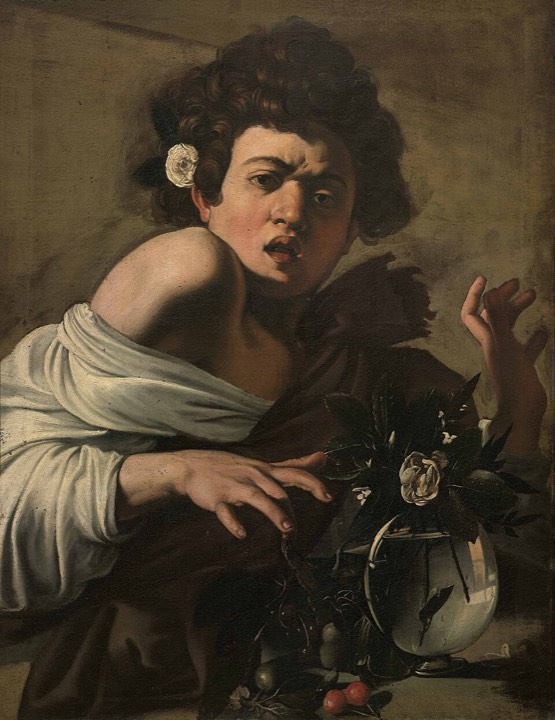 | Boy Bitten by a Lizard (Florence version) | c.1594–5 | Sold on the open market | Later in the collection of the art historian Roberto Longhi → Fondazione Roberto Longhi, Florence |
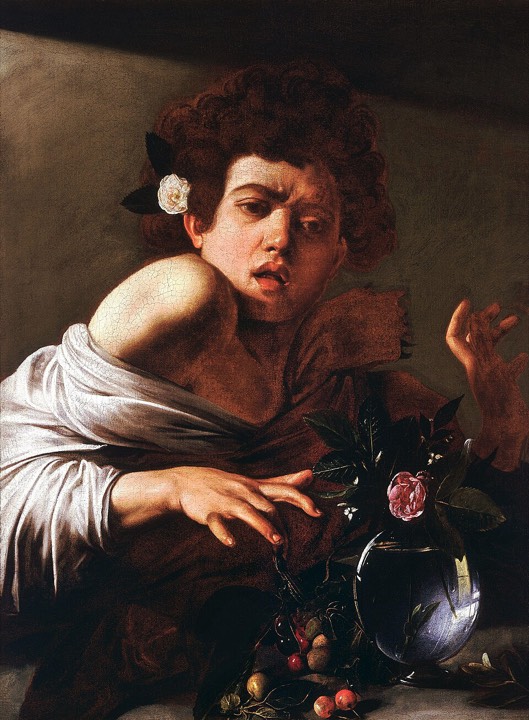 | Boy Bitten by a Lizard (London version) | c.1594–5 | Sold on the open market | Private collections → bought 1986 → National Gallery, London (UK state) |
| The Fortune Teller (Capitoline version) | c.1594 | Bought by Cardinal del Monte | Pio di Savoia collection → bought for the Capitoline by Pope Benedict XIV in 1750 → Capitoline Museums, Rome (City of Rome) |
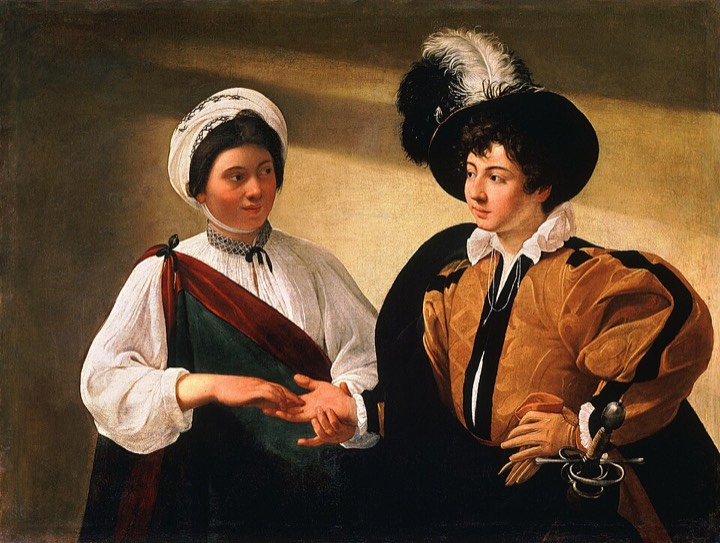 | The Fortune Teller (Louvre version) | c.1595 | Unknown; later owned by Prince Camillo Pamphilj | Given to Louis XIV by Prince Pamphilj in 1665 → French royal collection → Louvre, Paris (French state) |
| The Cardsharps | c.1594 | Bought by Cardinal del Monte | Del Monte → Cardinal Antonio Barberini 1628 → Colonna-Sciarra heirs → disappeared in the 1890s → rediscovered 1987 → Kimbell Art Museum, Fort Worth |
| The Musicians | c.1595 | Cardinal del Monte | Del Monte → Barberini 1628 → lost → rediscovered and bought 1952 → Metropolitan Museum, New York |
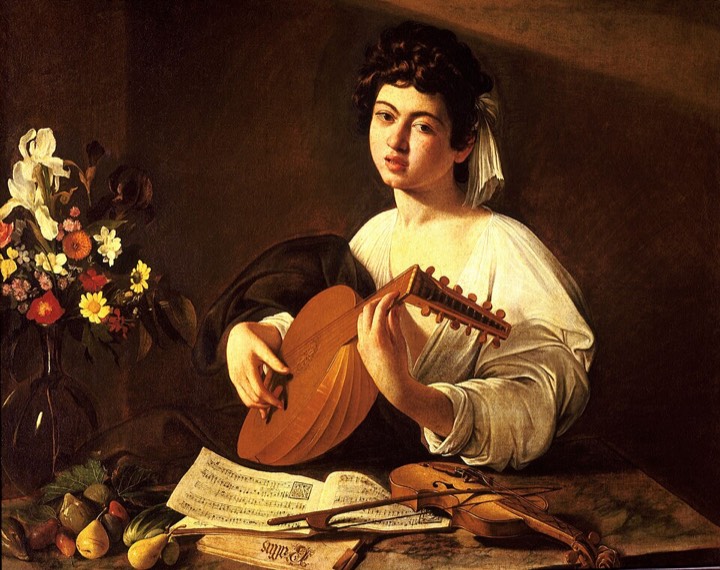 | The Lute Player (Giustiniani version) | c.1596 | Vincenzo Giustiniani | Giustiniani heirs sold it to Tsar Alexander I in 1808 → Hermitage, St Petersburg (Russian state) |
| The Lute Player (del Monte version) | c.1597 | Cardinal del Monte | Del Monte → sold with his collection in 1628 → later private collections → private collection (Wildenstein, New York), long shown on loan at the Metropolitan Museum |
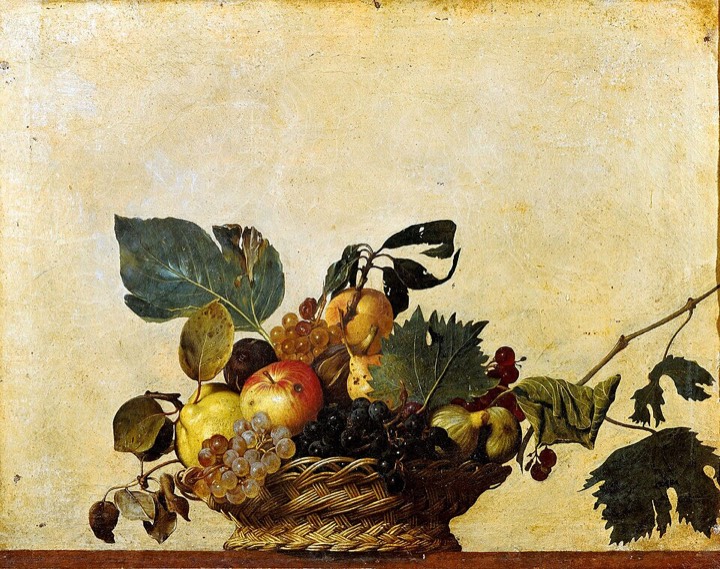 | Basket of Fruit | c.1597–1600 | Cardinal Federico Borromeo | Borromeo gave it to his own foundation, the Ambrosiana, in 1607 → Pinacoteca Ambrosiana, Milan |
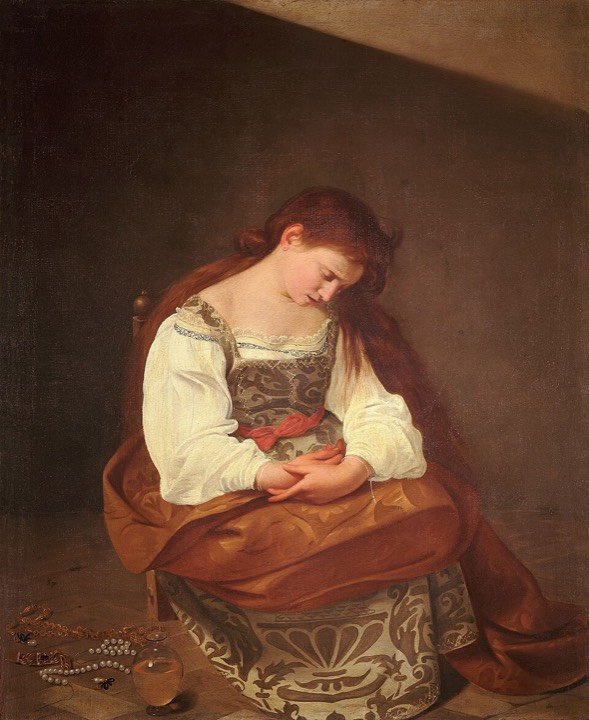 | The Penitent Magdalen | c.1595 | Possibly Girolamo Vittrice | Cardinal Pietro Aldobrandini’s collection by 1603 → inherited by his niece Olimpia Aldobrandini → passed to the Pamphilj on her marriage to Camillo Pamphilj in 1647 → Doria Pamphilj family → Galleria Doria Pamphilj, Rome (owned privately by the family) |
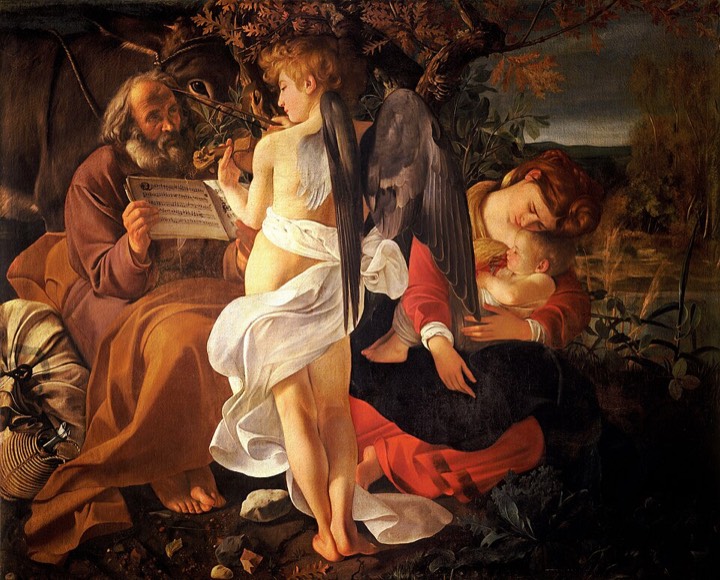 | Rest on the Flight into Egypt | c.1595–6 | Possibly Vittrice | Cardinal Pietro Aldobrandini’s collection by 1603 → inherited by his niece Olimpia Aldobrandini → passed to the Pamphilj on her marriage to Camillo Pamphilj in 1647 → Doria Pamphilj family → Galleria Doria Pamphilj, Rome (owned privately by the family) |
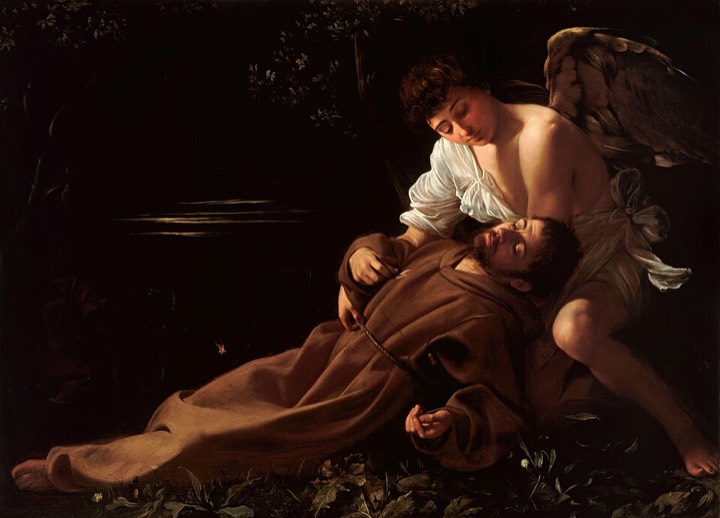 | St Francis in Ecstasy | c.1595 | Possibly del Monte or Ottavio Costa | Costa → various collections → bought 1943 → Wadsworth Atheneum, Hartford |
| Bacchus | c.1596 | Cardinal del Monte, as a gift for Grand Duke Ferdinando de’ Medici | Medici collection, forgotten in storage, rediscovered 1916 → Uffizi, Florence (Italian state) |
| Medusa (on a shield) | 1597–8 | Del Monte, as a gift for Ferdinando de’ Medici | Medici armoury → Uffizi. An earlier version is in a private collection. |
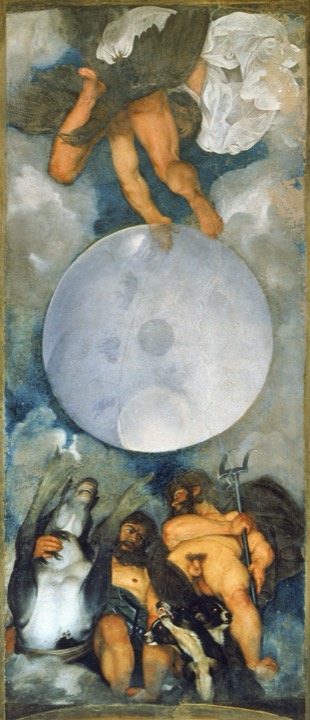 | Jupiter, Neptune and Pluto (ceiling) | c.1597 | Del Monte, for his alchemy room | Still on the ceiling of the Casino Ludovisi (Villa Aurora), Rome, owned by the Ludovisi family. It went to auction in 2022 and did not sell. |
| Image: pre-war photograph | Portrait of Fillide | c.1597–8 | Giulio Strozzi | Fillide left it to Strozzi in her will (1618) → Giustiniani → bought by Prussia 1815 → Kaiser-Friedrich-Museum, Berlin → destroyed 1945 |
| Martha and Mary Magdalen | c.1598 | Unknown | Various → bought 1973 → Detroit Institute of Arts |
| David and Goliath (Prado) | c.1599 | Unknown | Early history uncertain → Spanish royal collection → Museo del Prado, Madrid (Spanish state) |
| Judith Beheading Holofernes | c.1598–9 | Ottavio Costa | Costa heirs → Coppi family → bought by the state in 1971 → Palazzo Barberini, Rome (Italian state) |
| St Catherine of Alexandria | c.1598 | Cardinal del Monte | Del Monte → sold with his collection to Cardinal Antonio Barberini 1628 → Barberini and Colonna-Sciarra heirs → Swiss private collection → bought by Baron Heinrich Thyssen-Bornemisza 1934 → Thyssen-Bornemisza Museum, Madrid (Spanish state since 1993) |
Public commissions and later Rome 1599–1606
| Image | Painting | Year | Commissioned by / first owner | Ownership history → where it is now |
|---|---|---|---|---|
| The Calling of St Matthew | 1599–1600 | Executors of Cardinal Matthieu Cointrel (Contarelli) | Still in place: Contarelli Chapel, San Luigi dei Francesi, Rome (the French national church in Rome) |
| The Martyrdom of St Matthew | 1599–1600 | Executors of Cardinal Matthieu Cointrel (Contarelli) | Hung in 1600 and never moved: Contarelli Chapel, San Luigi dei Francesi, Rome (the French national church in Rome) |
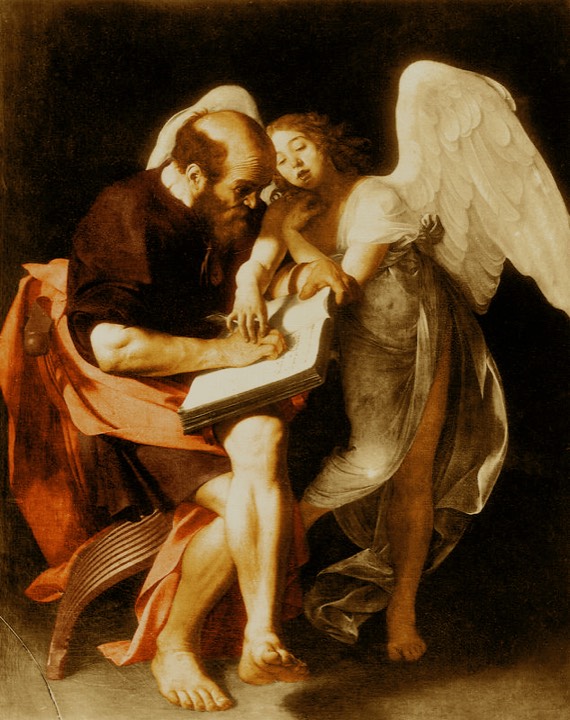 Image: pre-war photograph Image: pre-war photograph | St Matthew and the Angel, first version | 1602 | Executors of Cardinal Contarelli, for the chapel altar; rejected | Bought by Vincenzo Giustiniani → Prussia 1815 → Kaiser-Friedrich-Museum → destroyed 1945 |
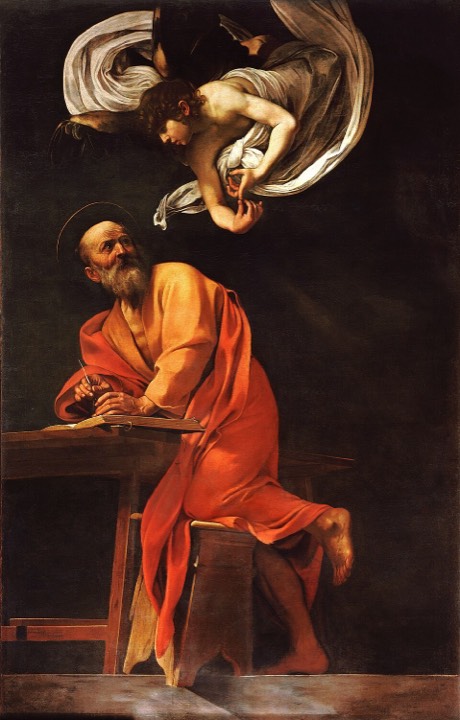 | St Matthew and the Angel, second version | 1602 | Executors of Cardinal Contarelli, for the chapel altar | Installed 1602 and never moved: Contarelli Chapel, San Luigi dei Francesi, Rome |
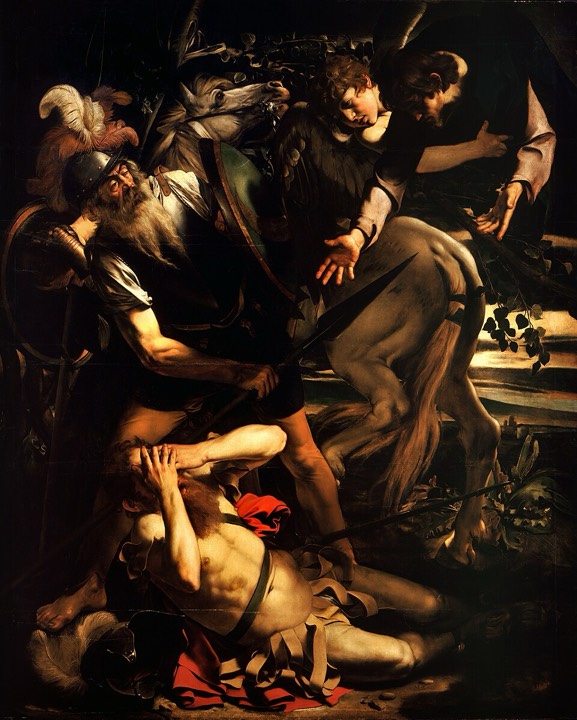 | The Conversion of St Paul, first version (panel) | 1600–01 | Tiberio Cerasi; rejected | Cardinal Giacomo Sannesio → descendants → Odescalchi Balbi collection, Rome (private) |
| The Conversion of St Paul, second version | 1601 | Tiberio Cerasi | Still in place: Cerasi Chapel, Santa Maria del Popolo, Rome |
| The Crucifixion of St Peter | 1601 | Tiberio Cerasi | Still in place, Cerasi Chapel. The rejected first version is lost. |
| The Supper at Emmaus (London) | 1601 | Ciriaco Mattei | Mattei → Scipione Borghese → later private collections → given by Lord Vernon in 1839 → National Gallery, London (UK state) |
| St John the Baptist (with the ram) | 1602 | Ciriaco Mattei | Left to his son Giovanni Battista Mattei → bequeathed to Cardinal del Monte 1624 → Pio collection → Capitoline Museums, Rome. A copy is in the Doria Pamphilj. |
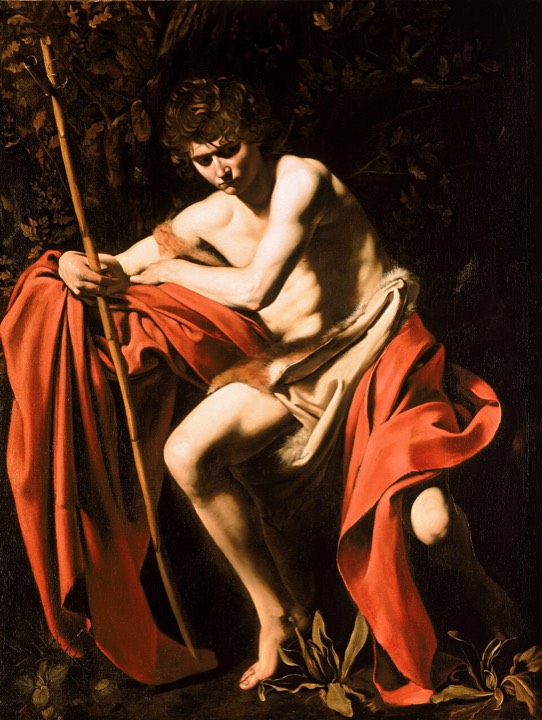 | St John the Baptist (Kansas City) | 1604 | Ottavio Costa, for an altar in Conscente, Liguria (he kept the original and sent a copy) | Costa heirs → later private collections → bought 1952 → Nelson-Atkins Museum of Art, Kansas City |
| The Taking (Betrayal) of Christ | 1602 | Ciriaco Mattei | Mattei → sold in 1802 to William Hamilton Nisbet, Scotland, attributed to Honthorst → sold 1921 → Dr Marie Lea-Wilson → given in the 1930s to the Jesuit community, Leeson Street, Dublin → identified by Sergio Benedetti in 1990 → National Gallery of Ireland, Dublin, on indefinite loan. Owner: the Irish Jesuits. |
| Omnia vincit amor | 1601–02 | Vincenzo Giustiniani | Giustiniani → bought by Prussia 1815 → Gemäldegalerie, Berlin (German state) |
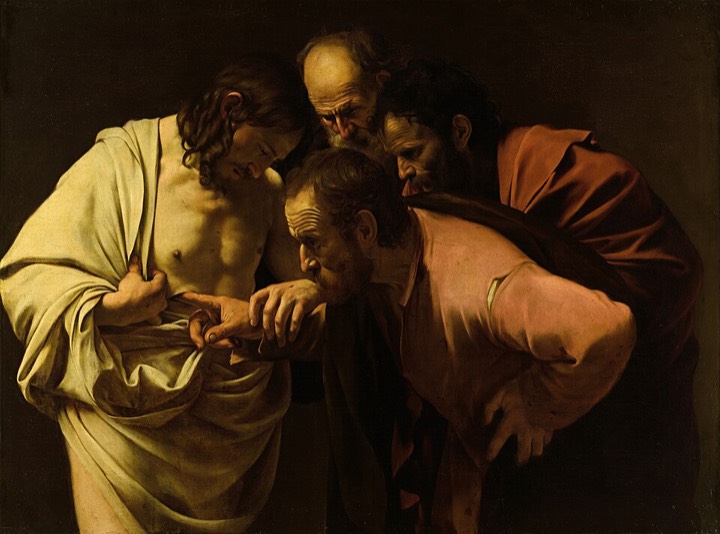 | Doubting Thomas | c.1601–02 | Vincenzo Giustiniani | Giustiniani → Prussia 1815 → Sanssouci Picture Gallery, Potsdam (Prussian Palaces and Gardens Foundation) |
| The Entombment | 1603–04 | Girolamo Vittrice, for the family chapel in the Chiesa Nuova | Taken to Paris by Napoleon in 1797, returned in 1817 → Pinacoteca Vaticana (Vatican Museums). A copy hangs in the chapel. |
| The Madonna of Loreto | 1604–06 | Heirs of Ermete Cavalletti | Still in place: Cavalletti Chapel, Sant’Agostino, Rome |
| The Madonna of the Palafrenieri | 1605–06 | Confraternity of the Palafrenieri, for St Peter’s; removed after two days | Removed from St Peter’s, kept briefly in the confraternity’s church of Sant’Anna dei Palafrenieri → sold cheaply to Scipione Borghese in 1606 → Borghese family collection → bought with the whole collection by the Italian state in 1902 → Galleria Borghese, Rome (Italian state) |
| The Death of the Virgin | 1601–06 | Laerzio Cherubini, for Santa Maria della Scala; rejected | Bought for the Duke of Mantua in 1607 on Rubens’s advice → Charles I of England 1627 → sold after his execution → Everhard Jabach → Louis XIV 1671 → Louvre, Paris |
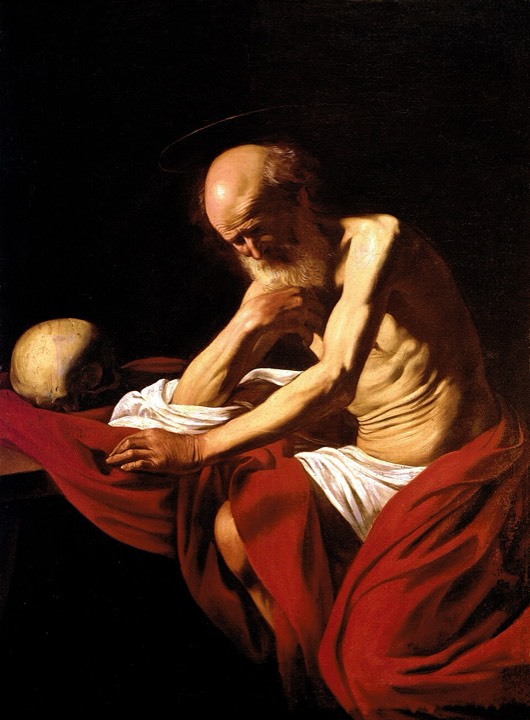 | St Jerome in Meditation (Montserrat) | c.1605 | Unknown | Early history uncertain → given to the Benedictine abbey of Montserrat in the early 20th century → Museu de Montserrat, Catalonia |
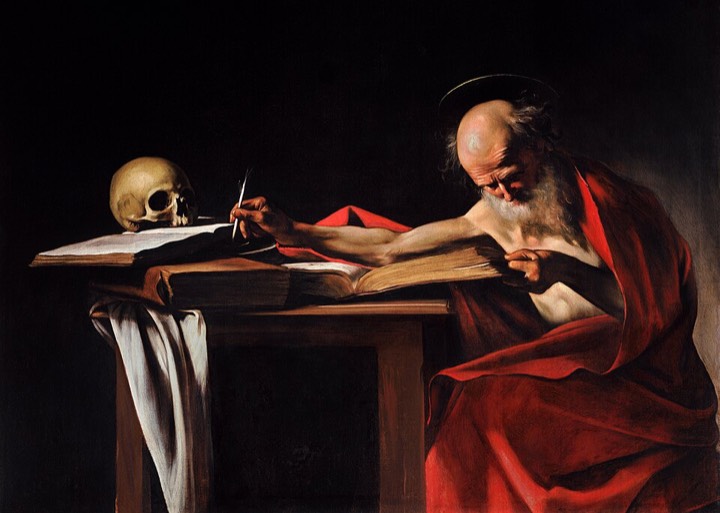 | St Jerome Writing (Borghese) | c.1605–06 | Scipione Borghese, probably as a gift | Scipione Borghese, from about 1606 → Borghese family collection → bought with the whole collection by the Italian state in 1902 → Galleria Borghese, Rome (Italian state) |
Exile 1606–10
| Image | Painting | Year | Commissioned by / first owner | Ownership history → where it is now |
|---|---|---|---|---|
| The Supper at Emmaus (Milan) | 1606 | Painted in hiding in the Colonna estates; sold to the banker Ottavio Costa | Later the Patrizi family → bought 1939 → Pinacoteca di Brera, Milan (Italian state) |
| David with the Head of Goliath | 1606–10 (dating disputed) | For Scipione Borghese, as a plea for pardon | Sent to Scipione Borghese in Rome → Borghese family collection → bought with the whole collection by the Italian state in 1902 → Galleria Borghese, Rome (Italian state) |
| The Seven Acts of Mercy | 1606–07 | Pio Monte della Misericordia, Naples | Still in place and still owned by the Pio Monte della Misericordia, Naples, which resolved in 1613 never to sell it |
| David with the Head of Goliath (Vienna) | c.1606–07 | Unknown; painted on poplar panel | Habsburg collection by the 17th century → Kunsthistorisches Museum, Vienna (Austrian state) |
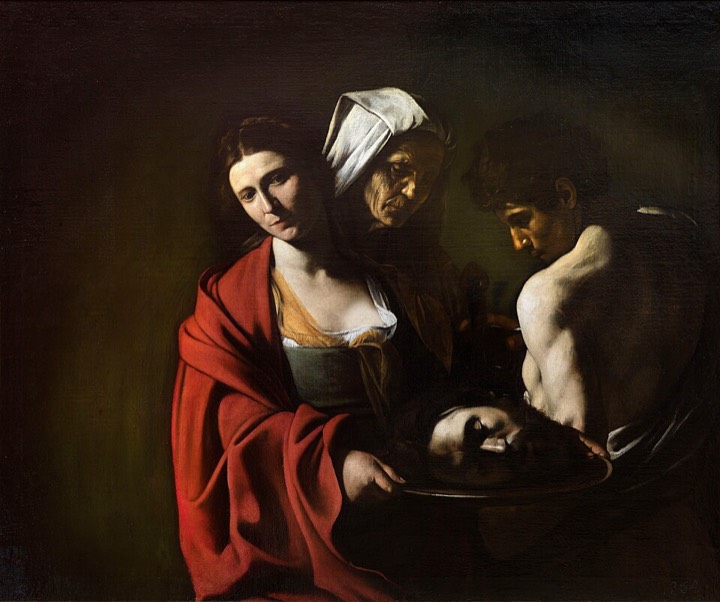 | Salome with the Head of John the Baptist (Madrid) | c.1607–09 | Unknown; probably acquired by a Spanish viceroy of Naples | Spanish royal collection → Palacio Real, Madrid (Patrimonio Nacional) |
| The Flagellation of Christ | 1607 | De Franchis family, for their chapel in San Domenico Maggiore | Moved to Museo di Capodimonte, Naples, on loan from the church |
| The Crucifixion of St Andrew | 1607 | Conde de Benavente, Spanish viceroy of Naples | Taken to his palace in Valladolid in 1610 → later Spanish private collections → bought 1976 → Cleveland Museum of Art |
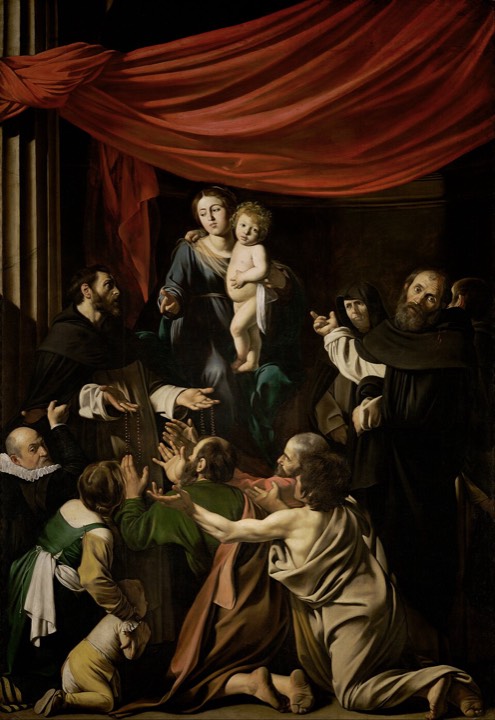 | The Madonna of the Rosary | c.1601–07 | Unknown donor; on sale in Naples in 1607 through the dealers Louis Finson and Abraham Vinck | Finson → bought by a group of artists including Rubens and given to the Dominican church in Antwerp in the 1620s → acquired by Emperor Joseph II in 1781 → Kunsthistorisches Museum, Vienna (Austrian state) |
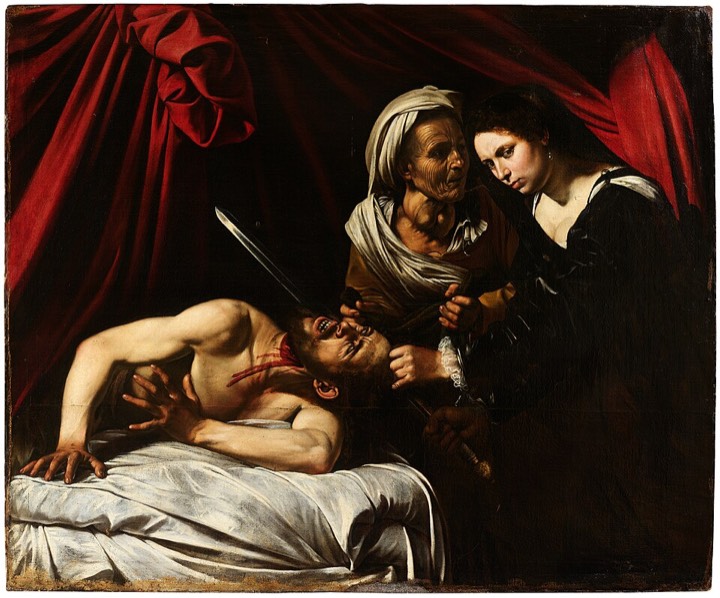 Image: the disputed Toulouse painting Image: the disputed Toulouse painting | Judith and Holofernes (Naples version) | c.1607 | Sold through Finson and Vinck | Lost. A painting found in an attic near Toulouse in 2014 is claimed by some as this work. It was sold privately in 2019 to the collector J. Tomilson Hill, and its attribution is still disputed. |
| St Jerome Writing (Malta) | 1607–08 | Fra Ippolito Malaspina | Malaspina left it to the Oratory of the Italian knights → St John’s Co-Cathedral, Valletta. Stolen in 1984 and recovered in 1988. |
| Portrait of Fra Antonio Martelli | 1607–08 | Antonio Martelli | Passed to the Medici → Palazzo Pitti, Florence (Italian state) |
| Portrait of Alof de Wignacourt | 1607–08 | Grand Master Alof de Wignacourt | In the French royal collection by the later 1600s → Louvre |
| The Beheading of St John the Baptist | 1608 | The Order of St John, as his entry fee | Still in place: Oratory, St John’s Co-Cathedral, Valletta |
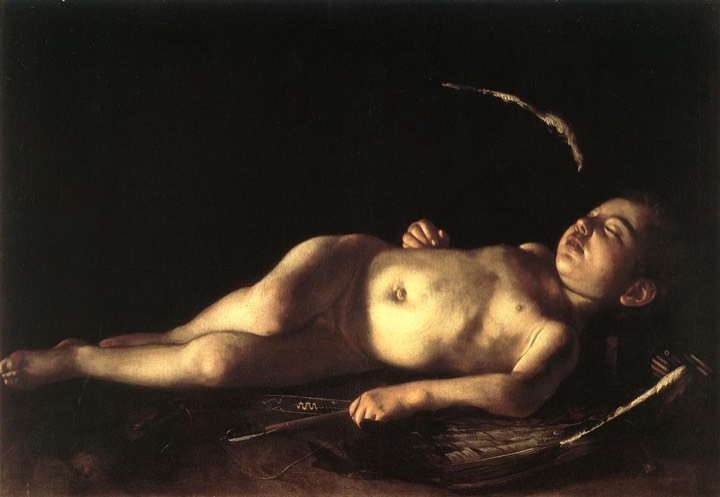 | Sleeping Cupid | 1608 | Francesco dell’Antella | Sent to Florence in 1609 → Palazzo Pitti |
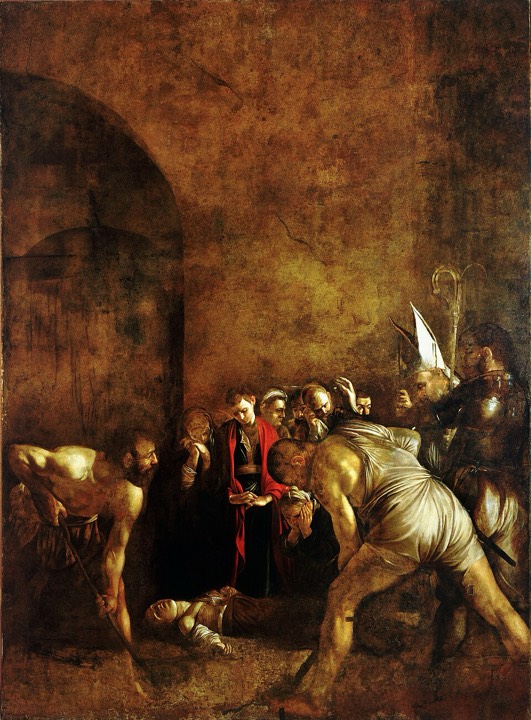 | The Burial of St Lucy | 1608 | The Senate of Syracuse | Painted for Santa Lucia al Sepolcro, Syracuse. Still in Syracuse, between that church and Santa Lucia alla Badia. |
| The Resurrection of Lazarus | 1609 | Giovan Battista de’ Lazzari, for the church of the Padri Crociferi, Messina | Moved after the 1908 earthquake → Museo Regionale, Messina (Sicilian region) |
| The Adoration of the Shepherds | 1609 | The Senate of Messina, for the Capuchin church | The Capuchins refused to give it to princes who wanted it → Museo Regionale, Messina |
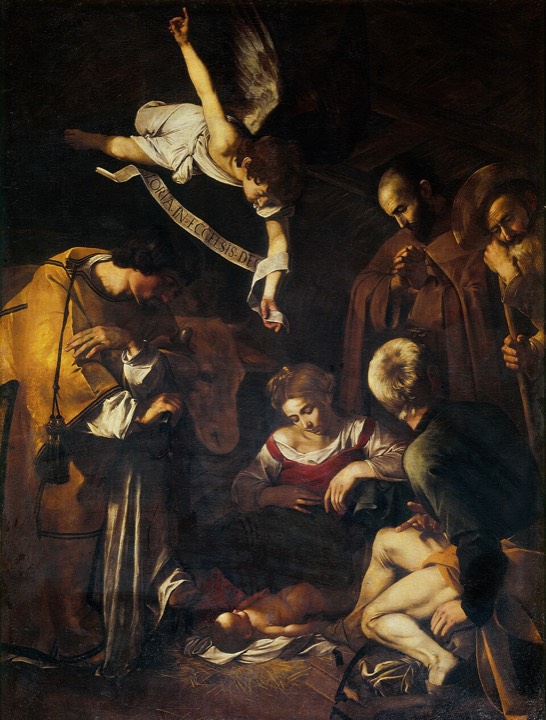 Image: photograph taken before the theft Image: photograph taken before the theft | Nativity with St Francis and St Lawrence | 1609 | Compagnia di San Francesco, for the Oratory of San Lorenzo, Palermo | Stolen in 1969, reportedly by the Mafia, and never recovered |
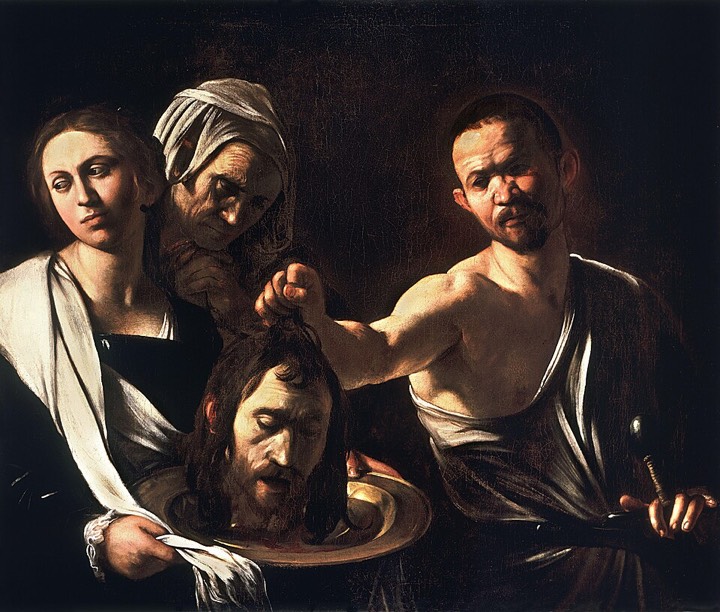 | Salome with the Head of John the Baptist | c.1609 | Possibly sent to Wignacourt as a peace offering | Various owners → bought 1970 → National Gallery, London |
No image survives | The Resurrection of Christ | 1609 | Alfonso Fenaroli, for Sant’Anna dei Lombardi, Naples | Destroyed in an earthquake around 1805 |
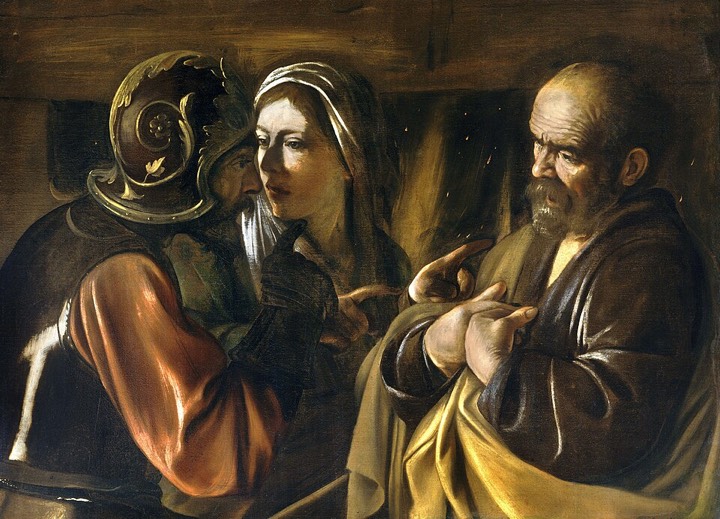 | The Denial of St Peter | 1610 | Unknown | Private collections → given 1997 → Metropolitan Museum, New York |
| The Martyrdom of St Ursula | 1610 | Prince Marcantonio Doria, Genoa | Doria family → later Romano-Avezzano family → bought in 1972 by Banca Commerciale Italiana → Gallerie d’Italia, Palazzo Zevallos, Naples, owned by the bank Intesa Sanpaolo |
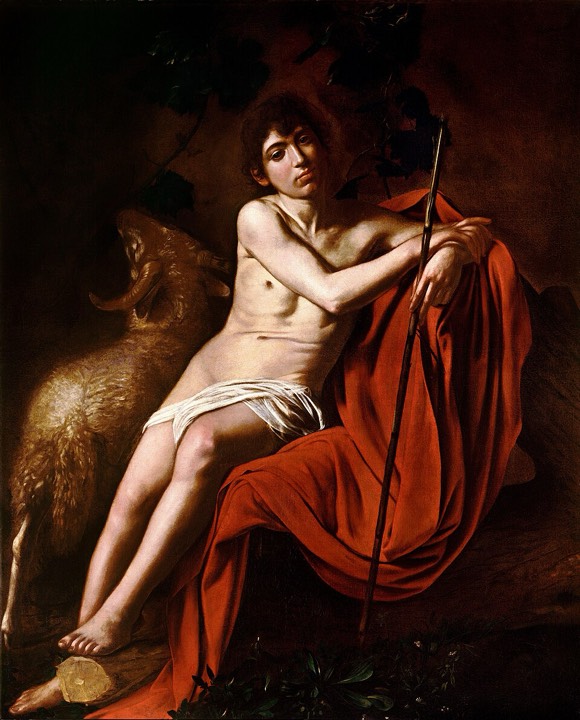 | St John the Baptist (reclining) | 1610 | In his luggage on his last voyage, meant for Scipione Borghese | Seized by the Knights of Malta, then kept by the Spanish viceroy, finally sent to Scipione Borghese in Rome in 1611 → Borghese family collection → bought with the whole collection by the Italian state in 1902 → Galleria Borghese, Rome (Italian state) |
No image survives | Mary Magdalen and a second St John | 1610 | In the same luggage | Lost, probably to creditors or Malta |
Destroyed or lost: the portrait of Fillide and the first St Matthew and the Angel (both destroyed in Berlin, 1945), the Naples Resurrection (earthquake), the Palermo Nativity (stolen 1969), the first Cerasi Crucifixion, the Radolovich altarpiece (possibly never painted), and the two paintings that disappeared from his last luggage.
The Galleria Borghese has the largest single group: six Caravaggios, almost all gathered by Scipione Borghese himself.
Other works mentioned by other artists
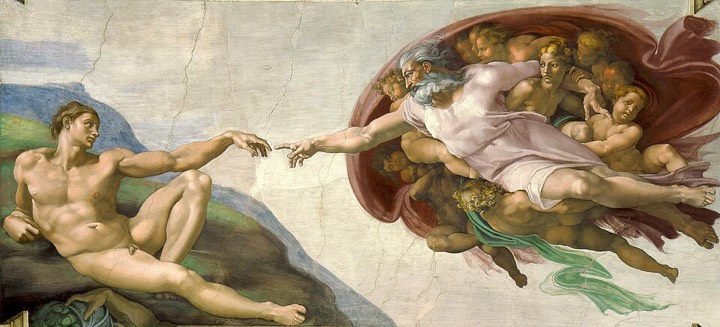
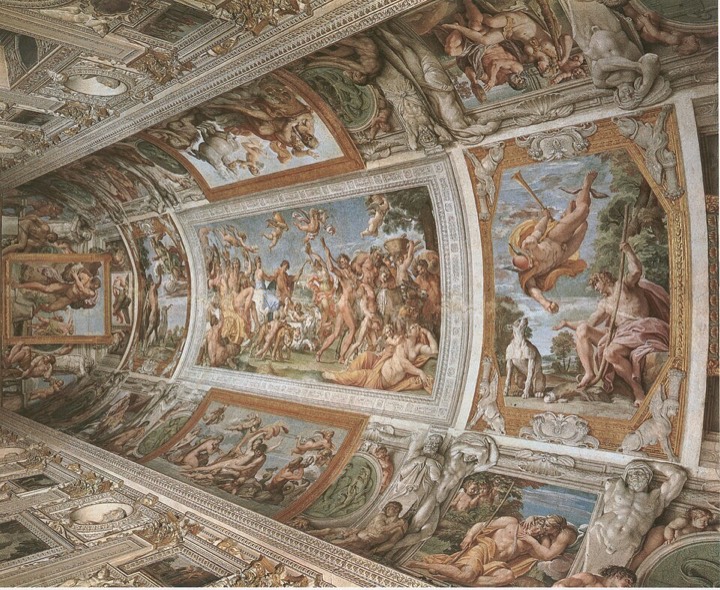
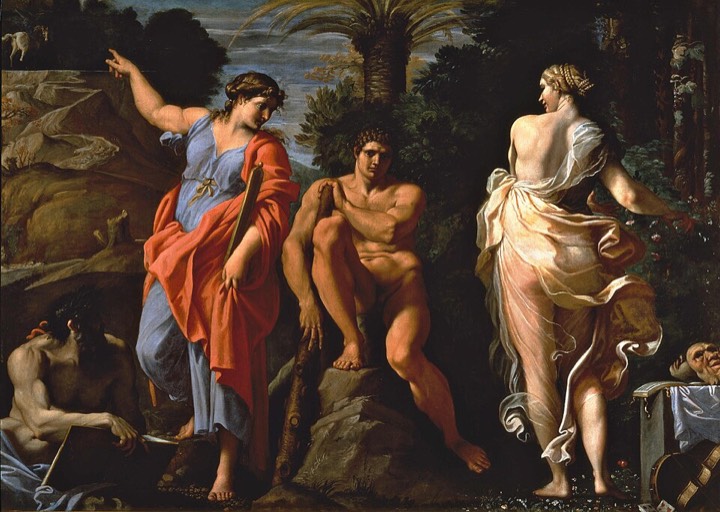
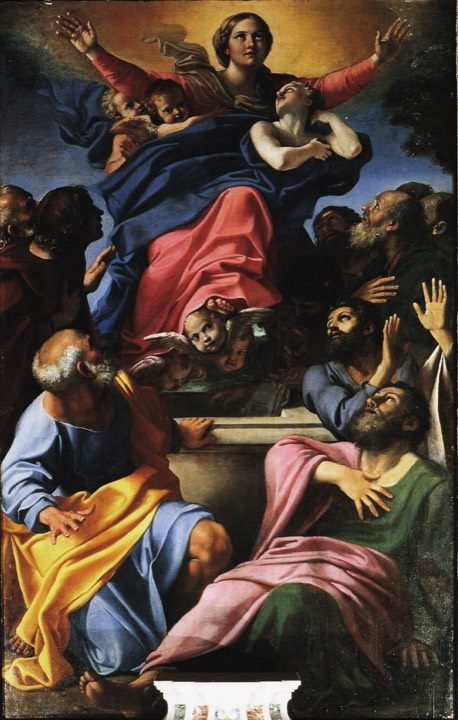
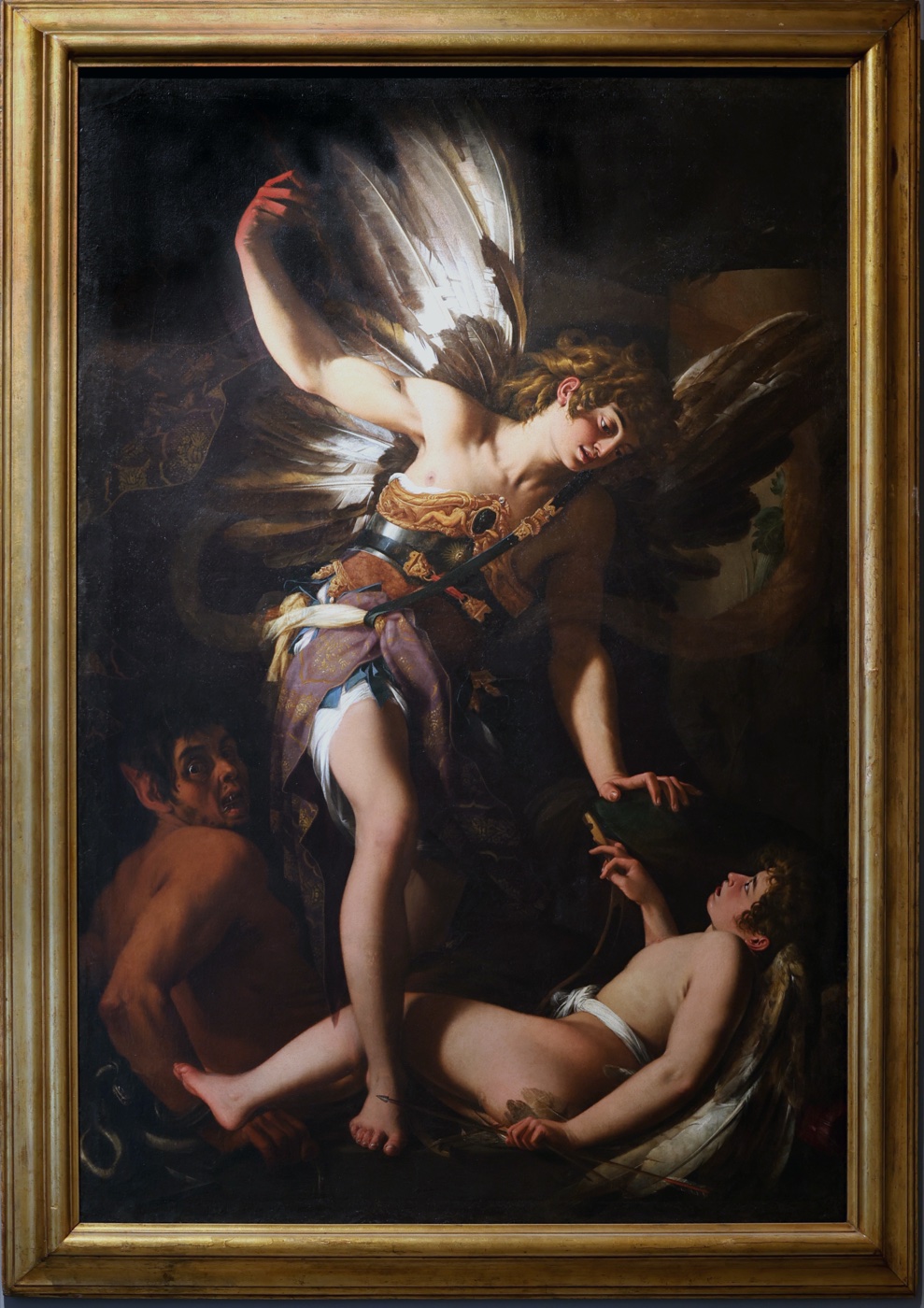
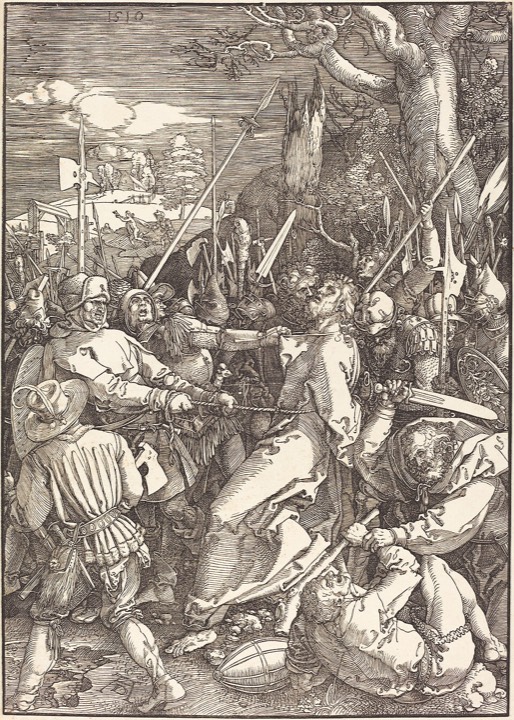
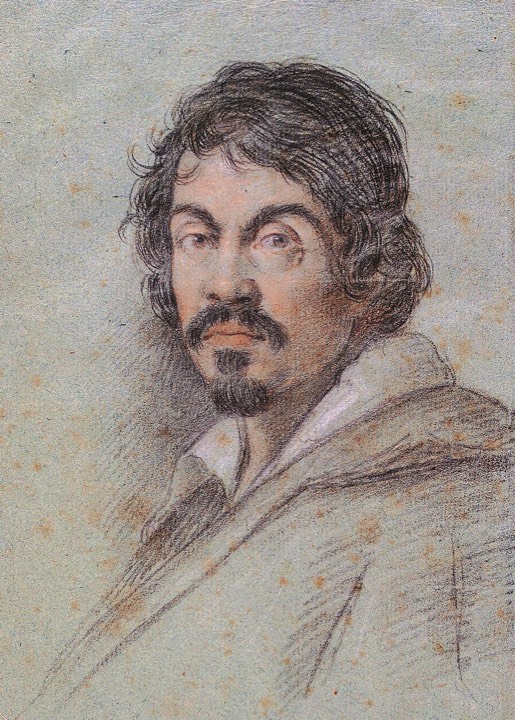
Who overlapped with whom