Map
Cold open
SFX: Steam train pulling out. Birdsong.
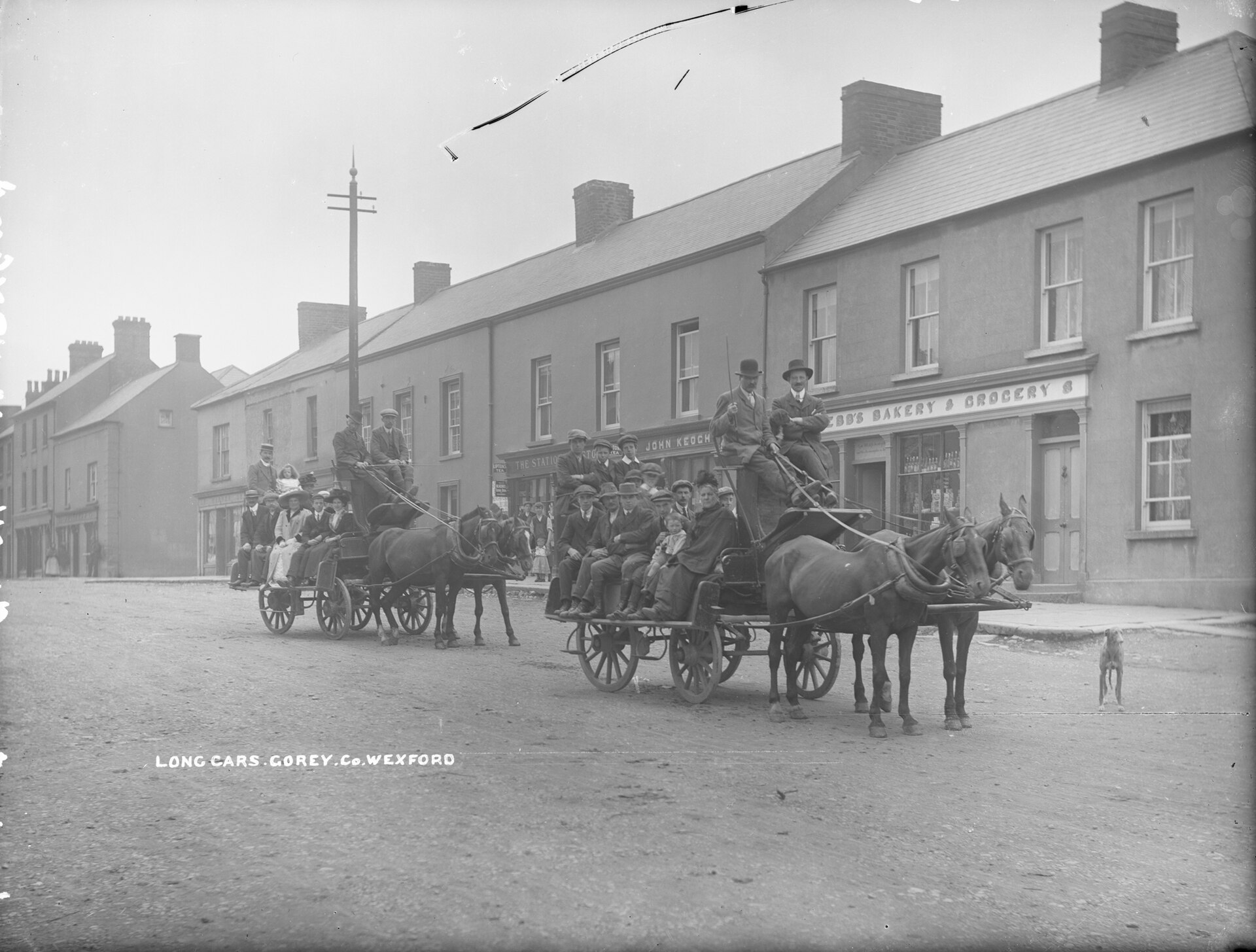
Gorey, County Wexford. The fifteenth of June, 1920.
Photograph
Gorey, Co. Wexford, around 1900
Horse-drawn long cars, an early kind of public transport, in the town where Lea-Wilson was District Inspector.
Photo: Robert French, Lawrence Collection, National Library of Ireland (public domain)
It's morning.
A man in his early thirties is walking home from the railway station.
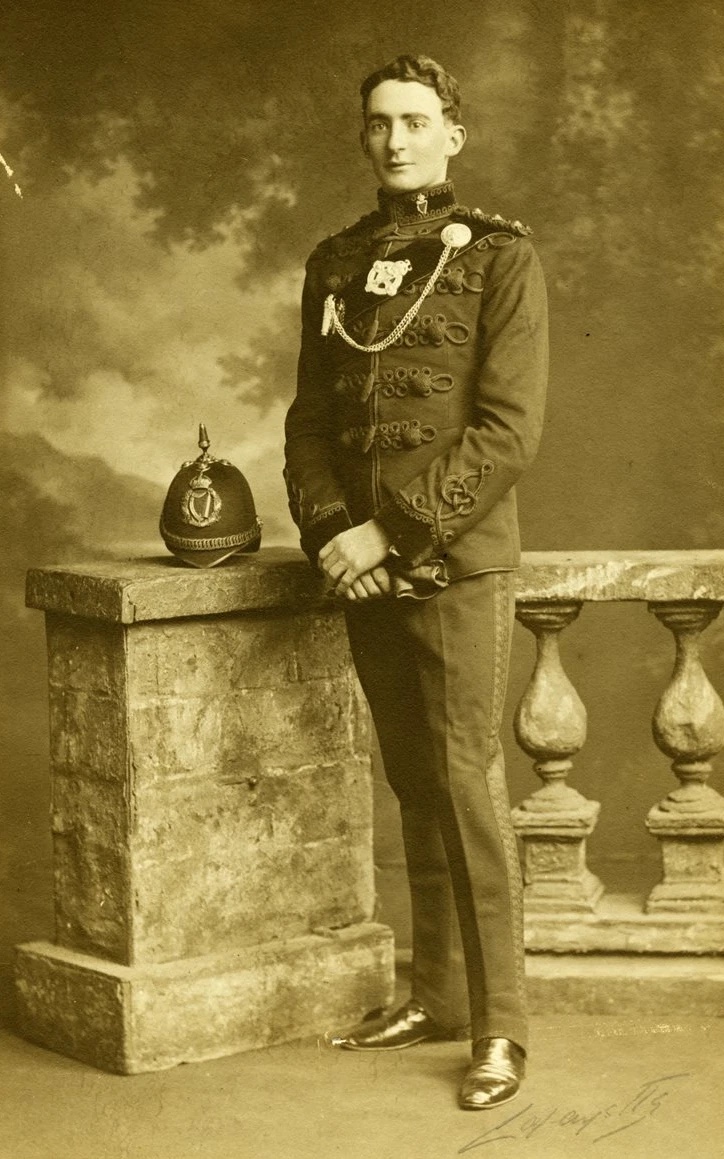
His name is Percival Lea-Wilson. He's the District Inspector of the Royal Irish Constabulary in Gorey.
Photograph
Percival Lea-Wilson
In RIC dress uniform, with the RIC helmet on the plinth beside him. The portrait used on his 1920 commemoration poster.
National Museum of Ireland, HE:EWT.417 (detail)
He's English, he's a war veteran and he's off duty today.
SFX: Footsteps on a country road. A car bonnet being lifted. Metal on metal.
Up ahead, a car is pulled in at the side of the road. It looks like it's broken down. A few men are leaning in under the bonnet, chatting to each other and tinkering away.
He doesn't think anything of it at first.
Then something about the men at the car makes him stop.
Maybe it's a face. Maybe it's instinct.
He runs for his house.
Shots ring out.
SFX: Gunfire. Several shots. A newspaper hitting the road.
He's hit several times. Percival falls to the ground about 250 yards from his front door.
The men jump into the car and drive away at speed.
SFX: Car engine starting and pulling away.
The RIC inspector dies on the road.
SFX: Hard cut. Silence. Then murmuring Italian voices in an enclosed courtyard. Footsteps on packed earth.
Rome. The twenty-eighth of May, 1606.
A tennis court near the Campo Marzio.
Nobody's playing tennis.
There are eight men on the court, four a side, with their seconds and witnesses watching from the edges. This duel has been arranged. Everybody here knows exactly why they've come.
SFX: Swords drawn.
On one side is a local pimp with powerful friends. His name is Ranuccio Tomassoni.
On the other is a painter. The most talked-about painter in Rome. His name is Michelangelo Merisi. But Rome already has one famous Michelangelo. So people call him after the town his family came from. Michelangelo da Caravaggio. Or just… Caravaggio.
SFX: Clash of steel. Grunting, scuffling feet. A sudden cry.
Caravaggio's blade slices at Tomassoni's groin. It cuts the femoral artery.
Tomassoni's brother rushes in and slashes Caravaggio across the head.
One of Caravaggio's men drags him clear.
Ranuccio Tomassoni bleeds to death on the ground.
The witnesses scatter. Caravaggio's men carry him off, and he goes to ground.
SFX: Running feet scattering. Fading.
Two killings, 314 years apart.
Both of them, in their own way, were settling a debt of honour. Or revenge, depending on how you look at it.
The two incidents would eventually become intertwined in the most unlikely of ways.
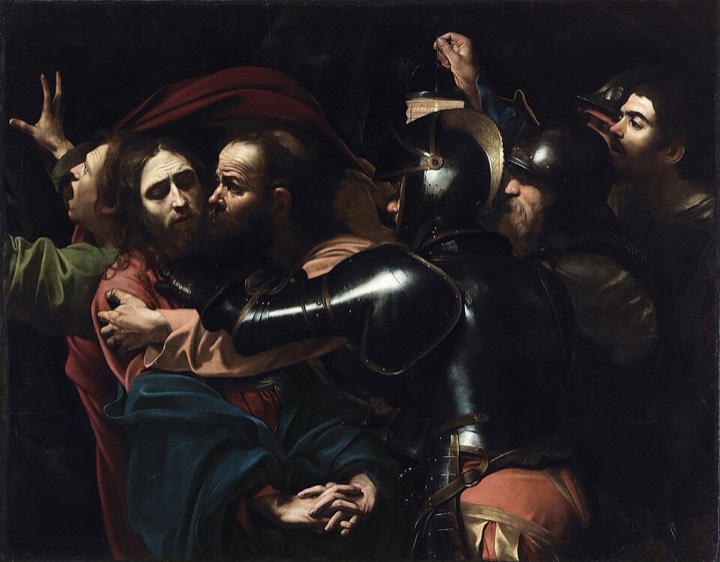
A few years before that day on the tennis court, the killer in Rome painted a scene of betrayal. A night arrest, lit by one lantern. A kiss, a grab, a scream.
Painting
The Taking of Christ
National Gallery of Ireland, Dublin, on indefinite loan from the Jesuit Community, Leeson Street
The painting at the centre of the episode. Caravaggio is the man on the right holding the lantern.
Three centuries later, that painting would end up in the hands of the dead man's widow in Ireland. She'd have no idea what it was.
This is the story of an artist and an art owner who lived 300 years apart.
And the unlikely journey of the painting they shared.
SFX: Yarn intro sting.
Yarn 30. How Ireland got a Caravaggio.
Act 1
SFX: Church bells. A large crowd chanting a Latin litany. Bare feet on stone.
Milan, 1576.
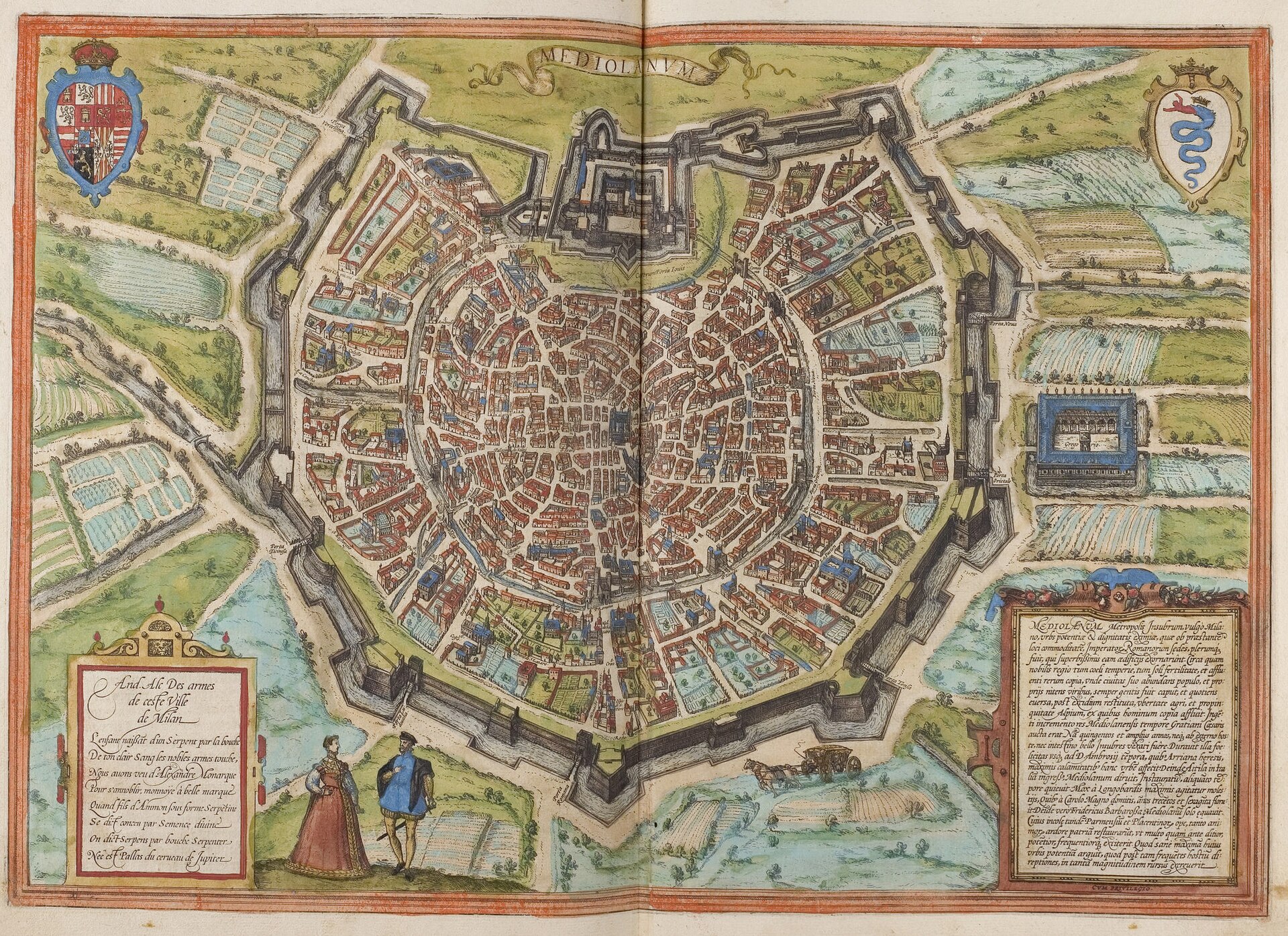
Engraving
Milan in 1572
Braun and Hogenberg’s bird’s-eye view of the city, four years before the plague arrived.
Georg Braun and Frans Hogenberg, Civitates Orbis Terrarum, 1572 (public domain)
Italy won't be unified as a country until 1861.
The Italian peninsula is home to several rich city states in the 1500s
Milan is ruled by Spain. It is famous across Europe for one thing: its swordsmiths.
But the man who really runs Milan isn't Spanish. He's the Archbishop. Carlo Borromeo.
Borromeo is the Counter-Reformation personified.
Austere, tireless, terrifying. He has his own private armed militia.
He introduces private confession boxes in the churches, so priests and sinners can't see each other.
He separates men and women at Mass.
He informs on heretics.
And he believes that faith should be something you can feel.
He wants people to see Christ's suffering in front of them, life-size, close enough to touch and experience even.
In the summer of 1576, the plague arrives in Milan.
Over the next two years it kills about a fifth of the people in the diocese.
Borromeo tells Milan this is God's punishment.
He leads penance processions through the streets, barefoot, with a rope around his neck.
Asking for God's forgiveness for the sins of the city.
In a family of stonemasons, there's a little boy watching all of this. He's only five years old.
As the plague spreads, his family leaves Milan for the small town of Caravaggio, about forty kilometres to the east, where they hope they'll be safe.
They aren't.
In October 1577, the boy's father dies. Then his grandfather. Then his grandmother.
All within a day of each other.
The boy's uncle had already died earlier that year.
By the time he's six, the boy has lost almost every man in his family.
SFX: Bell stops. Silence.
The boy shows promise at drawing and painting.
At thirteen he is sent back to Milan and apprenticed to a painter there.
Not a very good painter, by most accounts.
Four years of training, at an unusually high fee. His mother dies in 1590.
Within a couple of years he's sold off his share of the family inheritance and cut ties with his brother and sister.
And then, in 1592, at the age of 21, he leaves Milan for good.
Nobody knows exactly why. Two of his early biographers give us some hints. One says he fled after killing a companion. Another scribbles something garbled about a prostitute, a gentleman, a policeman and a year in prison.
What we do know is that he arrives in Rome with no money, no name and not a single known painting to his credit.
SFX: Street noise. Hawkers, carts, dogs, a dozen accents.
Rome in the 1590s is a building site and a slum at the same time. The Pope is turning it into a showcase for Catholic triumph: new avenues, obelisks, and the great dome of St Peter's is finally finished.
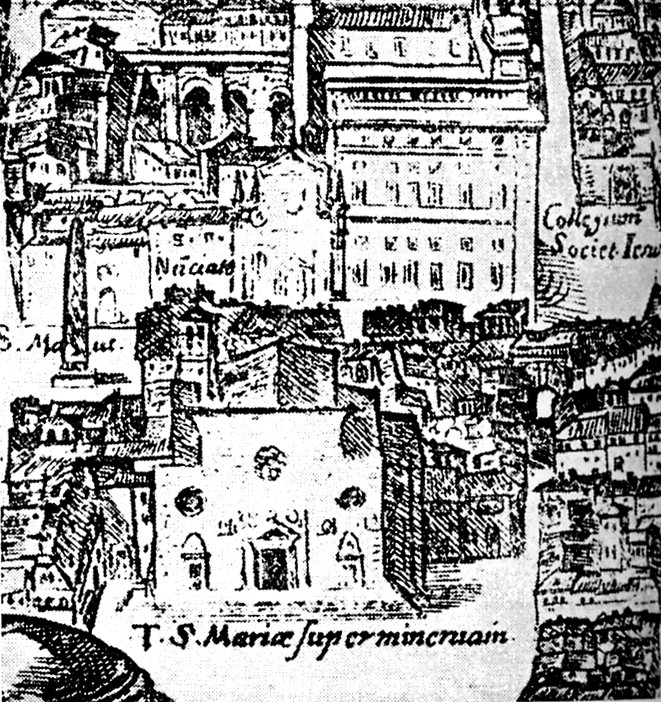
Map
Rome in 1593
A detail of Antonio Tempesta’s great map of the city, made the year after Caravaggio arrived.
Antonio Tempesta, map of Rome, 1593 (public domain)
Rome's streets are full of migrants, beggars, pilgrims, prostitutes and soldiers looking for work.
Around two thousand artists are crammed into one small district near the Piazza del Popolo. They group together by where they come from. In taverns they trade insults about each other's home towns.
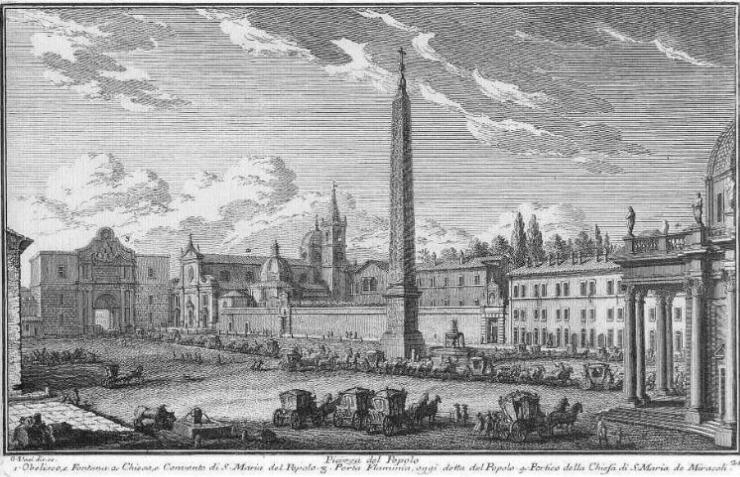
Engraving
The Piazza del Popolo
The square at the edge of the artists’ quarter where Caravaggio lived and worked, as Vasi drew it a century and a half later.
Giuseppe Vasi, 1752 (public domain)
And the whole city runs on a code of honour.
A man's reputation is everything. Insult it, and the debt has to be repaid. A slap, a slur, a look at the wrong man's wife. Often it's repaid in blood.
Men also defend their honour by slashing the faces of women who've crossed them. It's an incredibly violent time.
The Pope tries to intervene. Clement VIII bans the carrying of weapons.
He bans duelling.
He makes libel a capital crime.
He puts a huge night-time police force on the streets.
It makes very little difference.
This is the city our boy, now a man, Caravaggio arrives in.
He carries a sword. The difference here is that so does everyone else.
SFX: Distant artillery. Rain on canvas. A field telephone ringing.
Let's jump forward three hundred years, and over a thousand miles north.
Percival Lea-Wilson is about as far from a poor Milanese artist as you can get.
He was born in Kensington, in London, into a wealthy City family. His father was a stockbroker. His great-grandfather had been Lord Mayor of London. He was educated at Winchester and New College, Oxford.
Then, in 1910, he did something a little unusual for a young Englishman. He applied to become an officer in the Royal Irish Constabulary, Ireland's armed national police. For a public-school man it was a respectable career, the police equivalent of an army commission. Within a year he'd be in charge of his own district. In England, a young gentleman couldn't just walk into command of a police district like that.
He was first posted to Castleisland, in County Kerry. From there he moved to Charleville in County Cork. It seems that's where he met a young woman called Marie Ryan.
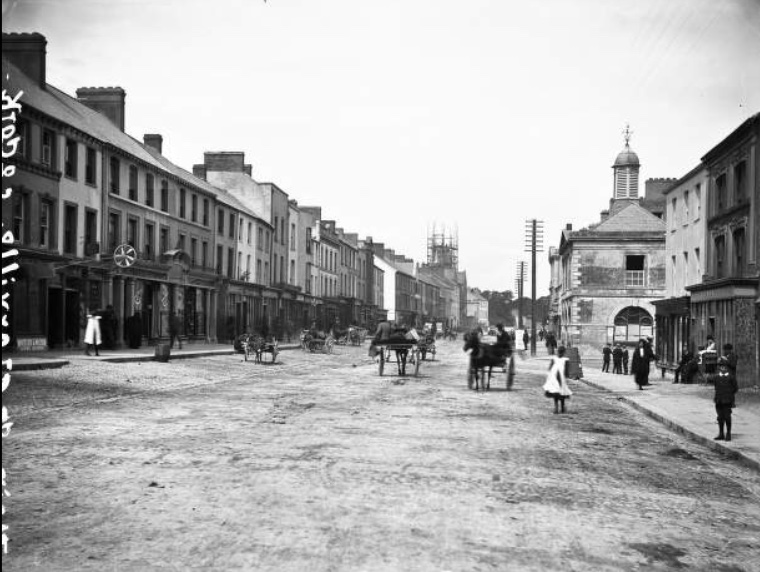
Photograph
Main Street, Charleville, Co. Cork
Photographed between 1865 and 1914, around the years Marie Ryan grew up here.
Photo: Robert French, Lawrence Collection, National Library of Ireland (public domain)
They married in January 1914 in Charleville.
It can't have been simple. She was an Irish Catholic, the daughter of a local solicitor. He was an English Protestant and a police officer. To marry in her church they'd have needed a special dispensation from the bishop. And under the Catholic Church's rules at the time, he'd usually have had to promise that any children would be raised Catholic. Mixed marriages weren't unheard of, but they were unusual, and in the Ireland of 1914 they were a sensitive subject.
When the Great War broke out that August, Percival, like a lot of police officers, took a commission in the army. He was sent to the Western Front and rose to the rank of captain.
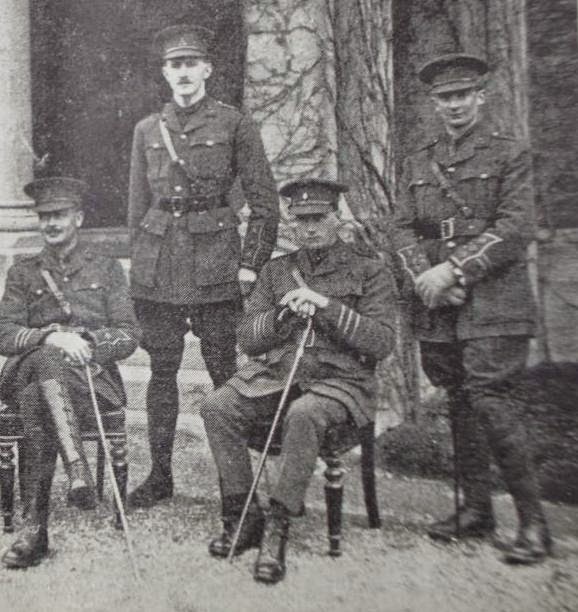
Photograph
Percival Lea-Wilson with fellow officers
From his war service. Lea-Wilson is standing on the right.
Image: via Roaringwater Journal (roaringwaterjournal.com)
He was badly wounded. One account calls him an early case of what they were starting to call shell shock.
By the spring of 1916, he's back in Ireland. And he's in Dublin.
SFX: Easter bells. Then rifle fire. Explosions. Glass breaking.
Easter Monday, 1916.
About sixteen hundred rebels, mostly from two militias, the Irish Volunteers and the Irish Citizen Army, seize buildings across Dublin and proclaim an Irish Republic. This would later be known as the Easter Rising.
It lasts less than a week.
By Saturday the General Post Office is a burnt-out shell, and the rebels surrender. Hundreds of prisoners are marched from the GPO and the Four Courts up Sackville Street, to the grounds of the Rotunda Hospital. They're packed onto a patch of grass in front of the building and held there overnight, in the open.
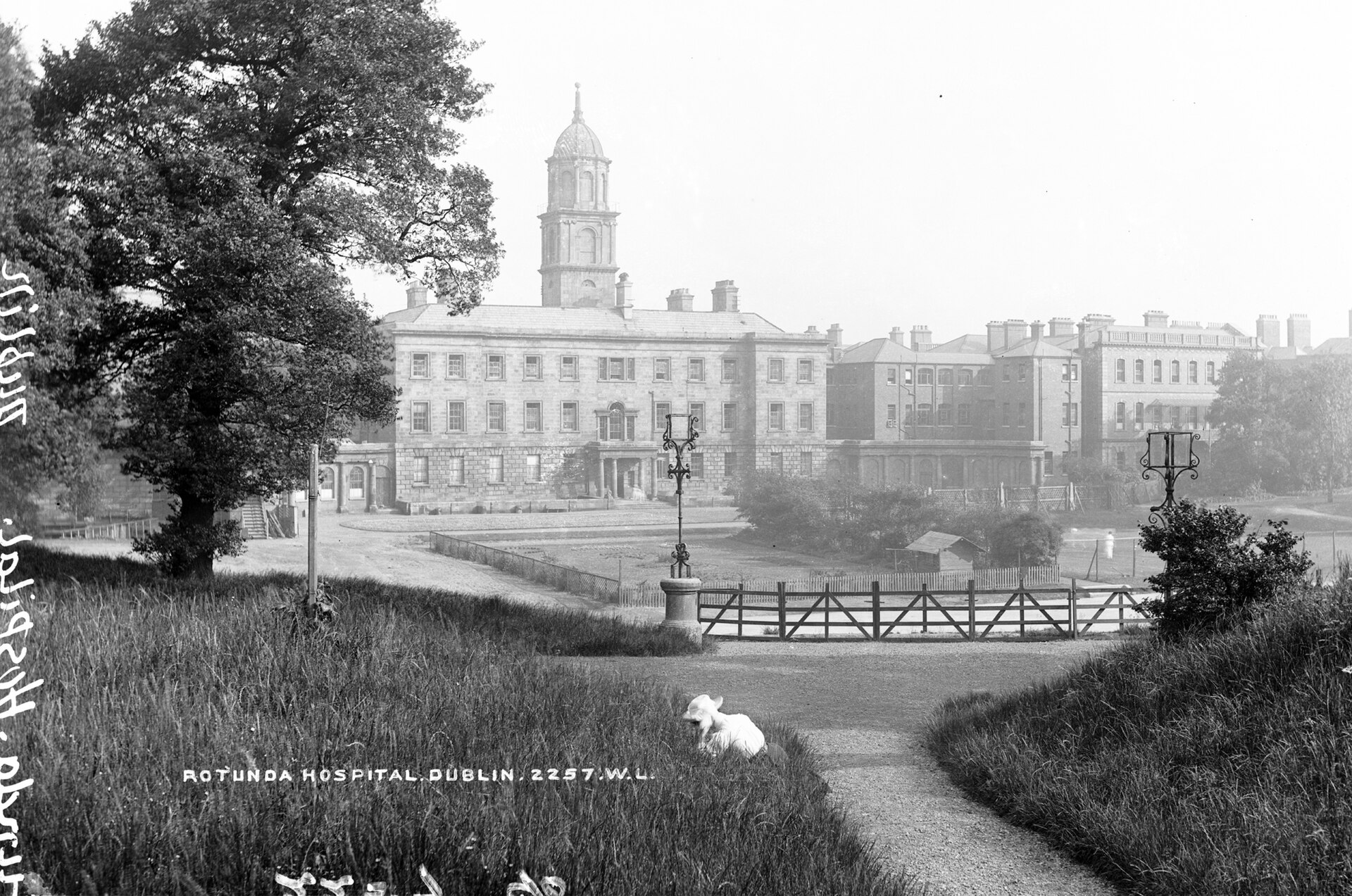
Photograph
The Rotunda Hospital, Dublin, around 1890
The hospital whose grounds held the prisoners overnight after the 1916 surrender.
Photo: Robert French, Lawrence Collection, National Library of Ireland (public domain)
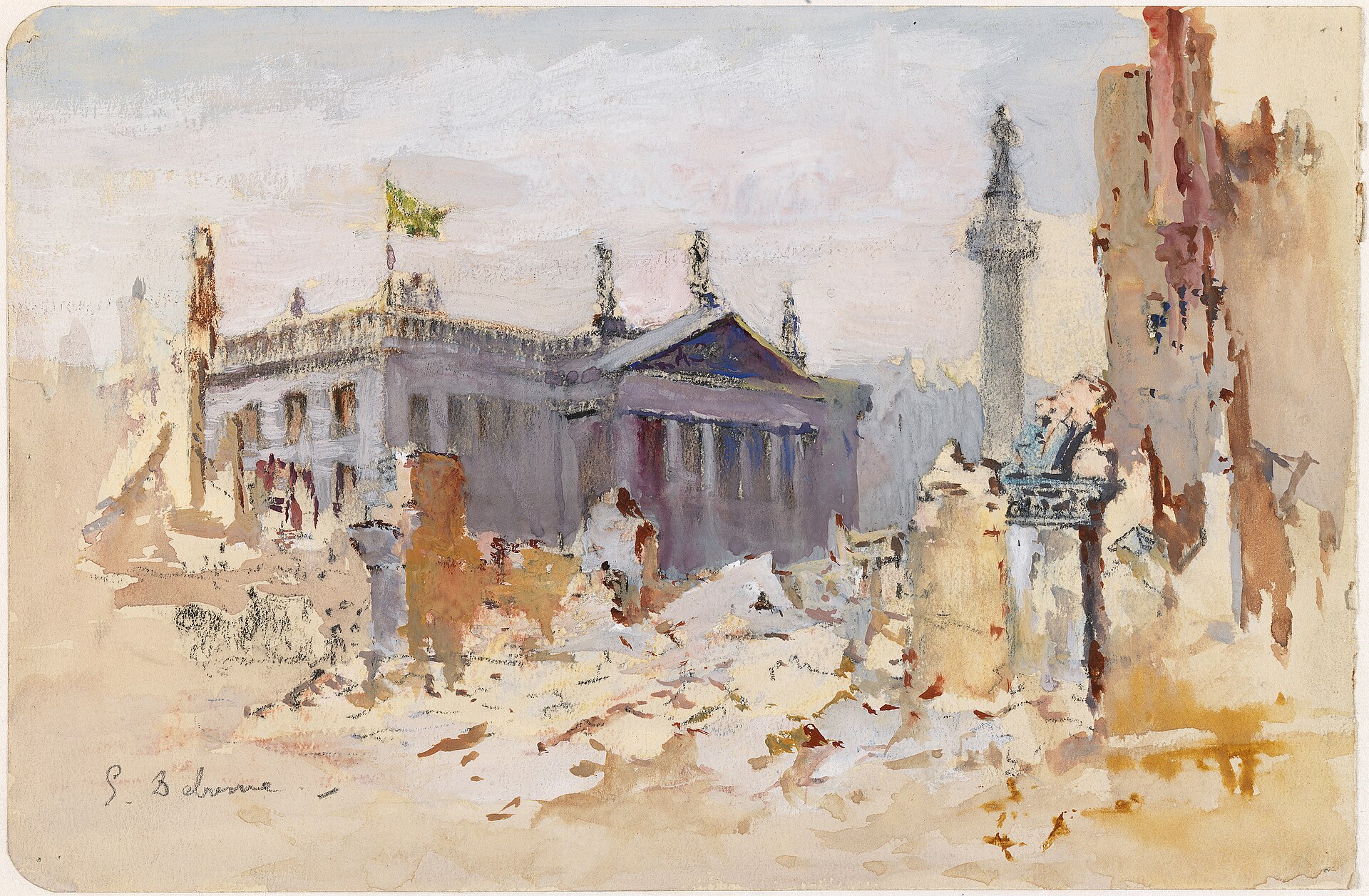
Watercolour
Sackville Street in ruins, 1916
The General Post Office after the Rising, with the rebels’ flag still flying over it.
Edmond Delrenne, 1916. National Gallery of Ireland (public domain)
The man in charge of them is a young officer, Captain Percival Lea-Wilson.
SFX: Night. A crowd of men, coughing, groaning. Boots on gravel. A sharp voice barking orders.
What happened on that patch of grass was described afterwards by several of the men who were there.
Lea-Wilson's treatment of them was harsh, even cruel by some accounts.
He wouldn't let the wounded be moved. Men were made to relieve themselves where they lay.
Eyewitnesses say he singled out one man in particular.
SFX: Crowd noise drops away.
Tom Clarke was 58 years old. A veteran Fenian. He'd already spent fifteen years in English prisons for the cause, and he was one of the men who signed the Proclamation of the Republic.
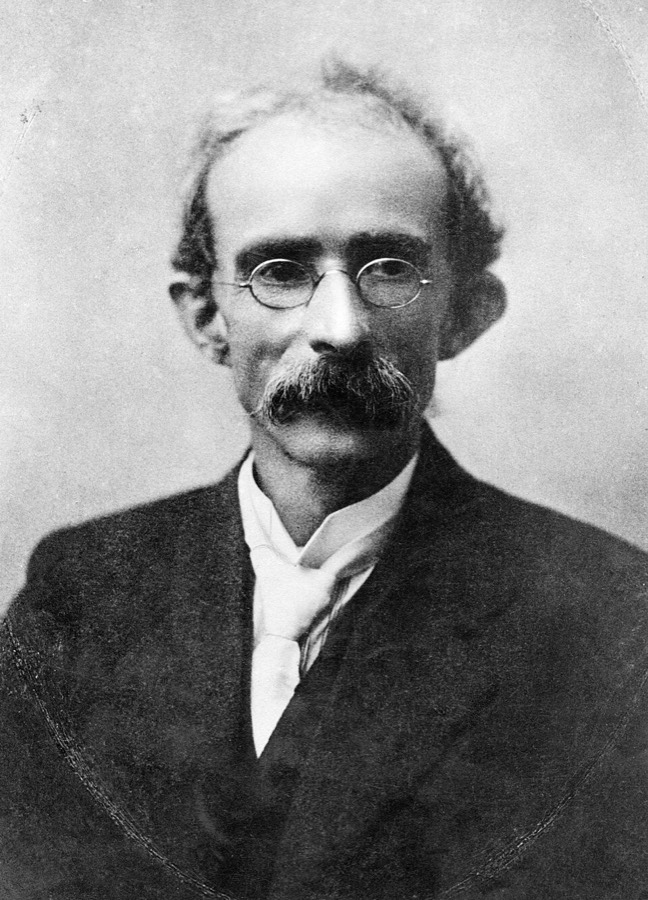
Photograph
Tom Clarke, c.1910
The veteran Fenian Lea-Wilson is said to have humiliated at the Rotunda in 1916
According to the accounts, Lea-Wilson had Clarke and several others stripped and searched, in front of their comrades. Some say in front of the nurses watching from the hospital windows.
An old man, a hero to every one of the men around him, stripped on the grass on a British officer's orders.
One Volunteer officer, Frank Henderson, put it plainly. "In particular," he said, "Captain Lea-Wilson was brutal."
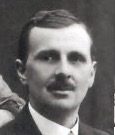
Photograph
Frank Henderson
Officer in the Dublin Brigade of the IRA.
Within a few days, Tom Clarke was taken to Kilmainham Gaol and shot by firing squad.
SFX: A single volley, distant. Silence.
Among the men held in the Rotunda grounds that night were Liam Tobin and Michael Collins.
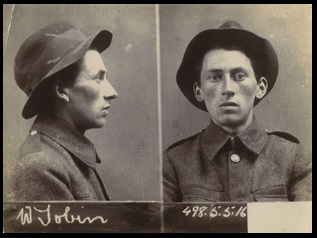
Photograph
Liam Tobin, 1916
His arrest photograph after the Rising. Within three years he was Collins’s deputy director of intelligence.
Image: via Irish Family Detective (irishfamilydetective.ie)
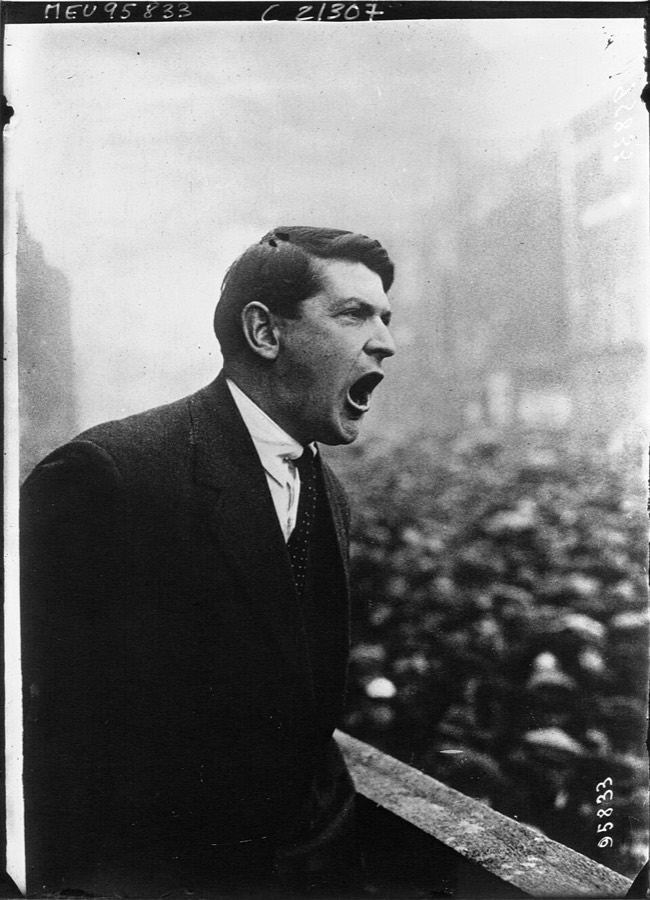
Photograph
Michael Collins, 1922
Director of Intelligence of the IRA, who ordered the Gorey operation
Tobin was lying on the damp grass with a bad cramp in his legs. He remembered Lea-Wilson walking round and round the prisoners, in uniform, but wearing a smoking cap with a fancy tassel hanging out of it. Every so often he’d stop and ask his soldiers, “Whom do you consider worst, the Boches or the Sinn Feiners?”
(The Germans, or the Irish rebels lying on the grass in front of them.)
The soldiers always said the Sinn Feiners.
Another prisoner asked if the young fellow with the cramp could stand up.
Lea-Wilson said, “No, let the so-and-so stay where he is.”
Years later, Tobin wrote: “I looked at him and I registered a vow to myself that I would deal with him at some time in the future.”
Collins never forgot it either.
Within three years, Collins would be running the IRA's intelligence war against the British in Ireland. And his right-hand man in that war, his deputy director of intelligence, would be Liam Tobin.
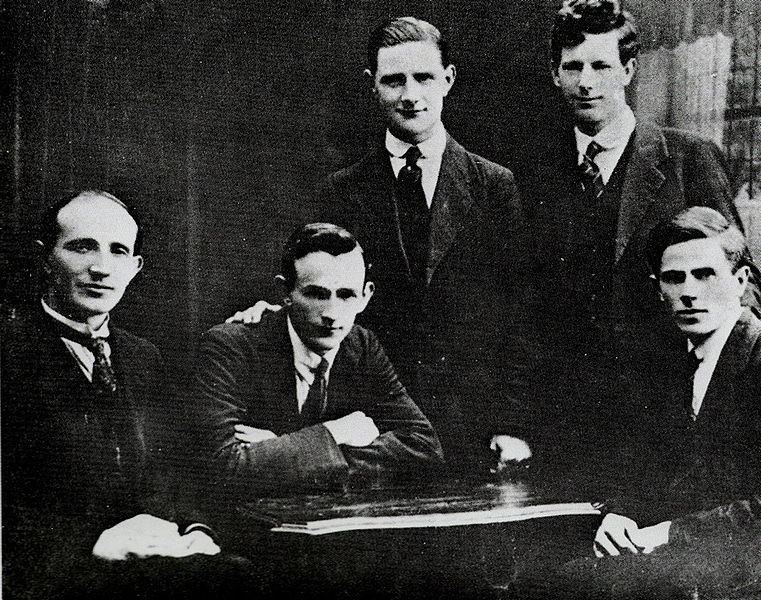
Photograph
Members of the Squad
Mick McDonnell, Liam Tobin, Vinny Byrne, Paddy Daly and Jim Slattery. Collins’s unit in Dublin, attached to his intelligence department.
SFX: Low drone.
In Caravaggio's Rome, a humiliation couldn't just be forgotten.
It had to be answered with a sword.
Outside the Rotunda, Tobin watched an old man stripped and mocked in front of his comrades. And he made the same calculation a Roman swordsman would have made.
The debt would have to be paid.
Four years after the Rotunda, Collins sent Tobin to Gorey to collect it.
SFX: Music sting.
Act 2
SFX: Rome street at night. A tavern door opening, laughter spilling out. Dice on a table.
Rome, 1593.
Caravaggio is twenty-one, broke, and moving from one rented room to the next. He'll move about ten times in his first three years in the city.
He paints heads for a Sicilian shopkeeper. Saints, character types, copies of popular pictures. Mass-produced and sold cheap. He’s paid a few coins apiece and churns out three a day.
He lodges for a while with a priest who's so stingy, Caravaggio nicknames him "Monsignor Salad", after the only thing he's ever given to eat.
Then he gets a break. Of sorts.
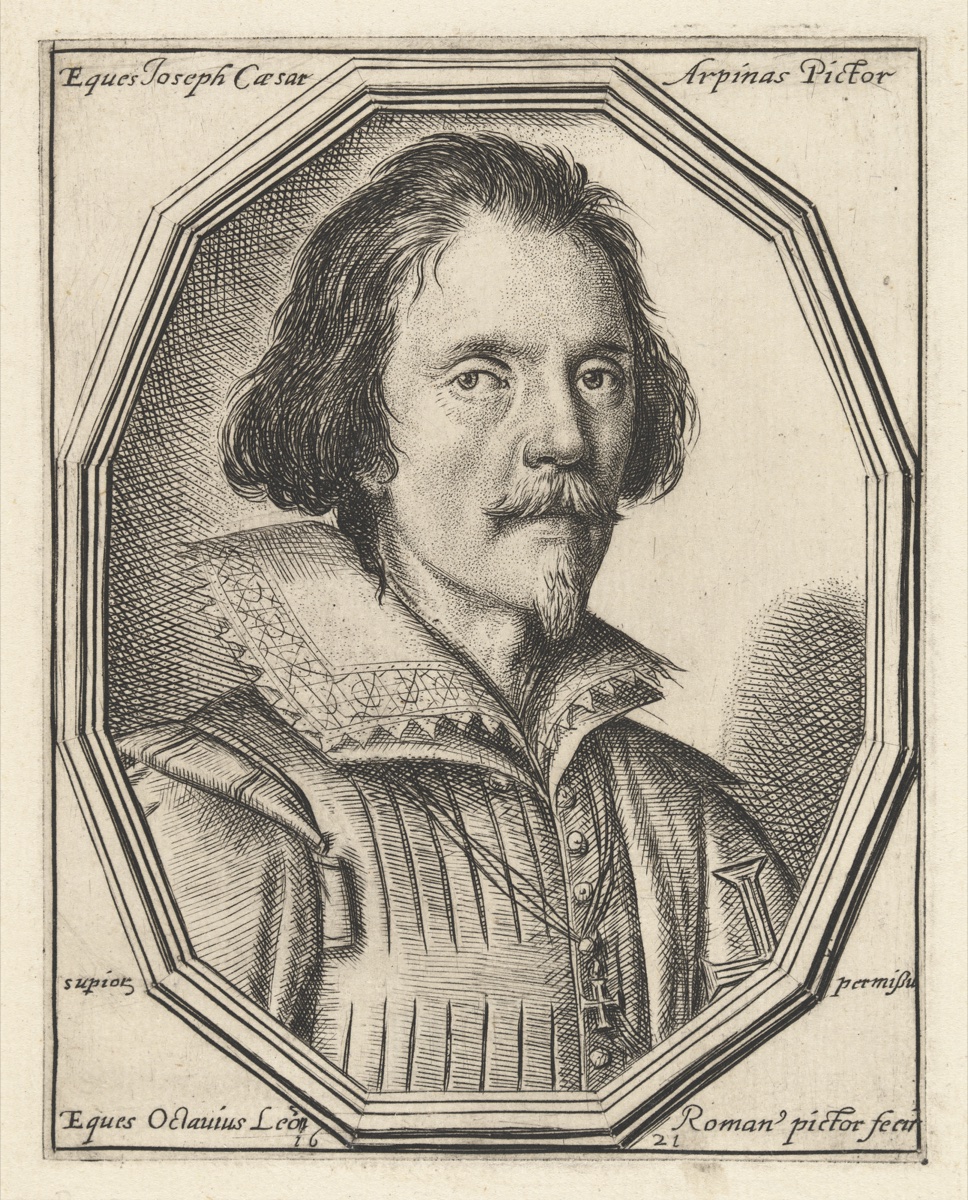
He's taken on in the workshop of Giuseppe Cesari, the Pope's favourite painter. The most fashionable studio in Rome.
Engraving
Giuseppe Cesari, the Cavaliere d’Arpino
Engraved from life by Ottavio Leoni in 1621.
And Cesari puts him on flowers and fruit.
In the art world of the time, there's a strict pecking order of subjects. At the top are gods, saints and heroes. At the very bottom, below portraits and below landscapes, is fruit.
Caravaggio hates it.
His time at Cesari's ends the way a lot of things in his life end. Badly, and slightly mysteriously. One of the early biographers says Cesari had to hide him at one point, but doesn't say why. Then a horse kicks him in the leg, he's carried off to the hospital of the Consolazione, and he never goes back.
SFX: Footsteps on cobbles. A shop bell.
So he strikes out on his own.
And at first, nobody buys anything.
Then a picture dealer called Costantino Spata takes a couple of his paintings to sell.
And through Spata, they reach a cardinal.
SFX: Music. A lute, a solo voice.
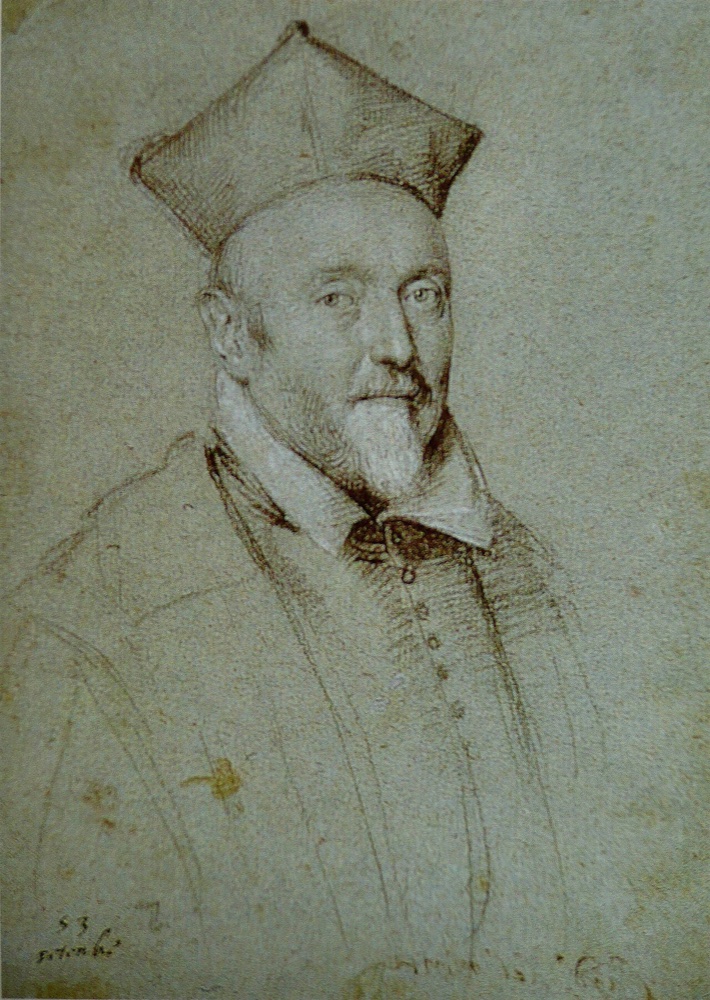
Cardinal Francesco Maria del Monte is about as cultured as a man in Rome can be.
Portrait
Cardinal Francesco Maria del Monte
Drawn by Ottavio Leoni in 1616.
Ottavio Leoni, Ringling Museum of Art, Sarasota (public domain) ↗
He was born in Venice, and the painter Titian came to his baptism. He's the right-hand man of the Medici family, who made him a cardinal to look after their interests in Rome. He owns around six hundred paintings. He loves music. He's a friend and supporter of Galileo. And in his spare time, he's an amateur alchemist.
The paintings Spata shows him are nothing like anything else in Rome.
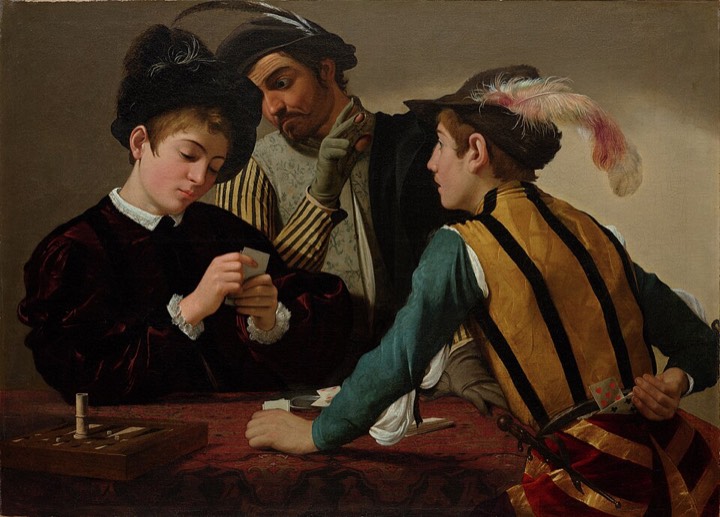
The first is The Cardsharps.
Painting
The Cardsharps
Kimbell Art Museum, Fort Worth
One of the two pictures that reached Cardinal del Monte through the dealer Costantino Spata.
A wide-eyed young man, a bit of a rich kid, is playing cards. Across the table, a young cheat is reaching behind his back for a card he's tucked into his belt. And behind the mark's shoulder stands an older man in torn gloves, peering at the young man's hand and signalling to his partner with his fingers.
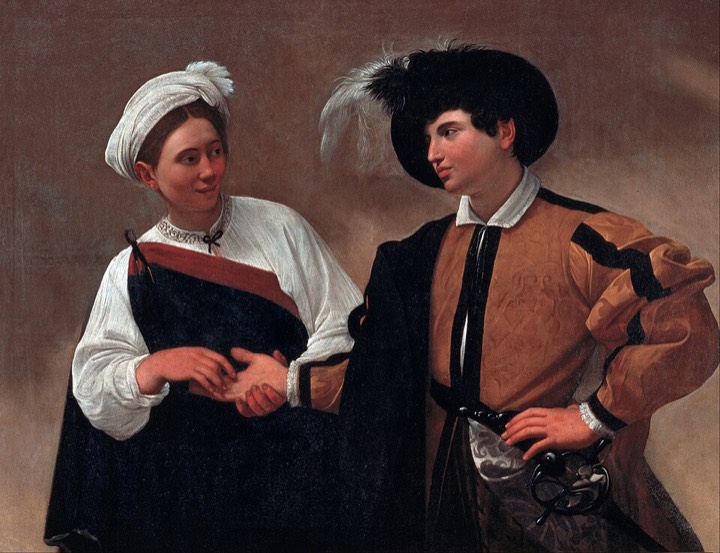
The second is The Fortune Teller.
Painting
The Fortune Teller
Capitoline Museums, Rome
The gypsy girl slides the ring off the young man’s finger while she reads his palm.
A dashing young man holds out his palm to a pretty gypsy girl. She gazes into his eyes, and gently strokes his hand. And while she does, she's sliding the ring off his finger.
They're funny. They're sly. And they're about the kind of people Caravaggio actually knows: hustlers, chancers, people living on their wits on the streets of Rome.
Nobody has painted the low life like this before. Within a few years, painters all over Europe will be copying the idea.
Del Monte buys both.
And in the autumn of 1595, he invites the painter to come and live in his palace.
SFX: A heavy door closing. The street noise cut off. Quiet.
Caravaggio is twenty-four.
For the first time since he was a small boy, somebody is looking after him. Del Monte is the closest thing to a father he's had since the plague.
He gets a room, meals, materials, and something he's never had before: time.
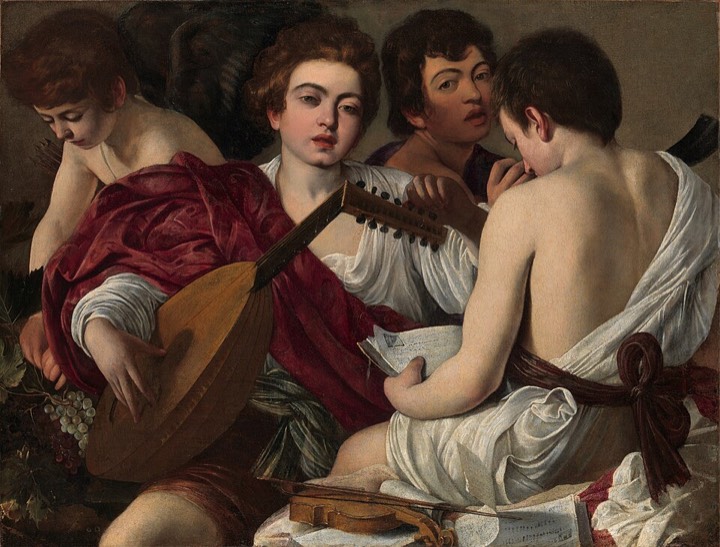
He paints The Musicians. Four young men, half-dressed in loose classical robes, crowded together, tuning up and rehearsing. One of them, at the back, holding a horn, is Caravaggio himself. The lute player is probably his friend Mario Minniti, a Sicilian painter who's also one of his favourite models.
 Boy with a Basket of FruitThe Fortune TellerThe MusiciansThe Lute PlayerBacchus
Paintings
Mario Minniti as Caravaggio’s model
The paintings he is usually identified in: the boy with the fruit, the young man having his palm read, the lute players and Bacchus.
Painting
The Musicians
Metropolitan Museum of Art, New York
Painted in del Monte’s palace. Caravaggio is the young man at the back with the horn.
It's a picture made for one particular audience: a cardinal who loves music, sitting in his own palace, watching his household rehearse.
Over the next few years he starts to develop the style that will make him famous. He darkens his backgrounds. He lights his figures with a single, hard light from high up and to one side, like a lamp in a closed room. He doesn't make drawings first. He scores outlines straight into the wet paint, and he paints from real people, posed in front of him.
SFX: Back out on the street. Night. A sword being drawn.
But there are two Caravaggios now.
By day he's the cardinal's painter.
By night he's out with a gang of painters, architects and hangers-on, drinking, gambling and looking for trouble.
In 1598 he's stopped by the police late at night, carrying a sword without a licence. He tells them, as if that settles it, that he's the painter of Cardinal del Monte.
A Dutch writer who heard about him at the time summed him up like this. He paints for two weeks, he said, and then he swaggers around for a month or two with a sword at his side and a servant at his heels, going from one ball court to the next, always ready to argue or fight.
Among the people he spends his nights with is a young woman called Fillide Melandroni. She came to Rome from Siena and was working as a prostitute by the age of thirteen. She becomes one of his favourite models.
 Portrait of FillideSt Catherine of AlexandriaJudith Beheading HolofernesMartha and Mary Magdalene
Paintings
Fillide as Caravaggio’s model
Her own portrait, destroyed in Berlin in 1945, then Fillide as St Catherine, as Judith, and as Mary Magdalene on the right.
In December 1600, Fillide ends up in court. She’s attacked another prostitute with a knife.
The fight was over a man. Fillide was jealous because the other woman had been seeing her pimp.
His name is Ranuccio Tomassoni.
SFX: Church interior. Footsteps echoing. Scaffolding creaking.
In July 1599, with del Monte pulling strings, Caravaggio lands the biggest job of his life.
In the French national church in Rome, San Luigi dei Francesi, there's a side chapel that's been sitting unfinished for decades. It belonged to a French cardinal, Matthieu Cointrel, or Contarelli as the Italians called him. He left money for it to be decorated with scenes from the life of his namesake, St Matthew.
Caravaggio is hired to paint two huge canvases for the walls.
He has never painted more than four figures in one picture before. These canvases are over ten feet wide.
He does it anyway.
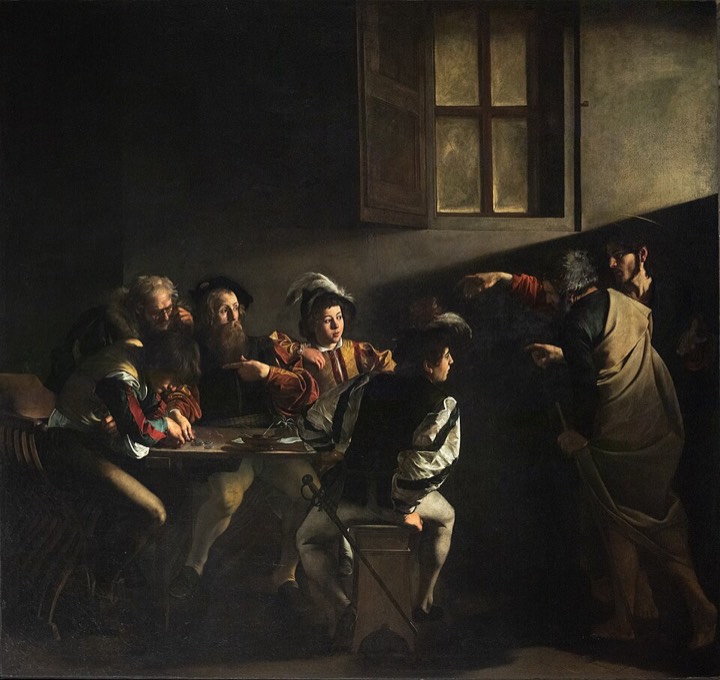
The first is The Calling of St Matthew.
Painting
The Calling of St Matthew
Contarelli Chapel, San Luigi dei Francesi, Rome
His first big public commission.
It isn't set in ancient Palestine. It's set in a dingy room in Rome, in his own time. A group of tax collectors sit around a table, counting money. A couple of them are dressed like the young dandies from The Cardsharps.
Then a beam of light falls across the wall. And from the shadows on the right, Christ points at Matthew.
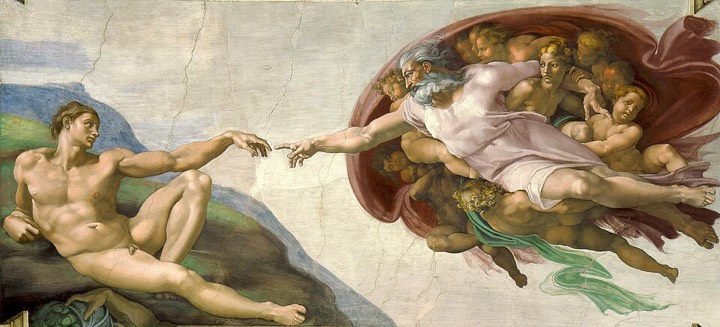
Christ's hand is a deliberate echo of Adam's hand on the ceiling of the Sistine Chapel. The idea is that Christ is a second Adam, come to give mankind a second chance.
Painting
The Creation of Adam
Sistine Chapel ceiling, Vatican
Adam’s hand is echoed in Christ’s pointing hand in The Calling of St Matthew.
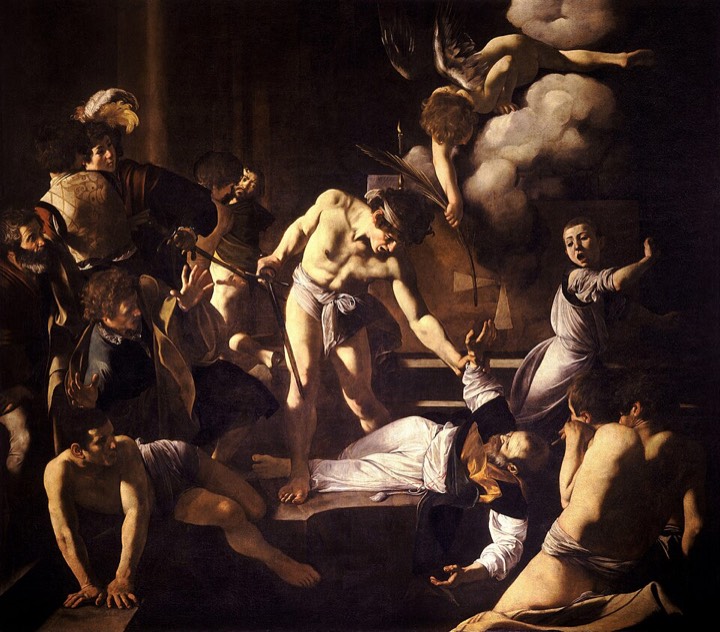
The second picture is The Martyrdom of St Matthew. The saint has been knocked to the ground beside an altar, and a half-naked executioner stands over him with a sword. Everyone around them scatters.
Painting
The Martyrdom of St Matthew
Contarelli Chapel, San Luigi dei Francesi, Rome
Caravaggio paints himself in the background, looking back as he runs from the killing.
And in the background, looking back over his shoulder as he runs away, is Caravaggio. A witness, slipping out of the scene.
When the paintings are unveiled in 1600, Rome comes to see them.
Some of the old guard sneer. The head of the painters' academy, Federico Zuccaro, looks at them and says he can't see what the fuss is about, it's just Giorgione warmed over. A crude kind of realism.
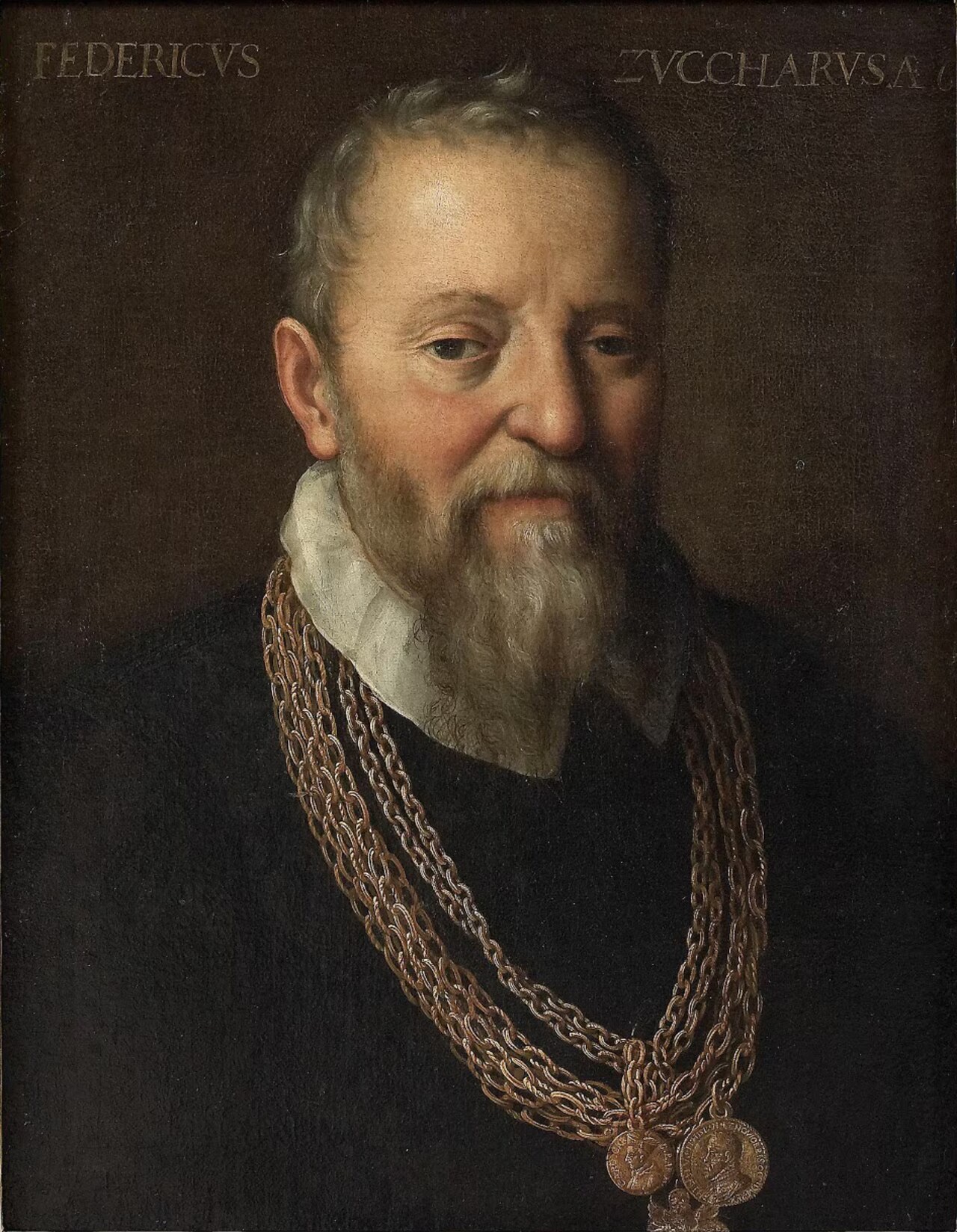
Portrait
Federico Zuccaro
Head of the painters’ academy in Rome. Painted by Fede Galizia in 1604.
But almost overnight, Caravaggio is the most talked-about painter in Rome.
Collectors queue up for him. Cardinals want him. Rival painters start copying him.
And he starts making enemies at the same speed he's making money.
Not long after the unveiling, he ambushes a young academy student who's probably been repeating Zuccaro's insult, and beats him with a stick. Around the same time, he wounds a former soldier in a sword fight.
Caravaggio’s talent and his powerful patrons keep getting him out of trouble. But it won’t stay this way.
SFX: Rain. A train pulling into a country station. A dog barking in the distance.
Ireland, after the Rising.
Marie Lea-Wilson was born Marie Ryan, in Charleville, County Cork, in 1887. Her family were comfortable, Catholic, professional people. Her father was a solicitor.
By marrying Percival, she'd stepped outside her world in more ways than one. She'd married a Protestant. An Englishman. And a policeman.
In 1914, that was unusual.
Within a few years, it would put her on the wrong side of a line that was being drawn right through Irish life.
SFX: Crowd noise. A brass band. Election-night cheering.
The Easter Rising was put down in a week. But the executions that followed turned a lot of Irish opinion in favour of the rebels and their cause.
In the general election of December 1918, the old Irish Parliamentary Party, which had spent decades pushing for Home Rule, is almost wiped out. Sinn Féin wins most of the Irish seats.
Its new MPs refuse to take their seats in London. Instead, in January 1919, they meet in the Mansion House in Dublin and declare themselves Dáil Éireann, the parliament and government of an independent Irish Republic.
SFX: Gunshots. Two, close together. Then silence.
On the very same day the Dáil first meets, at a quarry called Soloheadbeg in County Tipperary, a group of Volunteers ambushes a cart carrying gelignite. Two RIC constables escorting it are shot dead.
Nobody ordered it from Dublin. But it's the first shot of what will become the War of Independence.
SFX: Low drone.
The IRA has worked out something important. The RIC is the British government's eyes and ears in every town and village in Ireland. Every barracks, every sergeant and every constable knows who lives where, who's been to which meeting, and who's been talking.
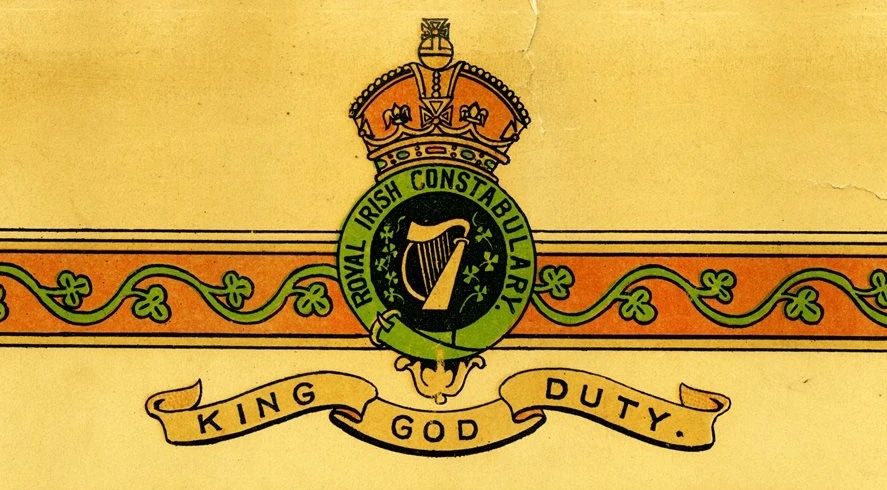
Emblem
The crest of the Royal Irish Constabulary
The crowned harp and shamrocks of the RIC, with its motto “King, God, Duty”. Detail from the 1920 commemoration poster for Percival Lea-Wilson.
National Museum of Ireland, HE:EWT.417
Blind the RIC, and Britain can't govern Ireland.
So the RIC becomes their main target.
Barracks in the countryside are attacked and burned. Constables are ambushed on lonely roads. And in Dublin, Michael Collins, now the IRA's Director of Intelligence, puts together a small, secret unit of gunmen. It comes to be known simply as the Squad. Its job is to kill the detectives, informers and officers who work for the enemy.
SFX: A shop door bell. Silence where there should be conversation.
The Dail also uses non-violent tactics to undermine British rule wherever they can.
In April 1919, the Dáil calls on the Irish people to ostracise the RIC.
Don't speak to them.
Don't serve them in shops.
Don't sell them food.
Don't let your daughters walk out with them.
Policemen's wives find that neighbours they've known for years cross the road to avoid them. Shopkeepers refuse to serve them. Their children are picked on at school.
Hundreds of Irish constables simply resign.
To replace them, Britain starts recruiting in England. Most of the new men are ex-soldiers, back from the Western Front, with no jobs and no idea of Ireland. There aren't enough uniforms to go round, so they're kitted out in a mix of army khaki and police dark green. The Irish nickname them the Black and Tans.
They start arriving in the spring of 1920.
SFX: A quiet country lane. Birdsong. A front door opening and closing.
By then, the Lea-Wilsons are living at Westmount, a house at Knockmullen, just outside the town of Gorey in north Wexford.
Percival is the District Inspector. He's in charge of the police across a whole district. He will not be intimidated into resigning.
Marie is an Irish Catholic, married to the man in charge of the police, in a county where the police are now the enemy.
Act 3
SFX: A heavy palace door. Footsteps across marble. A clock ticking in a quiet room.
Rome, 1601.
Caravaggio has a new home.
He leaves Cardinal del Monte's palace and moves in with another powerful family, the Mattei. Their palace is a short walk away, near the old Jewish quarter.
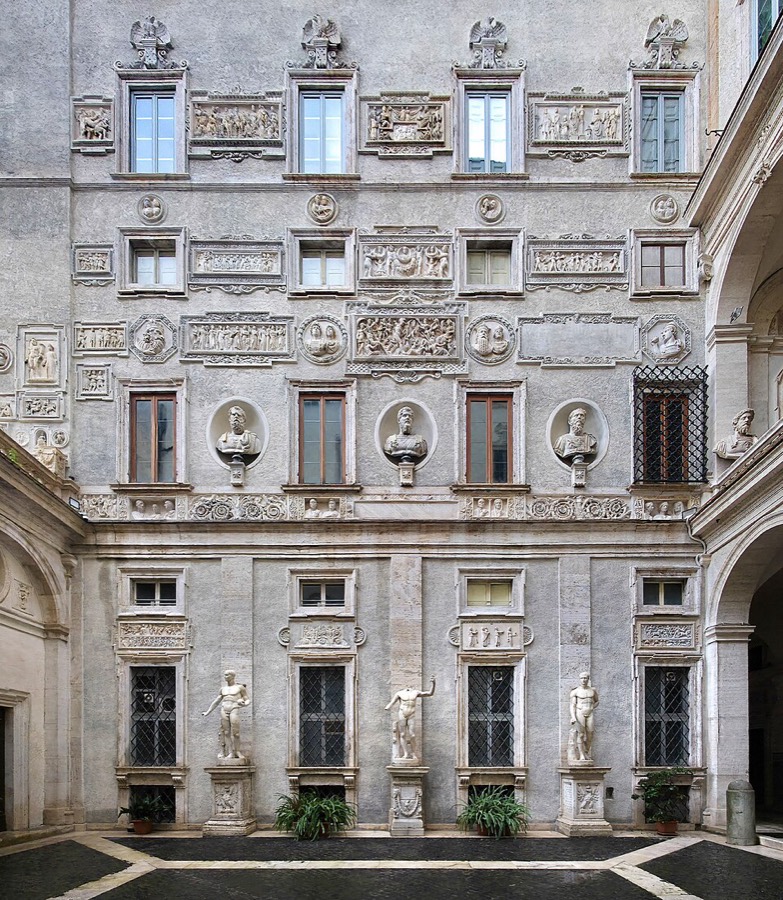
Photograph
Palazzo Mattei di Giove, Rome
The courtyard of the palace built for Ciriaco’s brother Asdrubale, in the family’s cluster of palaces near Piazza Mattei.
There are three Mattei brothers. One is a cardinal, Girolamo.
Another is Ciriaco. He's a nobleman, a magistrate of the city, and one of the great collectors of his age.
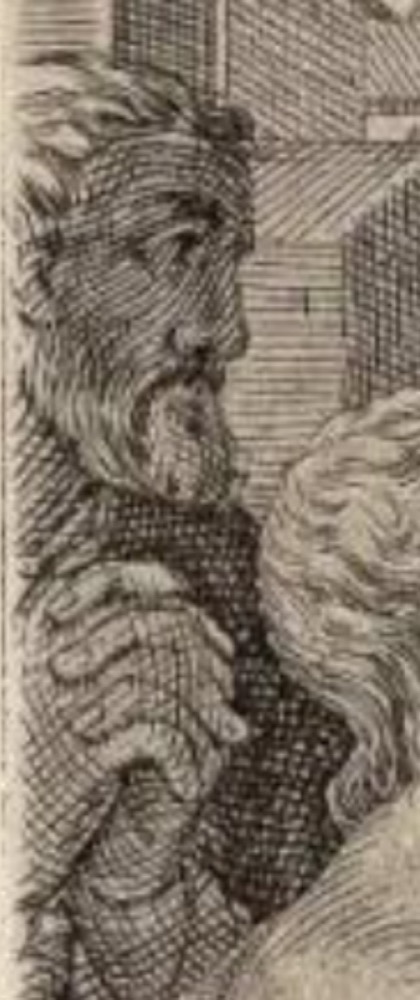
Portrait
Ciriaco Mattei, probably
He commissioned The Taking of Christ in 1602. This is thought to be him, in an engraving of 1596.
Marco Antonio Grecchi, Sant’Ansano Baptising the Sienese, 1596 (detail, public domain) ↗
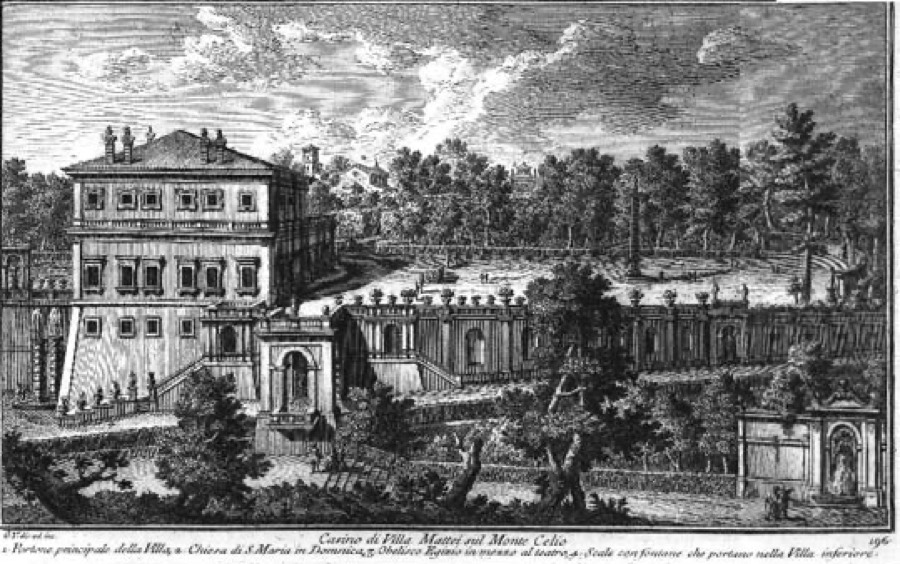
Giuseppe Vasi, Villa Celimontana, 1761
The garden villa Ciriaco Mattei began on the Caelian Hill in 1582
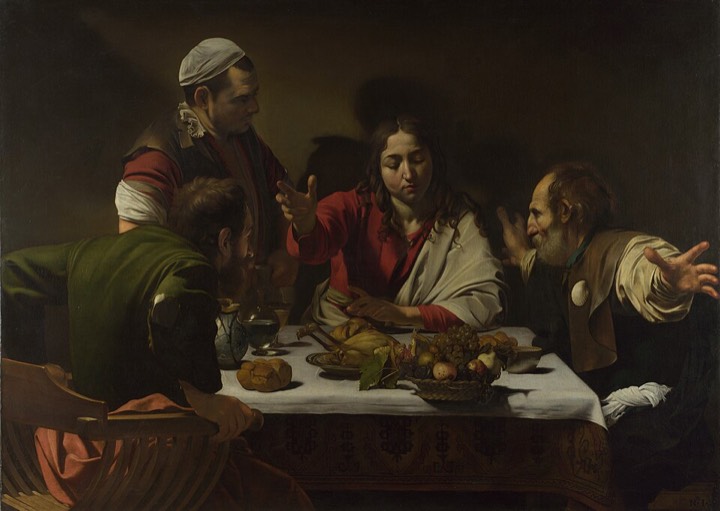
In January 1602, Ciriaco's account book records a payment of 150 scudi to Caravaggio for a painting of The Supper at Emmaus. That's the moment, after Jesus’ death, when two of his disciples sit down to eat with a stranger and suddenly realise who he is.
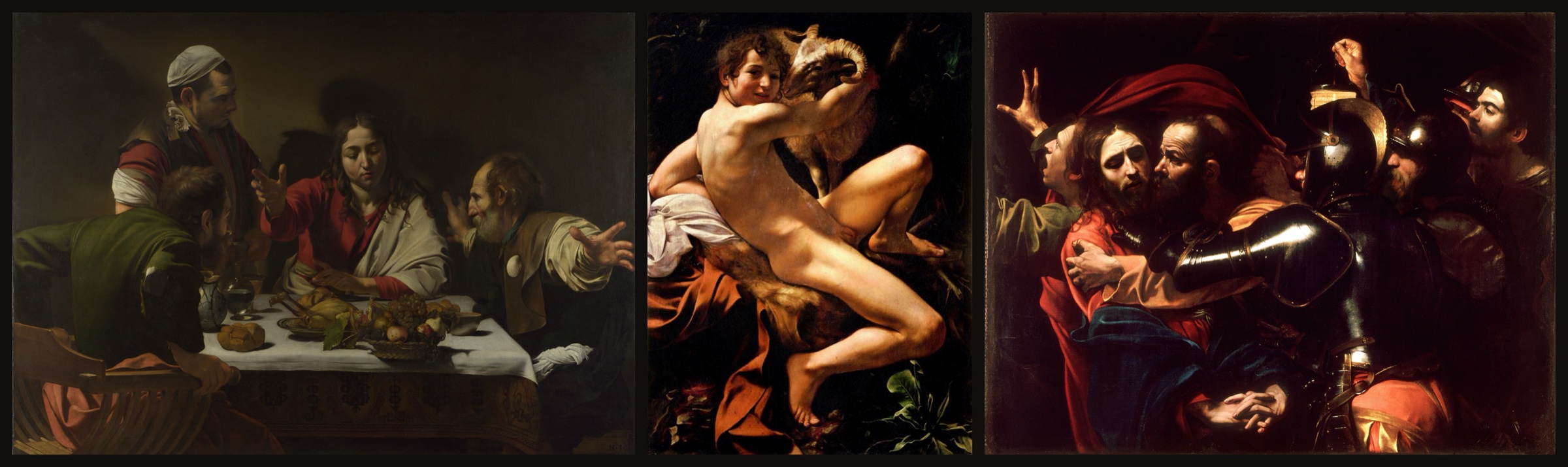 The Supper at Emmaus, 1601St John the Baptist, 1602The Taking of Christ, 1602
Paintings
Ciriaco Mattei’s commissions
London, Rome and Dublin
The three paintings Ciriaco Mattei paid Caravaggio for. They have not hung together since they left the Mattei palace.
Painting
The Supper at Emmaus
National Gallery, London
Bought by Ciriaco Mattei. The disciple flinging his arms wide is the same model as the soldier on the right of The Taking of Christ.
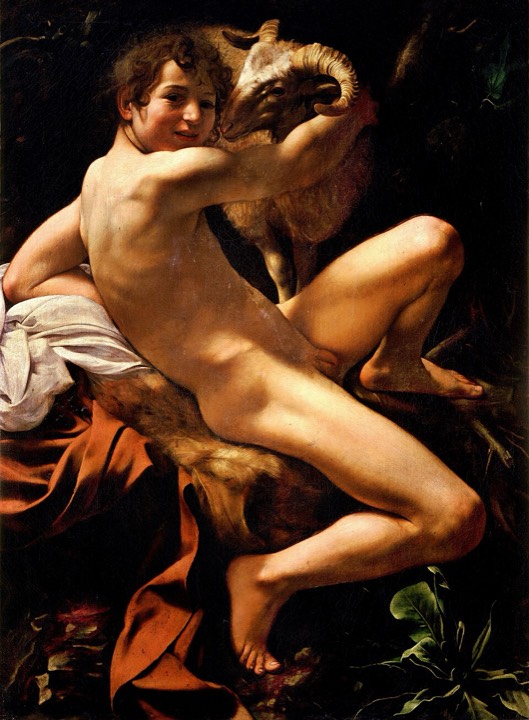
Next comes a laughing, naked young St John the Baptist with a ram.
Painting
St John the Baptist (Youth with a Ram)
Capitoline Museums, Rome
The second picture Ciriaco Mattei bought.
And on the second of January 1603, Ciriaco pays Caravaggio 125 scudi, frame included, for a third picture.
The Taking of Christ.
SFX: Night. A garden. Wind in olive trees. Distant voices, metal clinking.
It's the night of the arrest in the Garden of Gethsemane. Judas has led the soldiers to Jesus, and he's agreed a signal with them. The man he kisses is the man they want.
Every Gospel tells the story a little differently, and Caravaggio takes a piece from each. From Matthew, the armed crowd sent by the priests. From John, the lanterns and torches that make it a night scene. From Mark, the kiss as the agreed signal. And from Luke, the idea that Jesus knows exactly what's coming.
Painters had shown this moment many times before, usually as a great confused crowd scene. Caravaggio throws almost everything into darkness and leaves just a few figures in the light.
On the left, Judas has just kissed Jesus. His face is coarse, weathered, sunburnt. His hand is clamped on Jesus’ shoulder. And his brow is creased, as if he's already beginning to regret it.
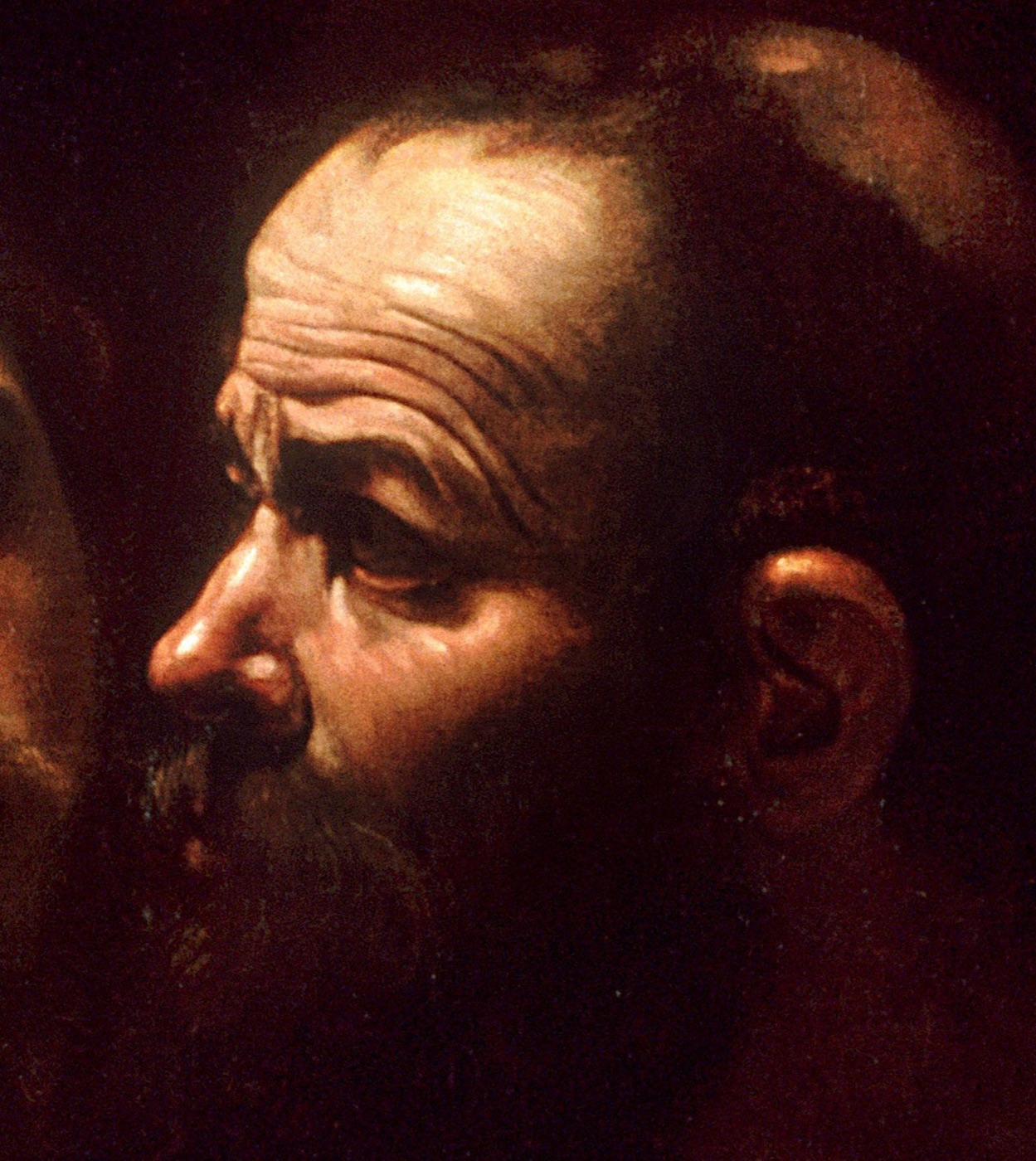
Close-up
Judas
His face is coarse, weathered and sunburnt, and his brow is creased, as if he’s already beginning to regret the kiss.
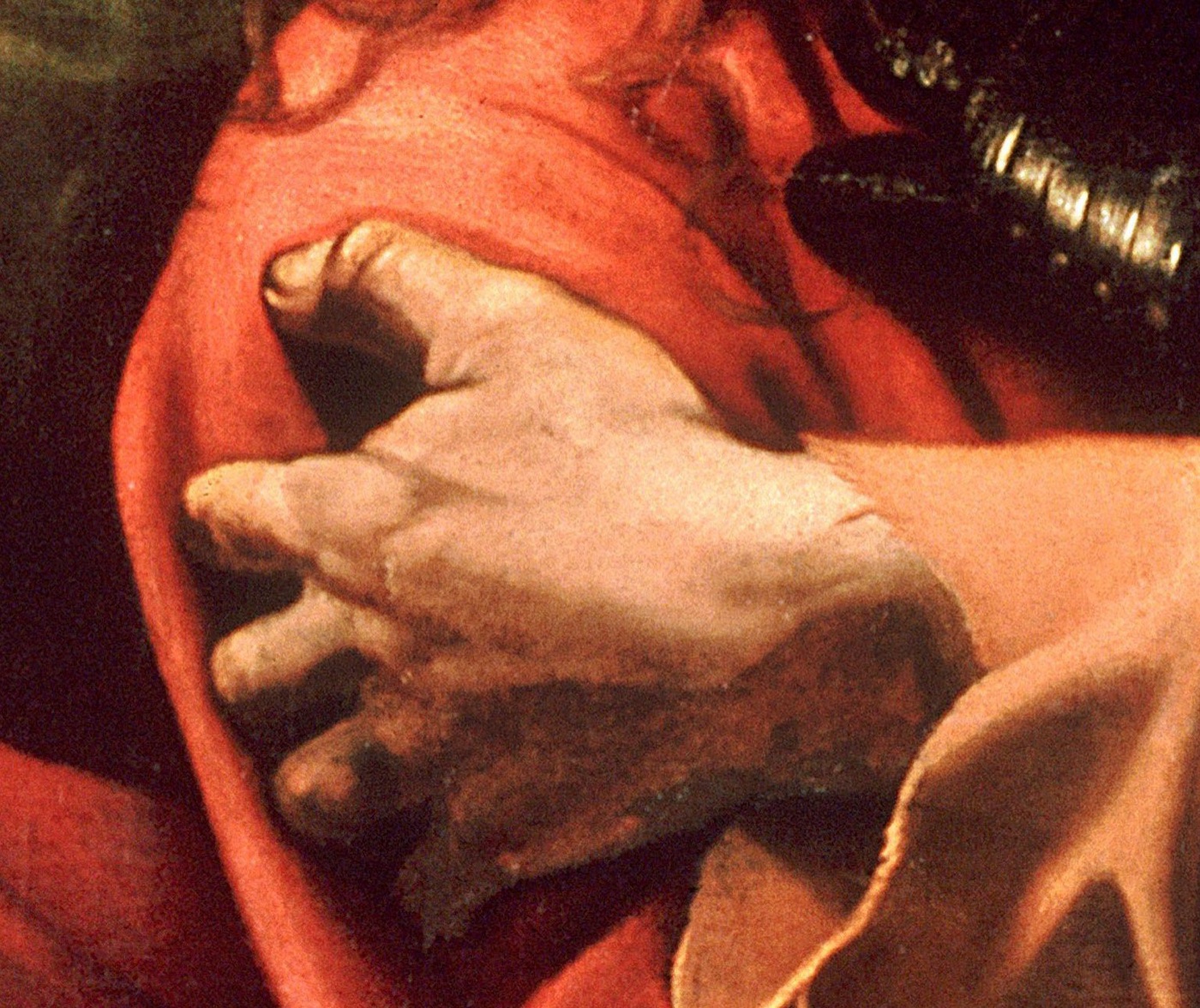
Close-up
Judas’s hand
Clamped on Jesus’s shoulder after the kiss.
An interesting detail about Judas that you can see with the naked eye in person is the position of Judas’ ear. It's been moved down. An adjustment made by Caravaggio, sloppily concealing the original placement. It's a detail that doesn't get repeated in later copies (more on which we’ll talk about later).
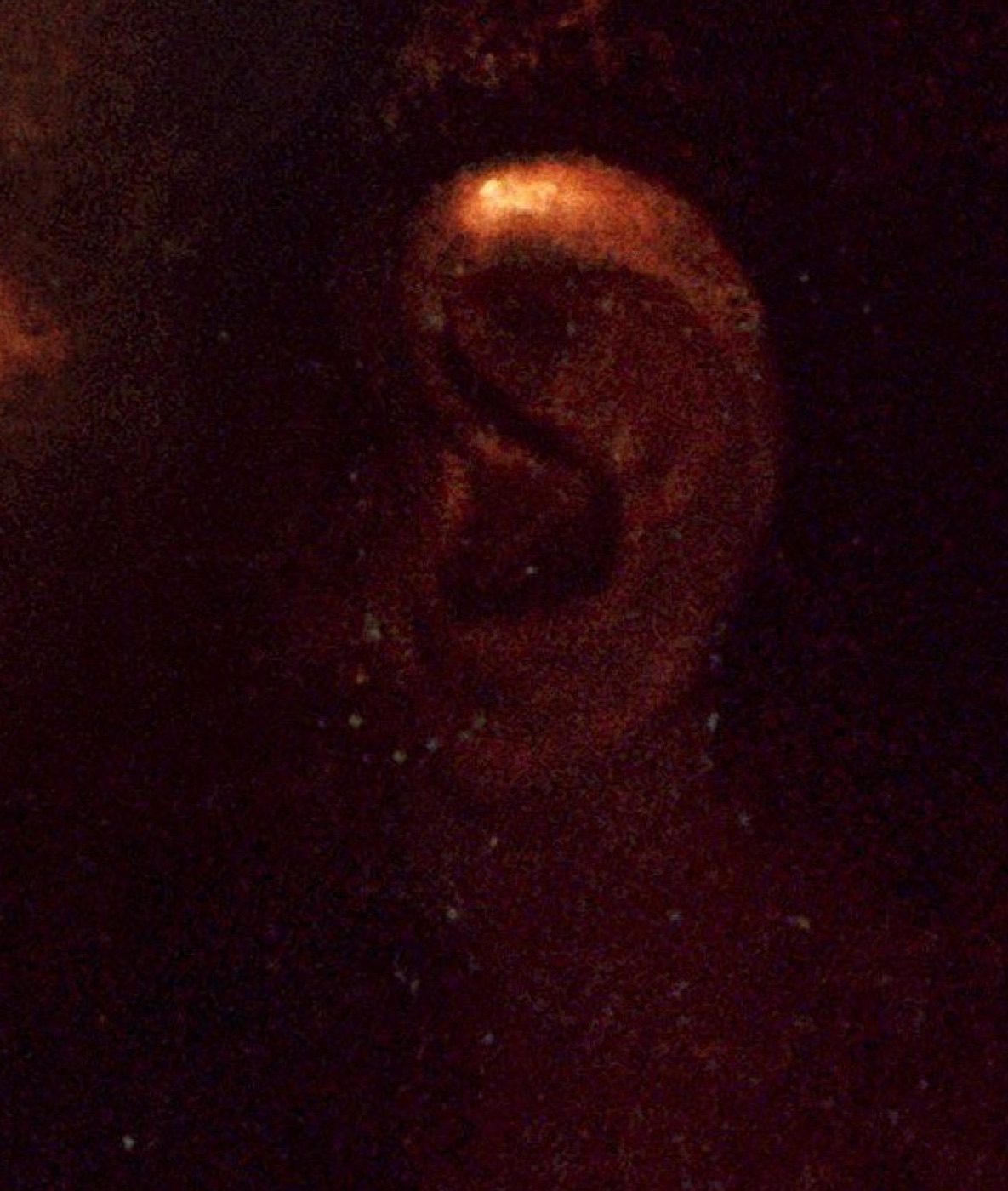
Close-up
Judas’s ear
The ear has been moved down. Look closely and you can see where Caravaggio painted over its first position.
Jesus is pale. His eyes are half-closed. He's pulling back from the kiss.
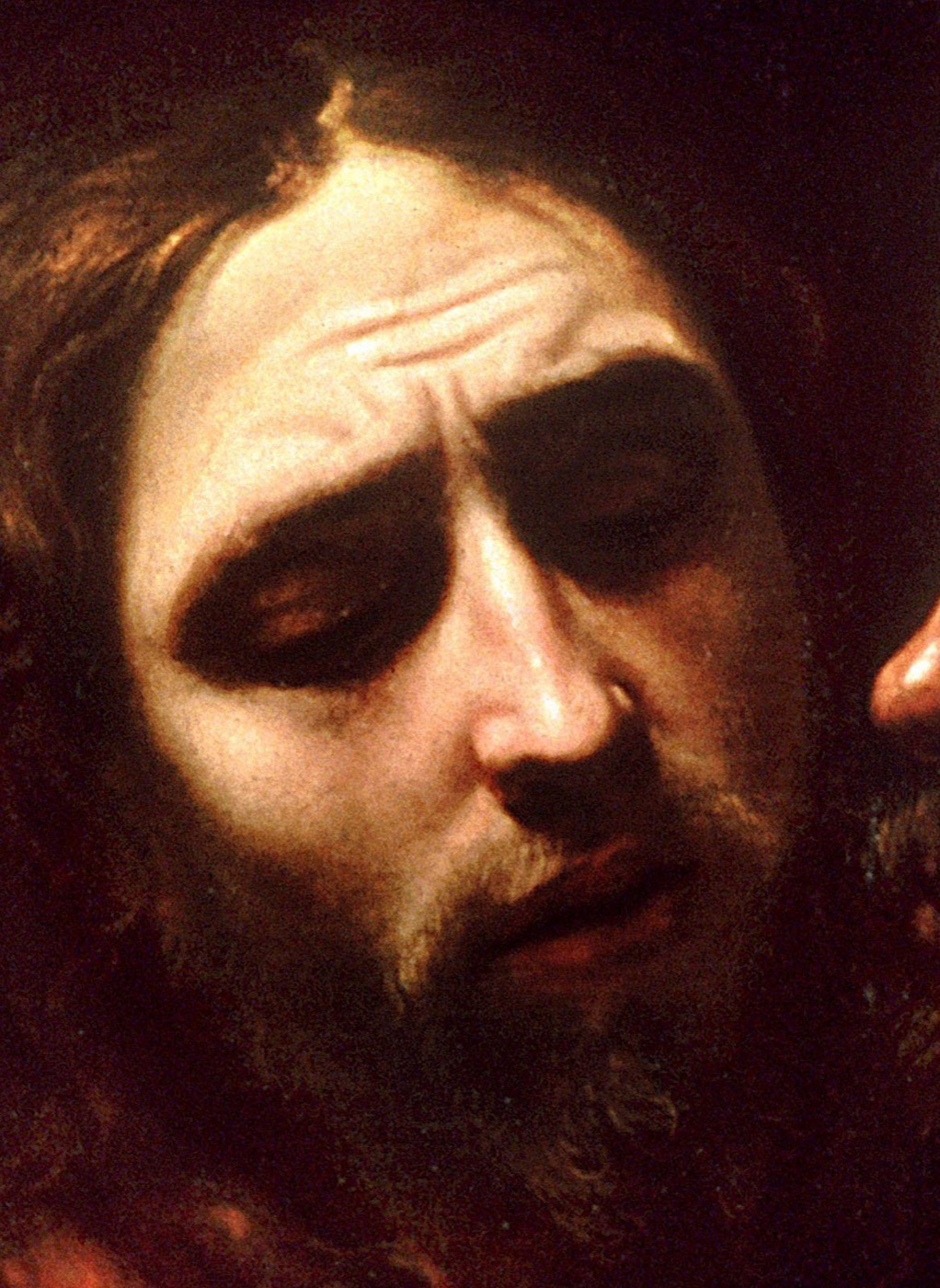
Close-up
Jesus
Pale, eyes half closed, pulling back from the kiss.
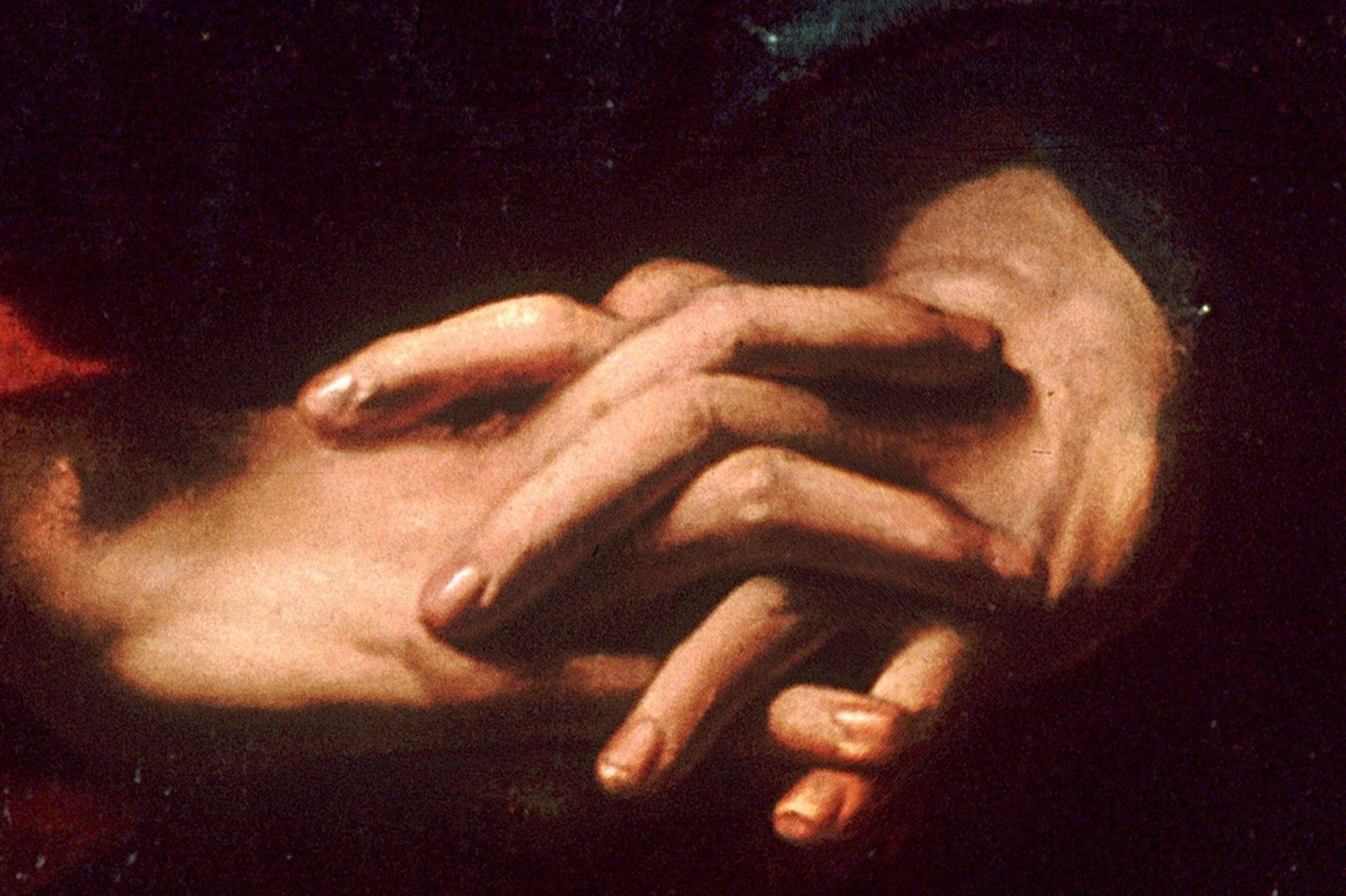
Jesus’ hands are lit on their own, at the bottom of the picture. His fingers are clasped together, and he pushes them away from his body. It isn't a struggle. It's surrender. He's giving himself up.
Close-up
Jesus’s hands
Lit on their own at the bottom of the picture, fingers clasped and pushed away from his body. Not a struggle: surrender.
SFX: Clatter of armour. A grunt.
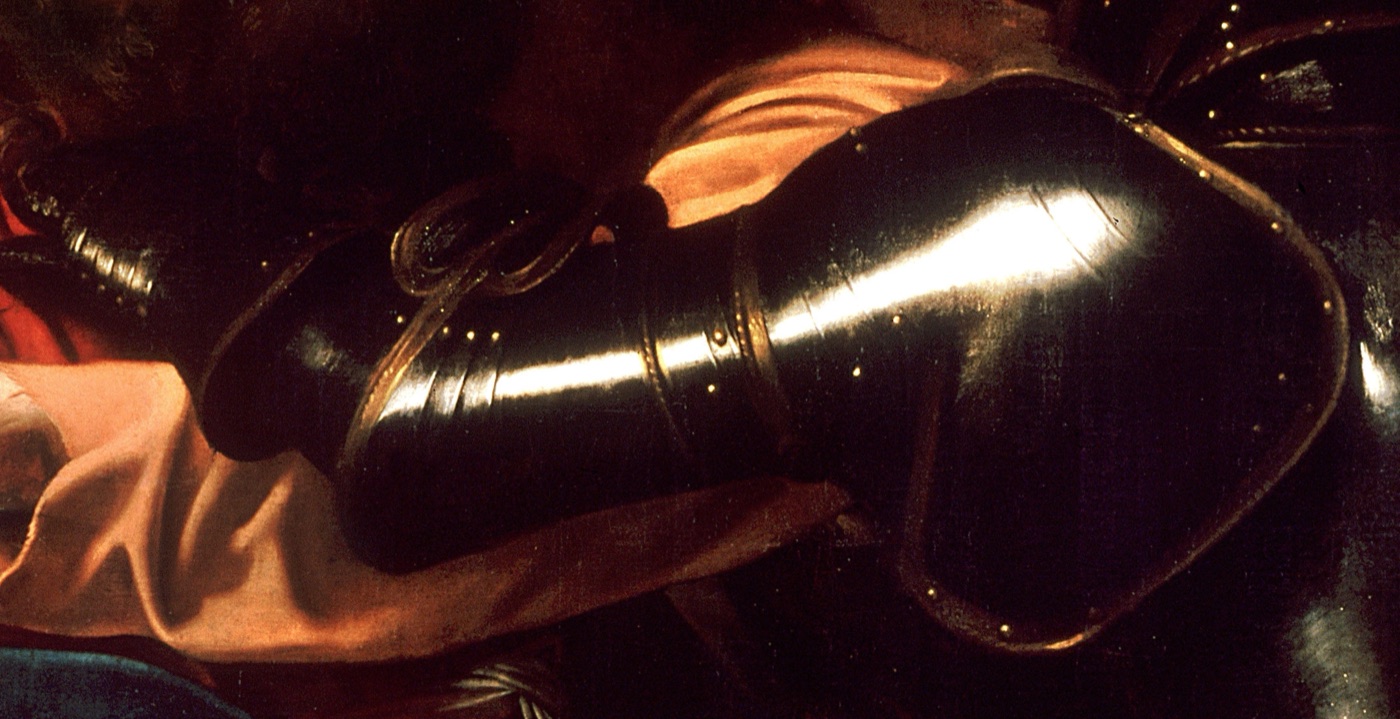
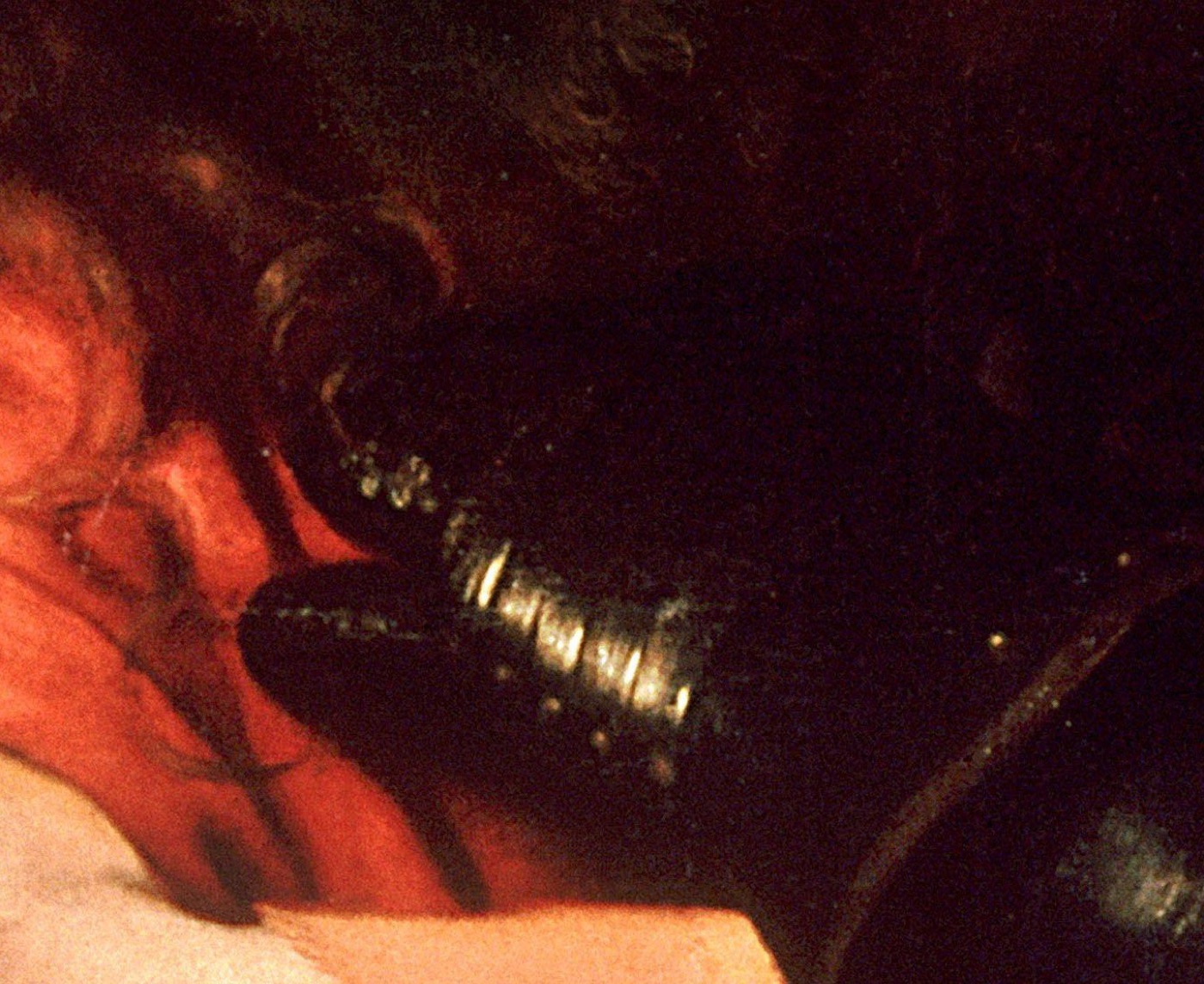
Coming in from the right are the soldiers. You hardly see their faces. They're all steel. Black, jointed armour, gleaming in the light like the shell of an insect. One armoured arm reaches right across the picture, and the black glove at the end of it points at Jesus’ throat, like a scorpion's sting.
Close-up
The soldier’s arm
Black, jointed armour gleaming like the shell of an insect, reaching right across the picture towards Jesus’s throat.
Close-up
The black glove
The soldier’s gauntlet pointing at Jesus’s throat.
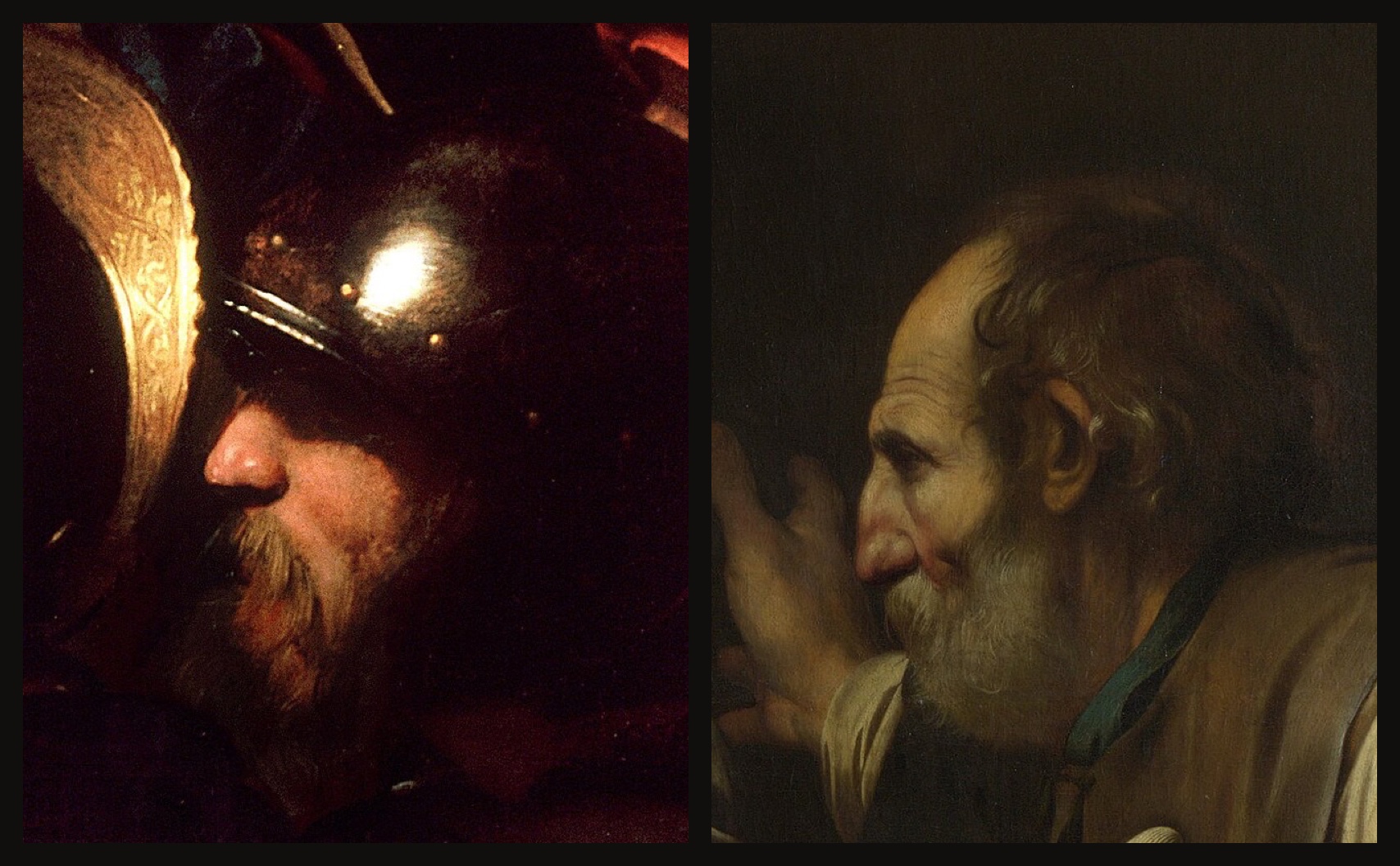
And there's a strange little detail in the soldier on the right.
Caravaggio painted from real people, posed in front of him. And the model he used for this soldier is the same man who plays one of the disciples in The Supper at Emmaus. In that picture he's thrown his arms wide in astonishment, the moment he recognises Jesus.
 The soldier, The Taking of ChristThe disciple, The Supper at Emmaus
Details
The same model, twice
Arresting Jesus in one painting, recognising him in the other.
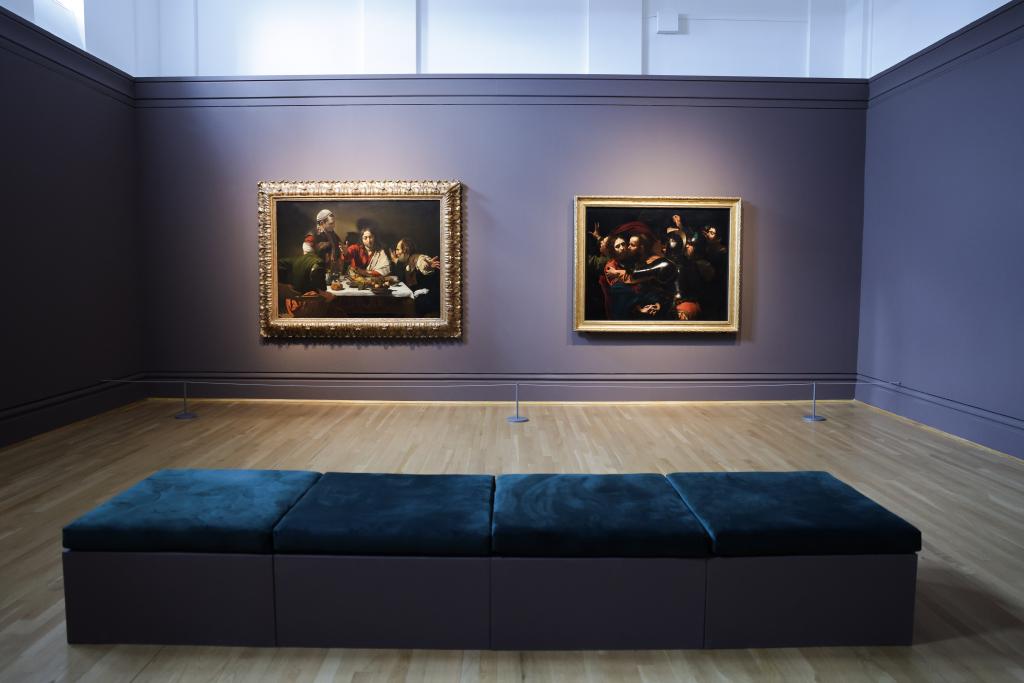
Photograph
The Supper at Emmaus and The Taking of Christ, Belfast, 2024
Reunited at the Ulster Museum, May to September 2024, for the first time since they left the Mattei palace.
Both paintings hung in Ciriaco Mattei's palace. So a visitor could walk from one room to the other and see the same face in two opposite roles. In one, a man recognising Jesus. In the other, a man arresting him.
Did Caravaggio do that on purpose? Maybe. The biographer Andrew Graham-Dixon wonders whether it was a bit of showing off, a way of letting the people who knew his method in on the trick.
SFX: Running feet. A cry. Cloth snapping in the wind.
On the far left, one of the disciples, John, is running away into the night. His mouth is open. His red cloak billows up behind him and arches over the heads of Jesus and Judas, as if the whole scene is screaming.
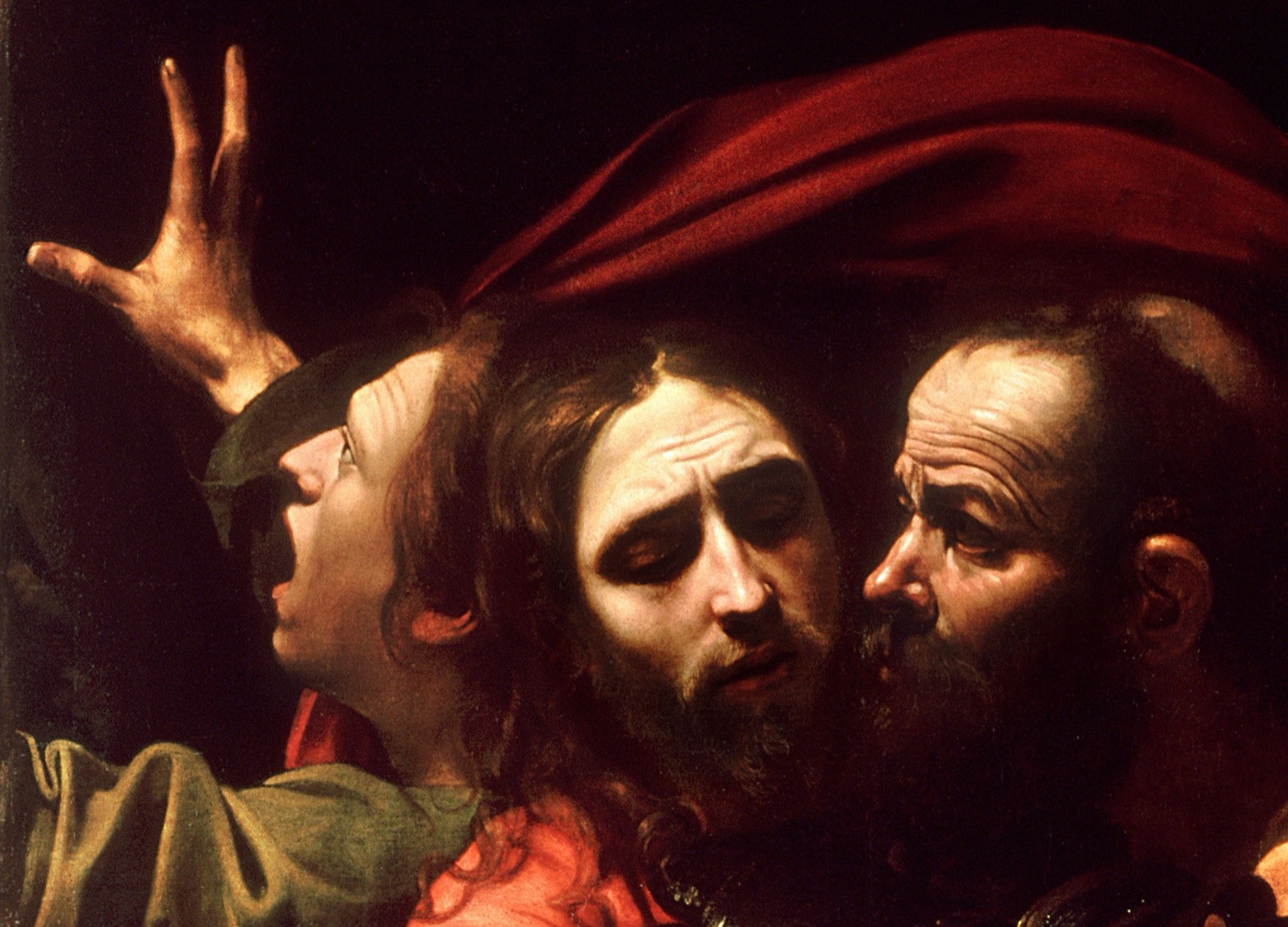
Close-up
John
Running away into the night, mouth open, his red cloak billowing up over the heads of Jesus and Judas.
That red cloth turns up again and again in his paintings. It was probably a real length of fabric he kept in the studio, along with the chairs and the armour, cheap to keep and easy to rearrange. In pictures that are mostly shadow, it’s where your eye lands. And John is the disciple painters traditionally dressed in red.
That blowing cloak is a specific reference. In 1601, Ciriaco Mattei had paid an engraver called Francesco Villamena to make a print of a street fight in Rome. A real one, between the gangs who supported France and the gangs who supported Spain. Cloaks flying. Swords out.
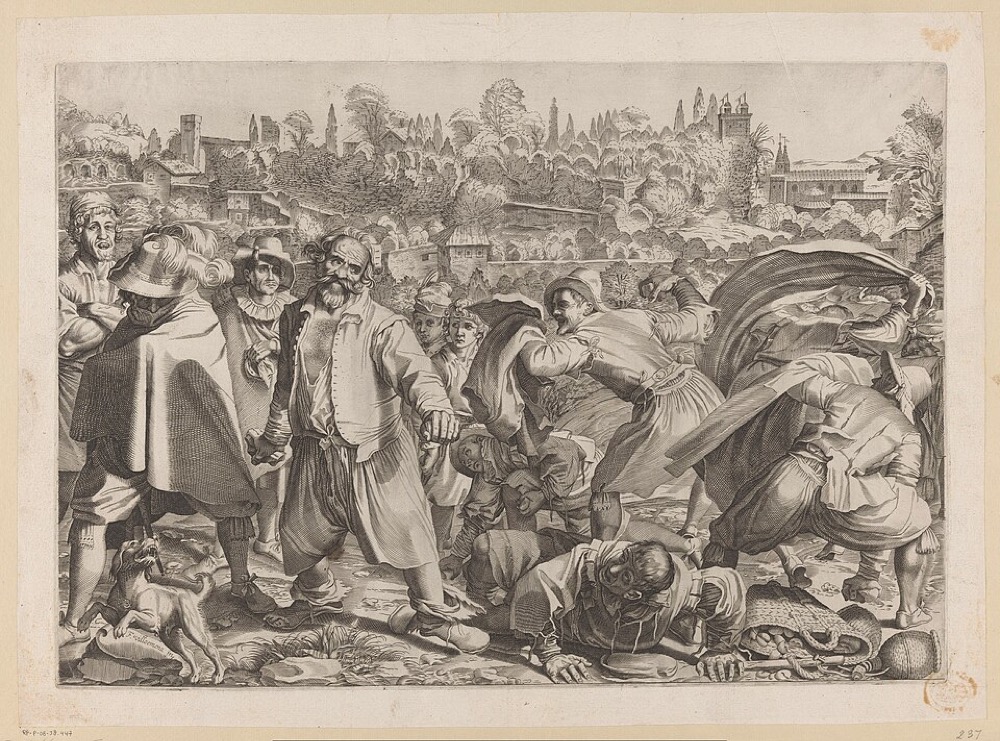
Painting
Brawl of Bruttobuono
Engraving
A Roman street fight Ciriaco Mattei paid Villamena to engrave. The flying cloak reappears on John in The Taking of Christ.
Caravaggio borrowed it. And maybe that tells us something about how he saw this scene. Not as something that happened long ago in the Holy Land, but as the kind of thing he saw on the streets of Rome every week. A man grabbed in the dark. Armed men closing in. Friends scattering.
SFX: A lantern being raised. The faint creak of its handle.
And there's one more figure.
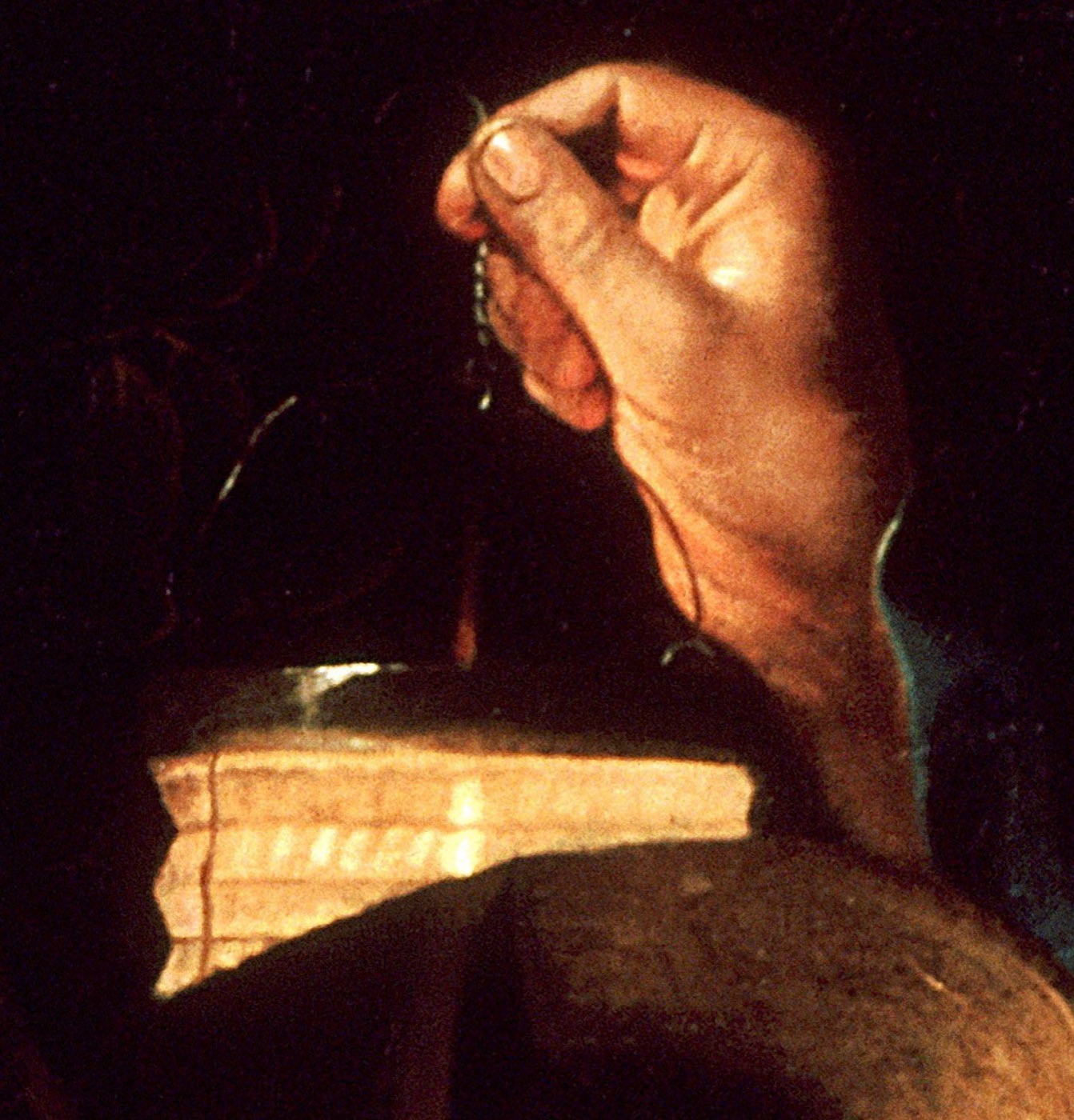
At the back, on the right, slightly apart from it all, a man is holding up a lantern to light the scene.
It's Caravaggio himself. A self-portrait.
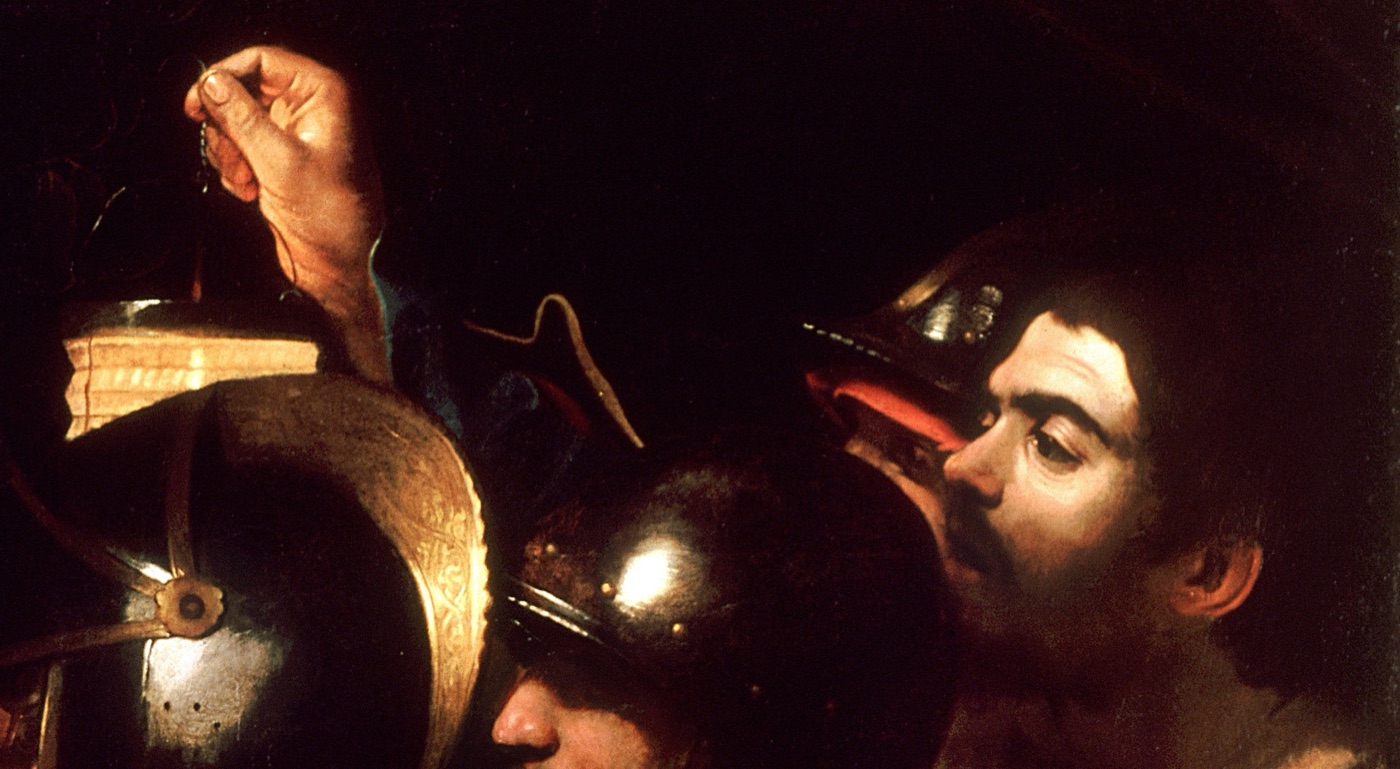
Close-up
Caravaggio
The man at the back holding up the lantern is Caravaggio himself. A witness, close enough to see everything.
Close-up
The lantern
Graham-Dixon’s point: the little paper lantern lights hardly anything beyond Caravaggio’s own face. The light on Jesus, Judas’s hand and the armour comes from somewhere else, with no source in the picture.
He's put himself in the picture again, the way he did in The Martyrdom of St Matthew. A witness. Close enough to see everything.
SFX: Steam train in the distance. A quiet country road. Birdsong.
Gorey. June 1920.
Let's go back to that morning on the Ballycanew road. Because the killing of Percival Lea-Wilson took three days to get right.
Almost everything we know about those three days comes from one of the men who did it.
His name is Seán Whelan. In 1920 he was a captain in the IRA's North Wexford Brigade. Years later he gave a written statement to the Bureau of Military History, the Irish state's archive of the War of Independence.
SFX: A busy bridge. A town at evening. Footsteps.
One evening in June 1920, Whelan is crossing the bridge in Enniscorthy when his battalion commander stops him and whispers some news.
Whelan has been chosen, along with two other local men, Mick Sinnott and Joe McMahon, for a "special job". They'll be working with two officers who've come down from IRA headquarters in Dublin.
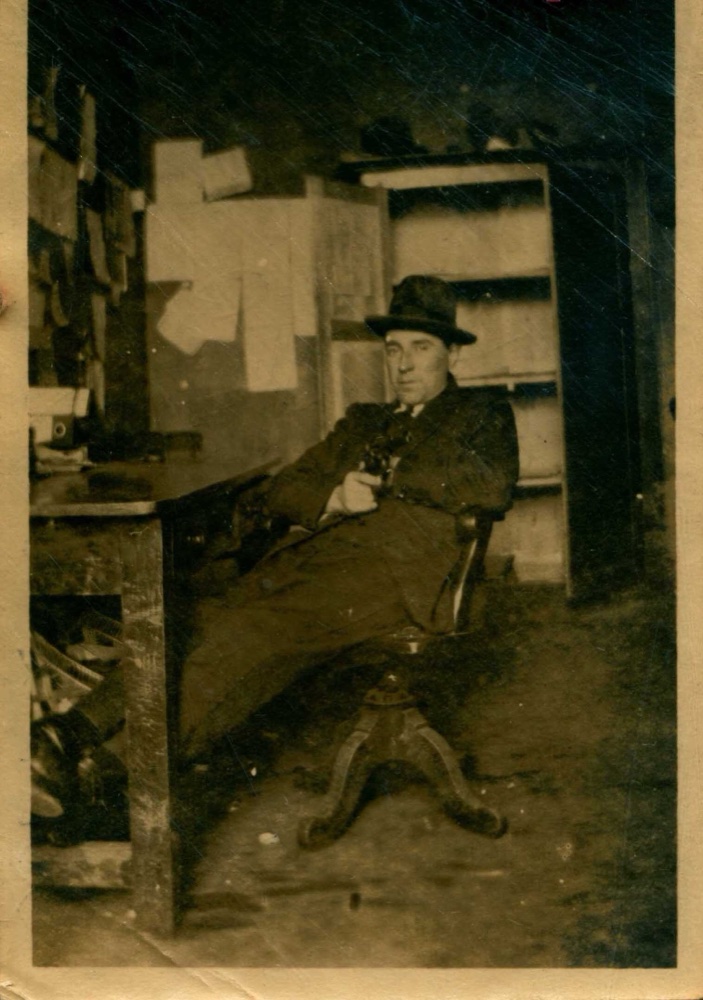
One of them is Frank Thornton.
Photograph
Frank Thornton, 1921
Photographed on the day of the Truce, 11 July 1921.
The other is Liam Tobin.
 Liam TobinFrank ThorntonNo known photographSeán WhelanNo known photographMick SinnottNo known photographJoe McMahon
Photographs
The five men sent to Gorey
Tobin and Thornton came down from Dublin. Whelan, Sinnott and McMahon were local Volunteers.
On the drive to Gorey, Whelan is told who they're after, and why.
They have a borrowed Ford hackney car, filled up, Whelan notes, with good British petrol.
SFX: Car engine. Gravel. The engine cuts out.
Their information is good. Every morning, the District Inspector walks to the station with a sergeant from the barracks to meet the 9.35 train from Dublin. He collects his own mail bag. He buys a paper on the way back through the town. And then he walks home along the Ballycanew road, reading the headlines as he goes.
Usually the sergeant leaves him at the bridge, and watches him walk on down the hill to his house.
The five men take up their position on the bridge overlooking the station.
SFX: The 9.35 pulls in. Doors slamming. Then quiet.
On the first morning, the train comes in, and the sergeant is standing on the platform alone.
Lea-Wilson isn't there.
Sometimes, Whelan says, the Inspector would be suffering from a hangover and would lie on in bed. On those mornings the sergeant collected the post and brought it out to the house.
So the five gunmen give up for the day and drive two miles down the road, to the beach at Courtown Harbour. They lie on the strand in the summer sunshine.
SFX: Waves. Gulls. Then the growl of a heavy truck engine pulling up.
And while they're lying there, an RIC lorry pulls up outside a pub, about forty yards away. Eight or nine policemen are sitting in the back.
The cab door opens, and out jumps Lea-Wilson, in uniform.
He doesn't look their way. He hops into the pub, comes back out a moment later, and they're gone.
SFX: The lorry pulls away.
On the second morning, they're back on the bridge for the 9.35. The sergeant is there again. Lea-Wilson isn't.
So they drive around Gorey looking for him.
Around midday, on the main street, a car just like their own passes them going the other way. Lea-Wilson is sitting beside the driver, with two or three policemen in the back.
Thornton turns to the others and says, "The armed forces of the two governments pass each other in the street without a word of greeting."
They all laugh.
SFX: A pony and trap. Hooves on a country road. Wheels creaking.
That afternoon, driving back towards Gorey, they meet him once more, heading the other way, out to Courtown.
This time he's in civilian clothes, driving a pony and trap.
And sitting beside him is Marie.
Tobin is the first to recognise him. And Whelan hears him tell Sinnott, at the wheel, not to stop.
They have orders not to shoot him in front of his wife.
SFX: The hooves fade into the distance.
Thornton and Tobin decide that if they don't get him the next day, they'll have to go back to Dublin. Whelan, Sinnott and McMahon will stay in Gorey until the job is done.
SFX: Morning. Birdsong. Footsteps on a platform.
The fifteenth of June, 1920. The third morning.
They're on the bridge earlier than usual. There aren't many people waiting for the train. And just when they're about to give up, the Inspector and the sergeant walk onto the platform.
He's in civilian clothes.
They drive down the road and pull in at the edge of the footpath.
SFX: A car bonnet being lifted. Metal on metal.
Whelan and Thornton stand at the front of the car with the bonnet up, leaning over the radiator, pretending to look for a fault in the engine. Through the windscreen they can watch the road behind them.
Percival Lea-Wilson walks on down the hill alone. He opens his newspaper and starts reading the headlines.
Whelan wrote later that he wondered if anyone had ever read a newspaper as they walked to their own death.
As he passes the car, he lifts his eyes from the paper.
SFX: Two shots, point blank.
Thornton and Whelan fire at point-blank range.
He drops the mail bag and the newspaper. He puts his hands over his head and he runs, towards his house.
SFX: A volley of shots. Running feet. Then silence.
They all fire after him. Tobin from the road. McMahon jumps out of the back of the car and runs along the footpath, shooting as he goes.
Percival Lea-Wilson falls fifteen or twenty yards from the car. Whelan reckons he's been hit at least a dozen times.
Then, in Whelan's words, "just to make sure", they shoot him again where he lies.
They leave his body where it is, with his gun and his post, so that nobody can mistake it for a robbery. This, Whelan says, was an execution.
When Whelan looks down the road, the young woman in black is lying curled up on the footpath, completely still.
They pick up the newspaper Lea-Wilson had been reading. It's the Irish Independent.
SFX: Car doors slamming. Engine roaring. Then, faintly, men singing in a speeding car.
The gunmen had orders not to kill him in front of his wife. So she wasn’t there when it happened.
I wonder if when Marie sees the Taking of Christ for the first time a few years later, does it remind her of her husband’s killing. Both scenes are ambushes dressed up as something harmless. Both happen in plain sight. Is this what draws her to the painting and why she has to buy it?
And there's one more thing she may have noticed. Percival was thirty-three when he was killed. By tradition, that's the same age Jesus was on the night of his arrest. Did Marie think about that too, when she looked at it?
SFX: Music sting.
Act 4
SFX: A crowded courtroom. Murmuring. A gavel. A clerk reading in Latin.
Rome, August 1603.
Caravaggio is in court.
The man suing him is another painter, Giovanni Baglione. Baglione has been feuding with him for a while.
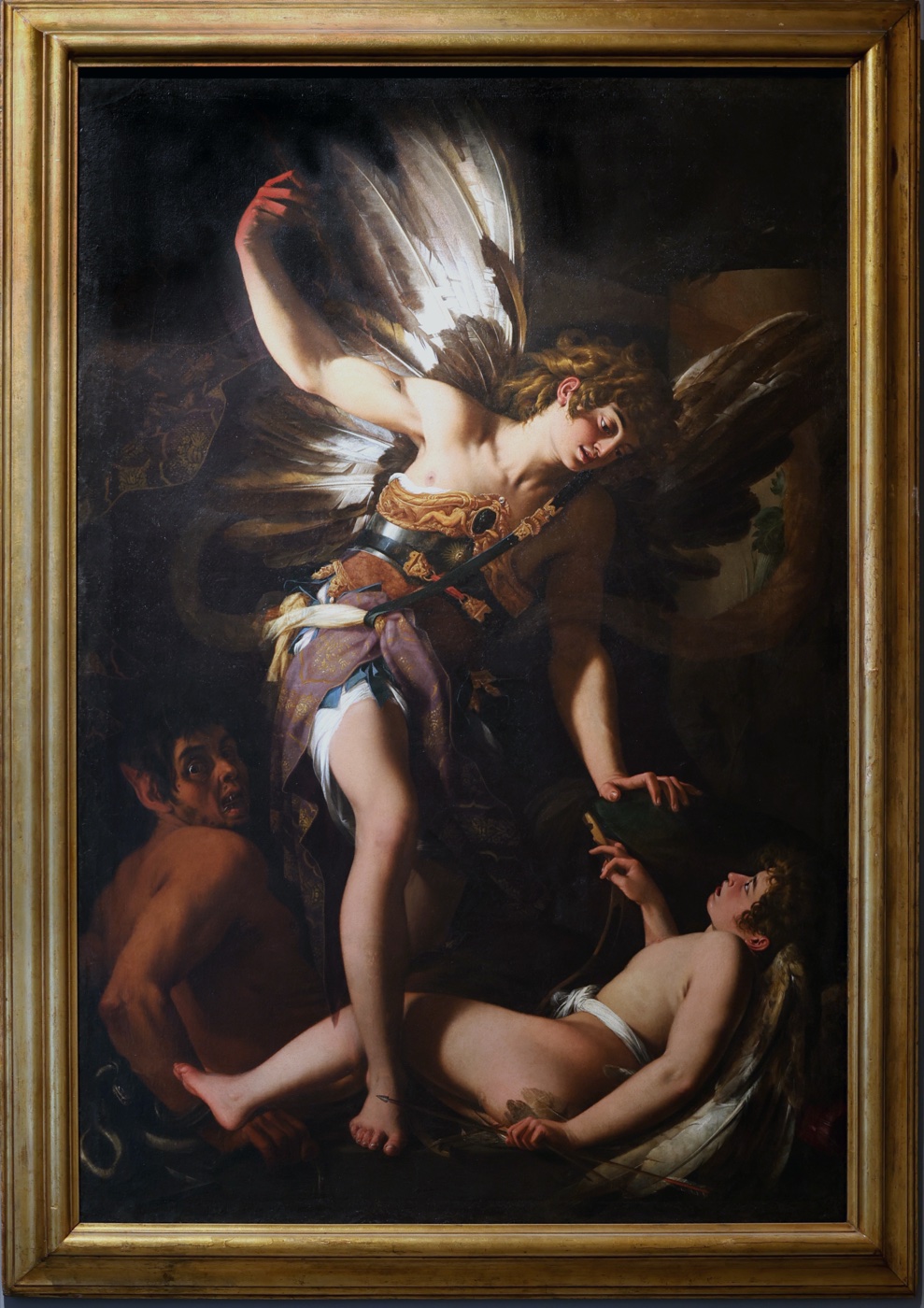
He painted a picture attacking one of Caravaggio's, and then a second version in which he painted Caravaggio as the devil.
Painting
Sacred and Profane Love, second version
Palazzo Barberini, Rome
Baglione’s answer to Caravaggio’s Omnia vincit amor, with the devil given Caravaggio’s face.
He's also been spreading a rumour that Caravaggio's young assistant and model, a boy called Cecco, is his lover.
 Omnia vincit amorSt John the BaptistThe Inspiration of St MatthewThe Sacrifice of Isaac
Paintings
Cecco as Caravaggio’s model
Cecco as Cupid, St John and the angel above St Matthew, and in The Sacrifice of Isaac. Baglione’s Sacred and Profane Love was painted as an answer to the Cupid.
Then, in 1603, Baglione unveils a huge altarpiece of the Resurrection for the Jesuits' main church in Rome. It flops. And soon, obscene verses mocking Baglione and his painting start going round the city.
Baglione sues for libel. He names Caravaggio, his friend the architect Onorio Longhi, the painter Orazio Gentileschi and another painter called Filippo Trisegni.
SFX: A quill scratching. A cell door clanging shut.
Libel is a capital crime in Clement VIII's Rome. Questioning a man's honour in 17th century Italy is a serious offence.
Caravaggio's testimony survives. He's curt and lofty.
He lists the painters he rates.
And when he's asked about Baglione's Resurrection, he says it's the worst thing he's ever seen.
He spends about two weeks in jail for the offence.
Then he's released, on bail guaranteed by the French ambassador.
That's almost certainly del Monte's doing. His powerful patrons have got him out again.
SFX: A tavern. Plates clattering. A sudden smash.
But the trouble keeps coming. In April 1604, in a tavern near the Pantheon, he asks a waiter which of the artichokes on his plate are cooked in butter and which in oil.
The waiter tells him to smell them and find out. Caravaggio throws the plate in his face.
That same year he's arrested for throwing stones at the police, for insulting a policeman, and again for carrying weapons. And all the while, he's painting some of the greatest pictures in Rome.
SFX: Night. A piazza. A woman laughing.
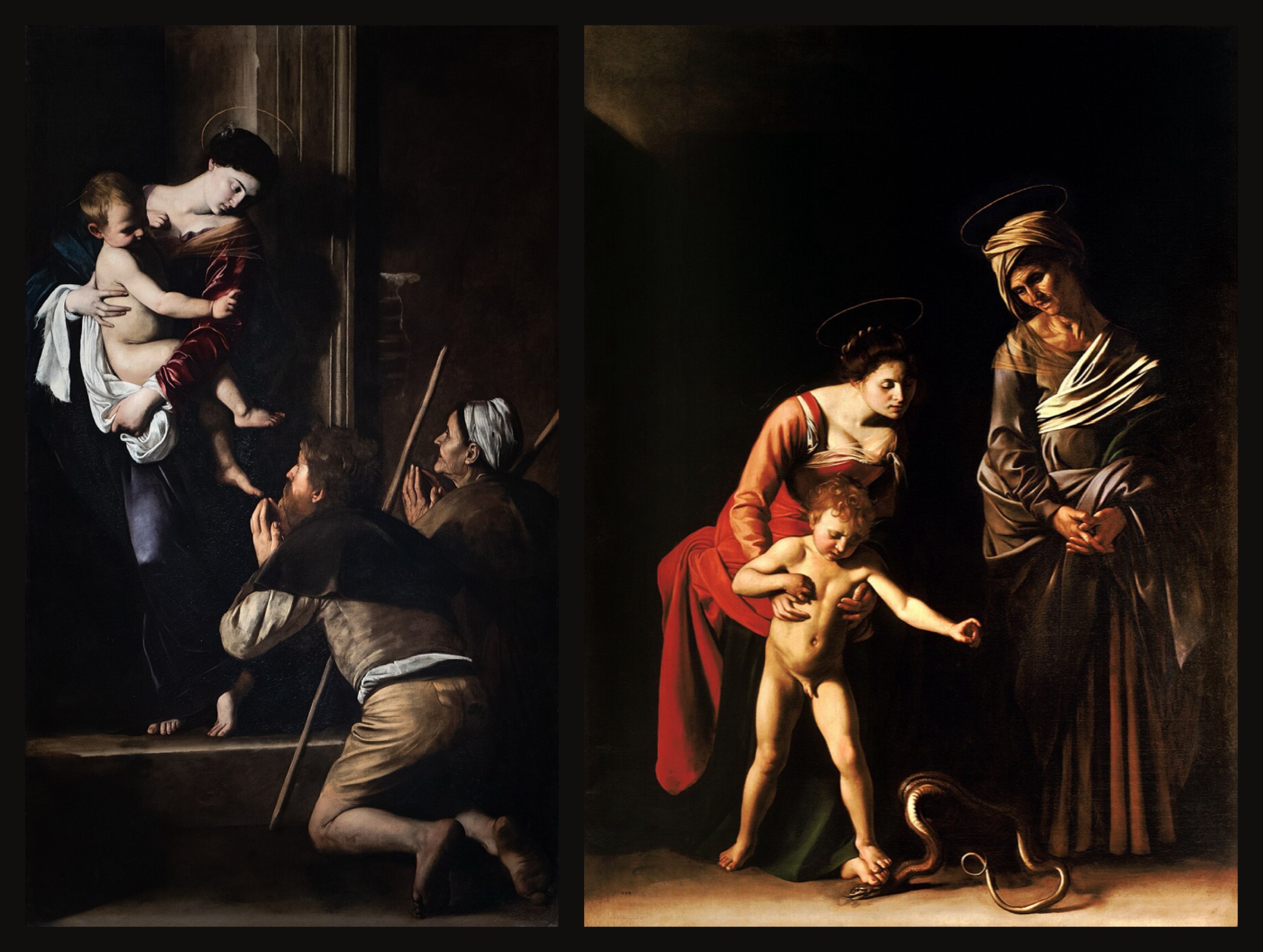
There's a woman in his life now, called Lena. She works the Piazza Navona, and people know her as "Michelangelo's woman". She's also his model. He paints her as the Virgin Mary.
 Madonna di LoretoMadonna dei Palafrenieri
Paintings
Lena as the Virgin
The Madonna at the door for the pilgrims, and the Madonna made for St Peter’s.
In July 1605, after a quarrel over Lena, Caravaggio comes up behind a notary called Mariano Pasqualone in the street and hits him over the head.
Pasqualone survives, and goes straight to the police. Caravaggio flees to Genoa until it blows over.
He only comes back to Rome after writing Pasqualone a grovelling apology.
His landlady throws him out over unpaid rent. He stones her windows.
SFX: Church interior. A crowd muttering. Canvas being lowered.
And now even his paintings are getting him into trouble. He paints a Madonna for an altar in St Peter's itself. The Virgin is modelled on Lena, and she shows rather a lot of cleavage.
It's taken down within two days.
He paints The Death of the Virgin, and it's rejected too. His Virgin doesn't look like she's peacefully falling asleep into heaven. She looks like what she is: a dead woman, swollen and pale, laid out for burial.
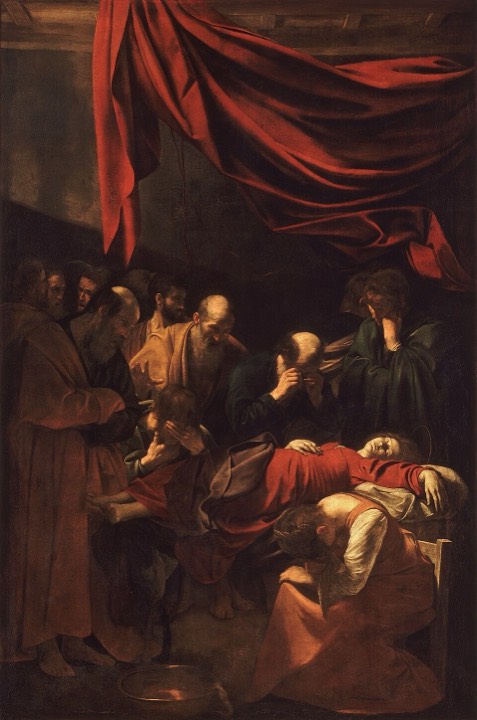
Painting
The Death of the Virgin
Louvre, Paris
Rejected by the church that commissioned it.
Above her hangs a huge red curtain, like the drape over a stage. Or like her spirit, floating away overhead.
One of the early biographers says the model was a courtesan Caravaggio loved.
Rome's taste is changing. The Church wants grandeur and glory now. But Caravaggio keeps giving them poverty, dirty feet and real bodies.
SFX: Low drone.
And through all of it runs one long, slow-burning feud with Ranuccio Tomassoni.
The Tomassonis are a family of hard men, with real power on the streets of their part of Rome.
They have friends and protectors among Rome's pro-Spanish families. Caravaggio's protectors are pro-French.
For years, court records put Caravaggio and Tomassoni on opposite sides of street fights and quarrels.
Between them, there's Fillide, Tomassoni's woman and Caravaggio's model.
Nobody knows exactly what tips it over. Historian Andrew Graham-Dixon thinks it might be a feud between rival pimps over girls and territory. There’s no evidence to say that Caravaggio was a pimp but it wouldn't surprise me if he was.
SFX: A Sunday afternoon. Church bells.
Sunday, the twenty-eighth of May, 1606.
The tennis court near the Campo Marzio.
Four men on each side, seconds and witnesses watching. Swords drawn.
This isn't a brawl that got out of hand. It's a duel, arranged in advance, and duels are banned in Rome.
SFX: Clash of steel. A cry.
Caravaggio's blade goes into Tomassoni's groin and cuts the femoral artery.
The biographer Andrew Graham-Dixon also has a theory about that wound. Tomassoni was married, to a woman called Lavinia. If the quarrel was over an insult involving her, then a cut to the groin wasn't just a killing blow. It was a deliberate humiliation. A way of saying exactly what the fight was about.
None of the witnesses ever said why they were fighting. Tomassoni's brother comes at Caravaggio and cuts his head open. Caravaggio's friend Petronio Toppa, drags him clear, and is badly wounded himself.
Ranuccio Tomassoni bleeds to death.
SFX: Running feet.
Everyone involved flees Rome. The others get away with exile. Caravaggio doesn't.
He's condemned under what's called a bando capitale. A capital ban.
It means anyone, anywhere in the papal states, can kill him on sight. And to claim the reward, all they have to do is bring back his head.
SFX: A cart on a country road. Night. Wind.
Bleeding and feverish, Caravaggio is smuggled out of the city. The Colonna family takes him in. The same family his mother's people had served back in Lombardy, and whose matriarch, Costanza Colonna, has been quietly protecting him for years.
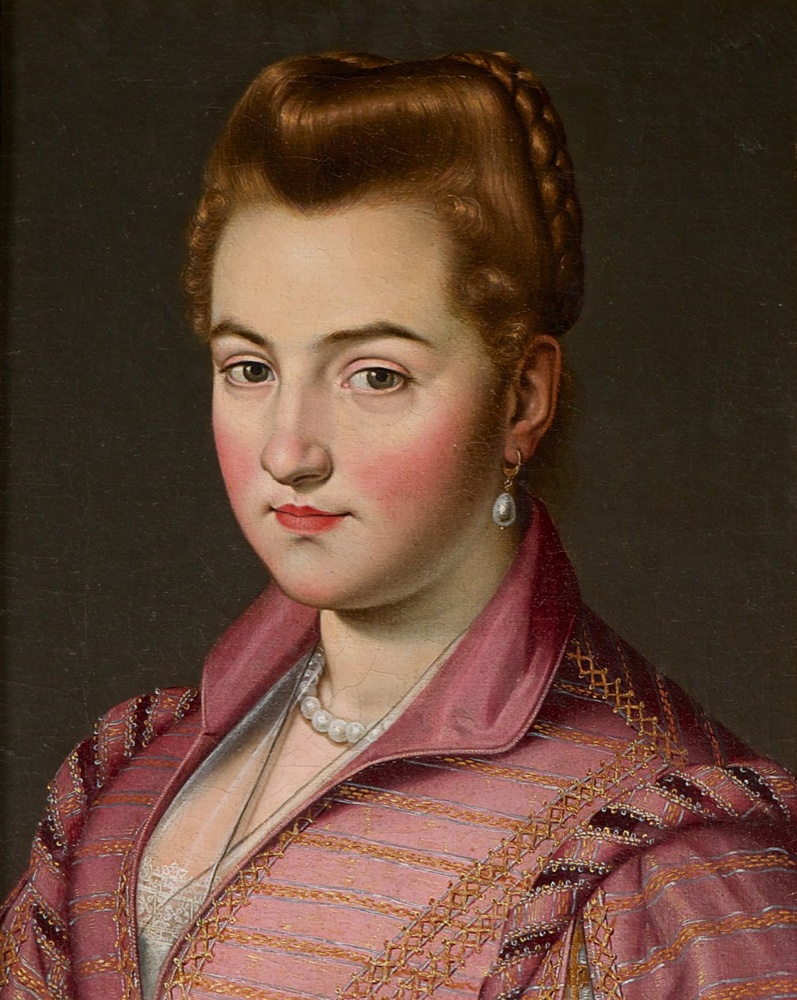
Painting
Costanza Colonna, possibly
Catalogued as a lady of the House of Parma, possibly Costanza Colonna.
She hides him on her family's estates in the hills south-east of Rome. He's thirty-four at this point.
The most famous painter in Rome. But now he can never go back.
Graham-Dixon believes it's around this time that he paints David with the Head of Goliath. A young David holds up the giant's severed head by the hair.
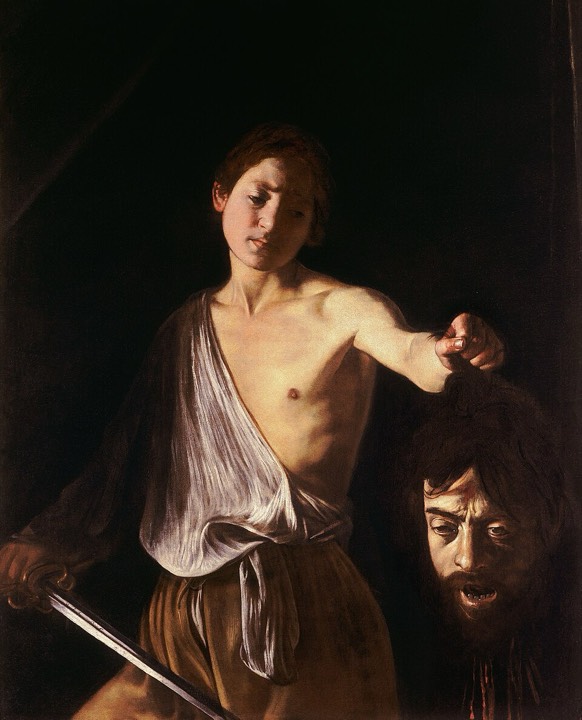
Painting
David with the Head of Goliath
Galleria Borghese, Rome
The severed head is Caravaggio’s own face.
The face on the head is Caravaggio's own. It reads like a message to the one man who could pardon him, the Pope's nephew, Cardinal Scipione Borghese. A great collector of his work.
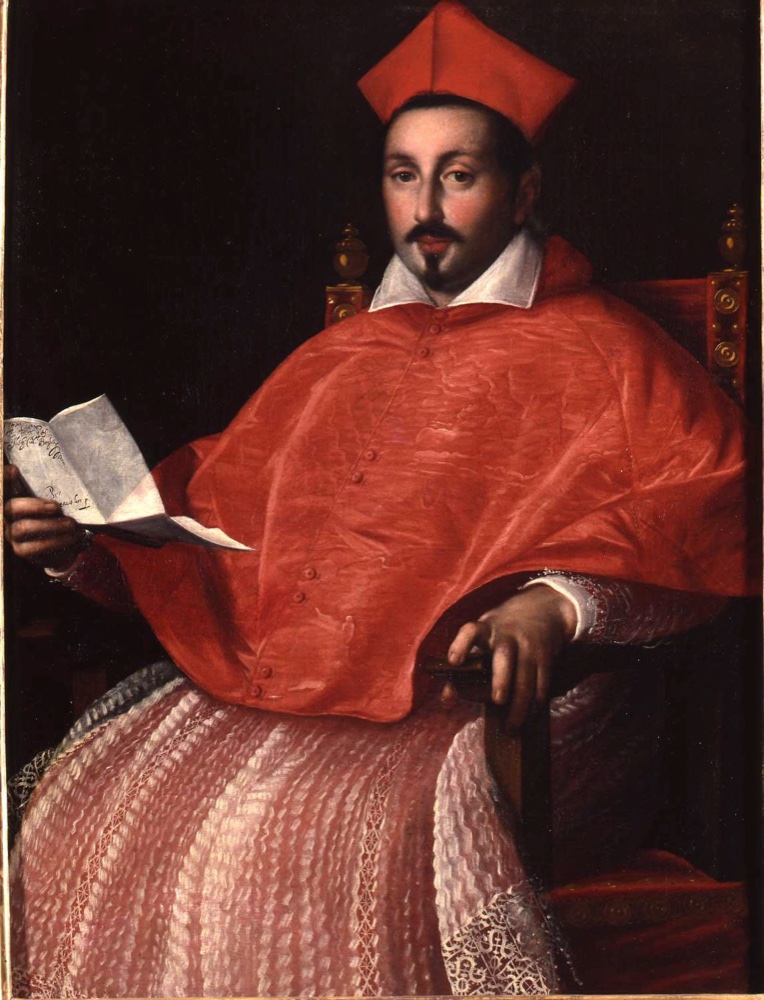
Portrait
Cardinal Scipione Borghese
The Pope’s nephew, drawn by Ottavio Leoni.
He’s saying;
“You want my head? Here it is, in a painting. Let me keep the real one.”
SFX: A hotel bar. Evening. Glasses. A door swinging open.
Dublin, the fifteenth of June 1920. The evening of the shooting.
Joe Sweeney is in the bar of the Wicklow Hotel, one of Michael Collins’s regular haunts. Sweeney had fought in the GPO in 1916. He’d spent that night on the grass outside the Rotunda too.
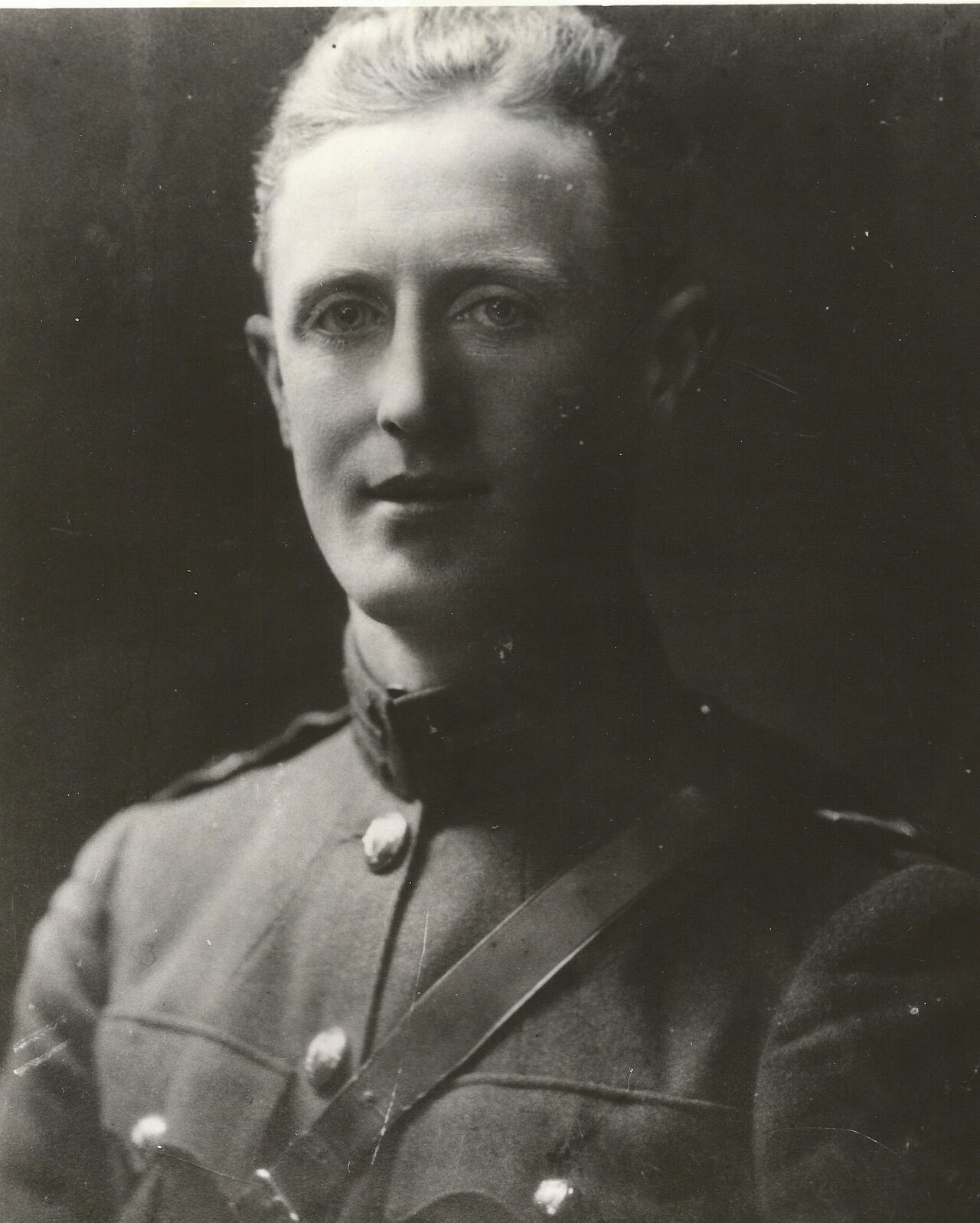
Photograph
Joe Sweeney, 1929
He fought in the GPO in 1916 and spent that night outside the Rotunda; later a TD and an army general.
Photo: unknown author, Wikimedia Commons, CC BY-SA 4.0
Collins comes in, delighted with himself. He asks Sweeney if he remembers that first night outside the Rotunda. If he remembers Lea-Wilson.
Sweeney says he’ll never forget it.
“Well,” says Collins, “we got him today in Gorey.”
SFX: A church. Rain on the windows. A single bell tolling.
Percival Lea-Wilson is buried in England, in Putney Vale Cemetery in south-west London..
Marie is in her early thirties.
She never believes what was said about her husband.
Not the stories from the Rotunda.
Not any of it.
To her, he was a good man, gunned down by cowards.
After his death, a memorial poster is printed in Dublin. It shows his photograph in RIC dress uniform, and the dates of his life. And under the photograph, a line from the Gospel of Luke: “Forgive them they know not what they do.” The words Jesus spoke from the cross, about the men who crucified him.
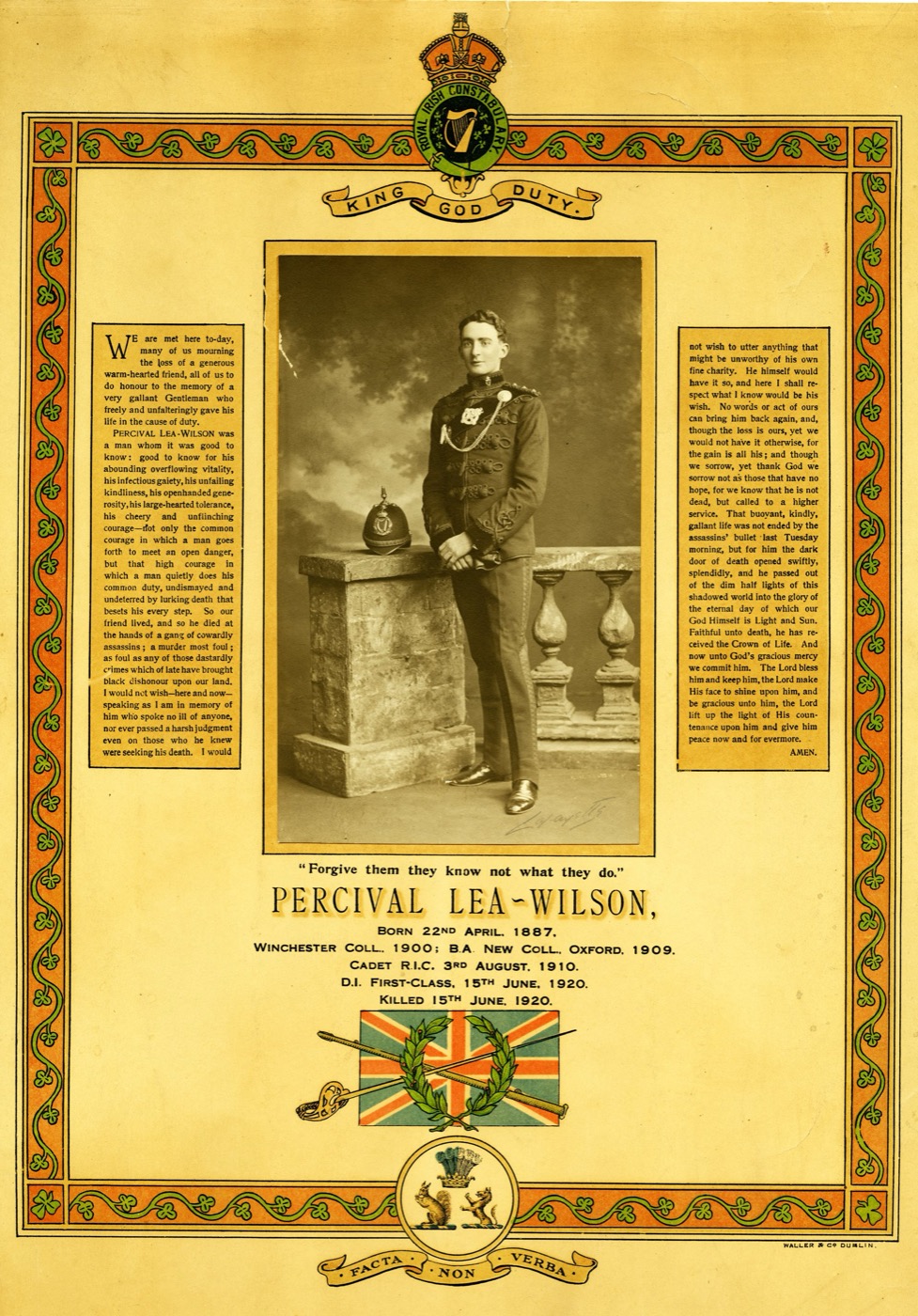
Poster
Commemoration poster for Percival Lea-Wilson, 1920
Printed by Waller & Co., Dublin, after his death, with the same studio portrait of him in RIC uniform.
National Museum of Ireland, HE:EWT.417
SFX: Low drone.
When she returns home to Gorey the war around her keeps going.
A month after Percival's death, Britain brings in a second new force for Ireland, the Auxiliaries, made up of former army officers.
By the end of 1920, towns are being burned in reprisals.
Cork city centre is set on fire.
In July 1921 there's a truce.
In December, the Anglo-Irish Treaty creates the Irish Free State.
And within six months, the men who'd fought the British together are fighting each other, in a civil war.
Through it all, Marie is in mourning.
SFX: A quill scratching.
Marie’s claim for compensation is heard by a judge at Gorey Quarter Sessions. She asks for twenty thousand pounds. He awards her seventeen thousand. The money comes from local ratepayers of County Wexford.
The papers call it a record: the largest award an Irish court had made so far for an IRA killing.
Today that would be worth over a million euro. She’s financially secure for life. And she has to decide what to do with that life.
She decides to go back to school. In her thirties, Marie Lea-Wilson enrols to study medicine at Trinity College Dublin.
In the 1920s women doctors are still rare. Women her age starting medicine are rarer still.
She qualifies in 1928, at the age of forty-one. One of only three women in her class.
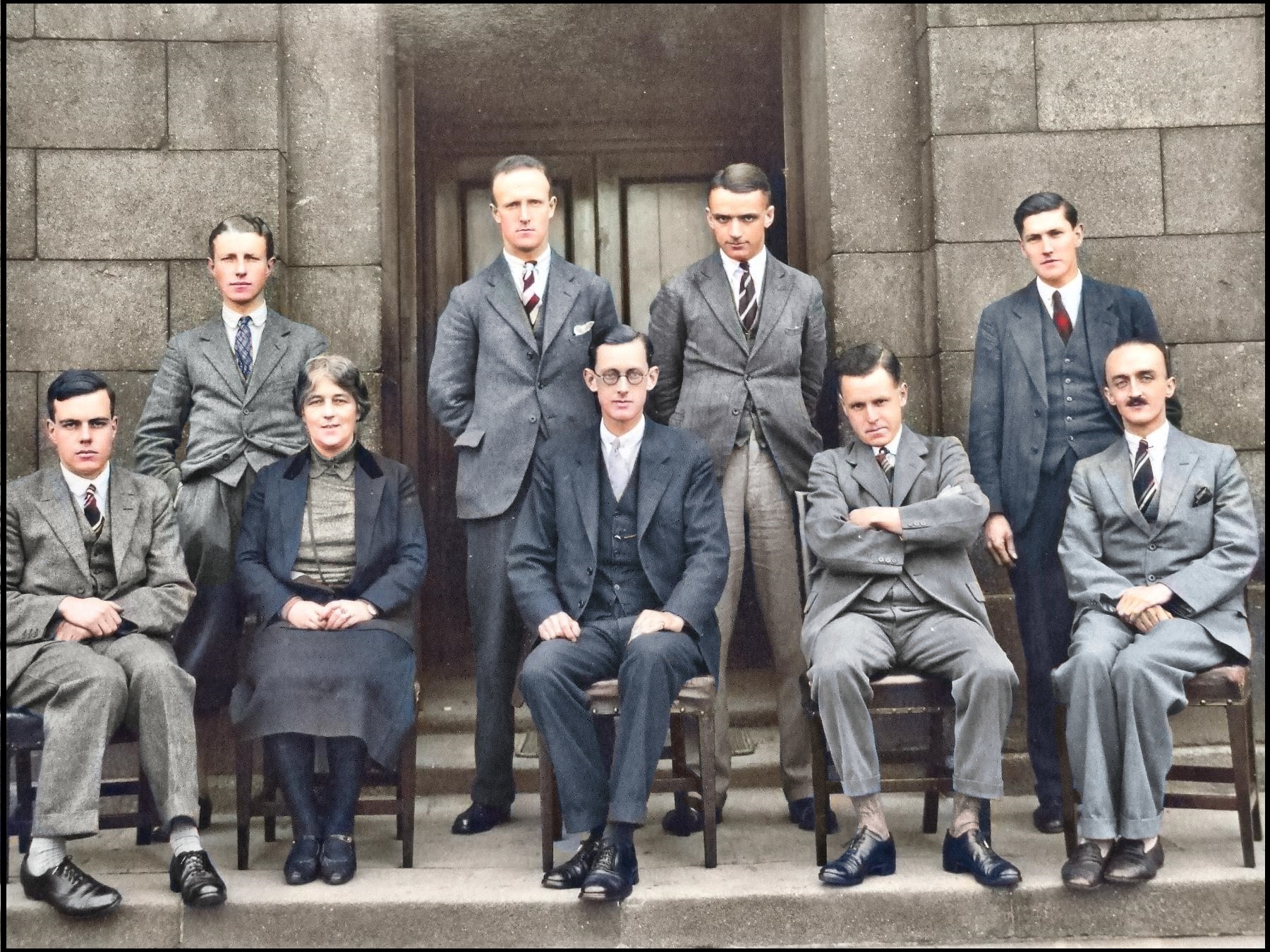
Photograph
Sir Patrick Dun’s Hospital resident staff, 1929
Marie Lea-Wilson is in this group of young doctors, a year after she qualified.
Image: via Irish Family Detective (irishfamilydetective.ie)
Marie will go on to become a children's doctor.
SFX: A Dublin street. Hooves. A tram bell.
She makes her life in Dublin.
Her aunt, Annette O'Neill, comes to live with her. Everyone calls her "Missy".
Missy is a Cork woman who spent years in Russia, as a governess to an aristocratic family, the Sumarokov-Elstons.
When the Russian Revolution kicked off aristocratic families became targets.
So Missy fled Russia, in 1921 and moved to dublin to live with her niece Marie.
A few years later, a teenage girl who’d been in Missy’s care comes to live with them too.
Zenaide Bashkiroff. An exile, with nowhere else to go.

Portrait
Zenaide Bashkiroff, 1941
A portrait drawing of her signed G. de Gennaro, 1941.
Her father was Captain Alexis Alexandrovitch Bashkiroff, an officer in the 1st Rifle Regiment of the Tsar's Imperial Guard. Her mother, also called Zenaide, was born a Countess Sumarokov-Elston. The same family Missy had worked for in Russia.
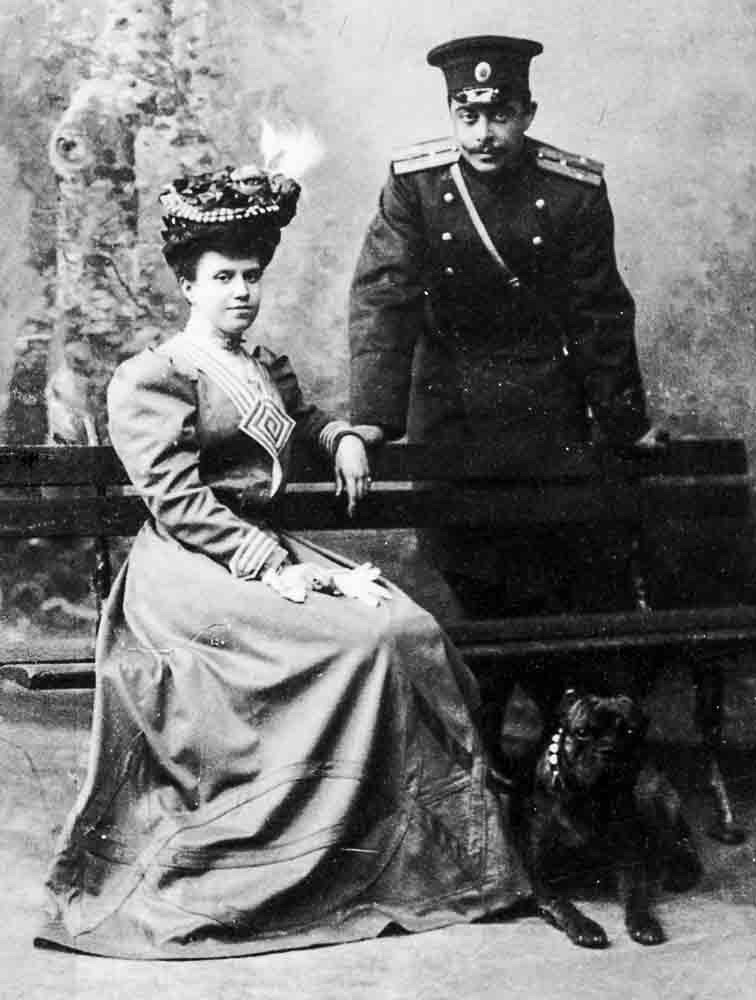
Photograph
Captain Alexis Bashkiroff and his wife Zenaide, 1907
Zenaide’s parents, the year before she was born.
In 1936, her father died at the hands of the Soviet regime. Her mother lived out her life in England, and died in Tunbridge Wells in 1952.
Marie pays for Zenaide's education.
And Zenaide converts to Catholicism.
For a few years, Marie has a family again.
A widow, an aunt and a young Russian girl, in a house in Dublin.
SFX: A wedding. Church bells. Then silence.
Then, around 1928 or 29, Zenaide gets married.
Her husband is Séamus Burke. A politician from Tipperary. A Dáil deputy, and a former government minister in the new Irish state.
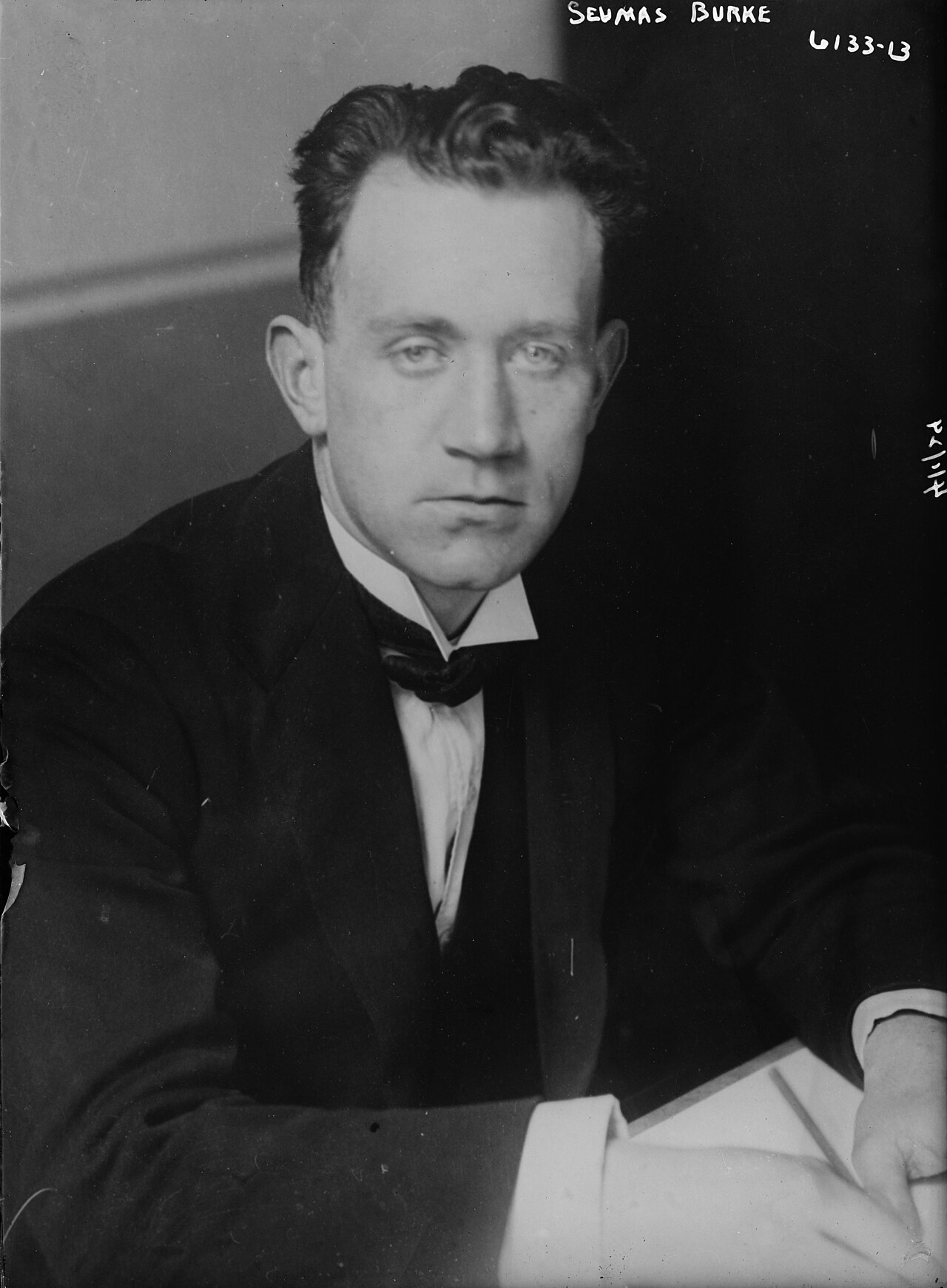
Photograph
Séamus Burke, around 1920
Dáil deputy and government minister, and a former IRA man, who married Zenaide Bashkiroff.
Photo: Bain News Service, Library of Congress
In the War of Independence, Séamus Burke had been in the IRA.
For Marie it's unforgivable. The girl she'd taken in, educated and brought into her church has married a man from the movement that had killed her husband.
The household breaks apart. Zenaide later moves to England and becomes a ceramic artist.
SFX: A door closing. Footsteps receding. Quiet.
What became of Missy, we don’t know. She simply disappears from the record.
By the end of the 1920s, Marie Lea-Wilson has finished her medical training and is a practicing doctor, living alone in a Georgian house on Fitzwilliam Place in Dublin.
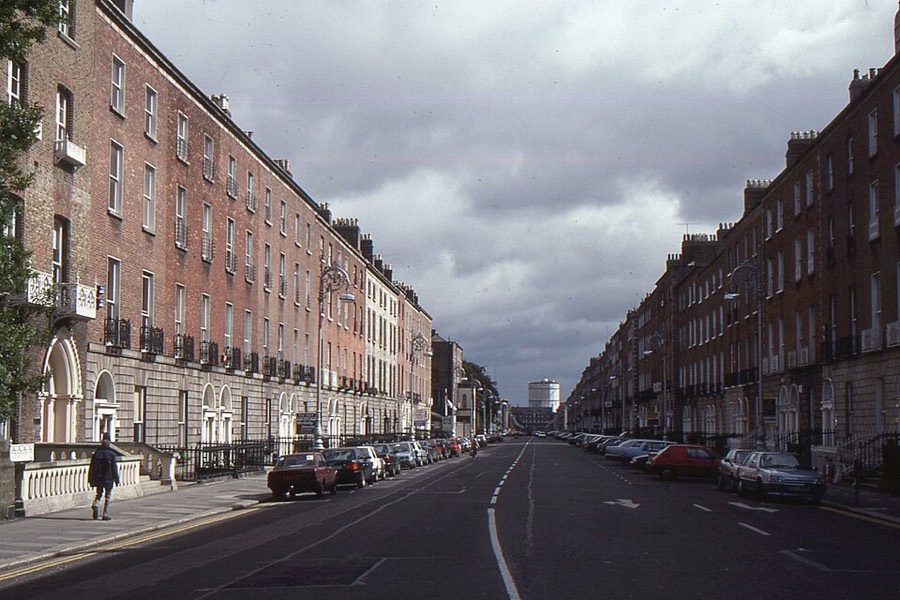
Photograph
Fitzwilliam Place, Dublin
Marie lived here from 1928 until her death; the painting hung in her house before she gave it away
On the wall of that house hangs a large, dark old painting she'd bought a few years earlier, on a trip to Scotland. She thinks it's by a Dutch painter called Gerrit van Honthorst. But she’s wrong about that.
Act 5
SFX: A busy port. Gulls. Shouting in Neapolitan. Bells from a dozen churches.
Naples, autumn 1606.
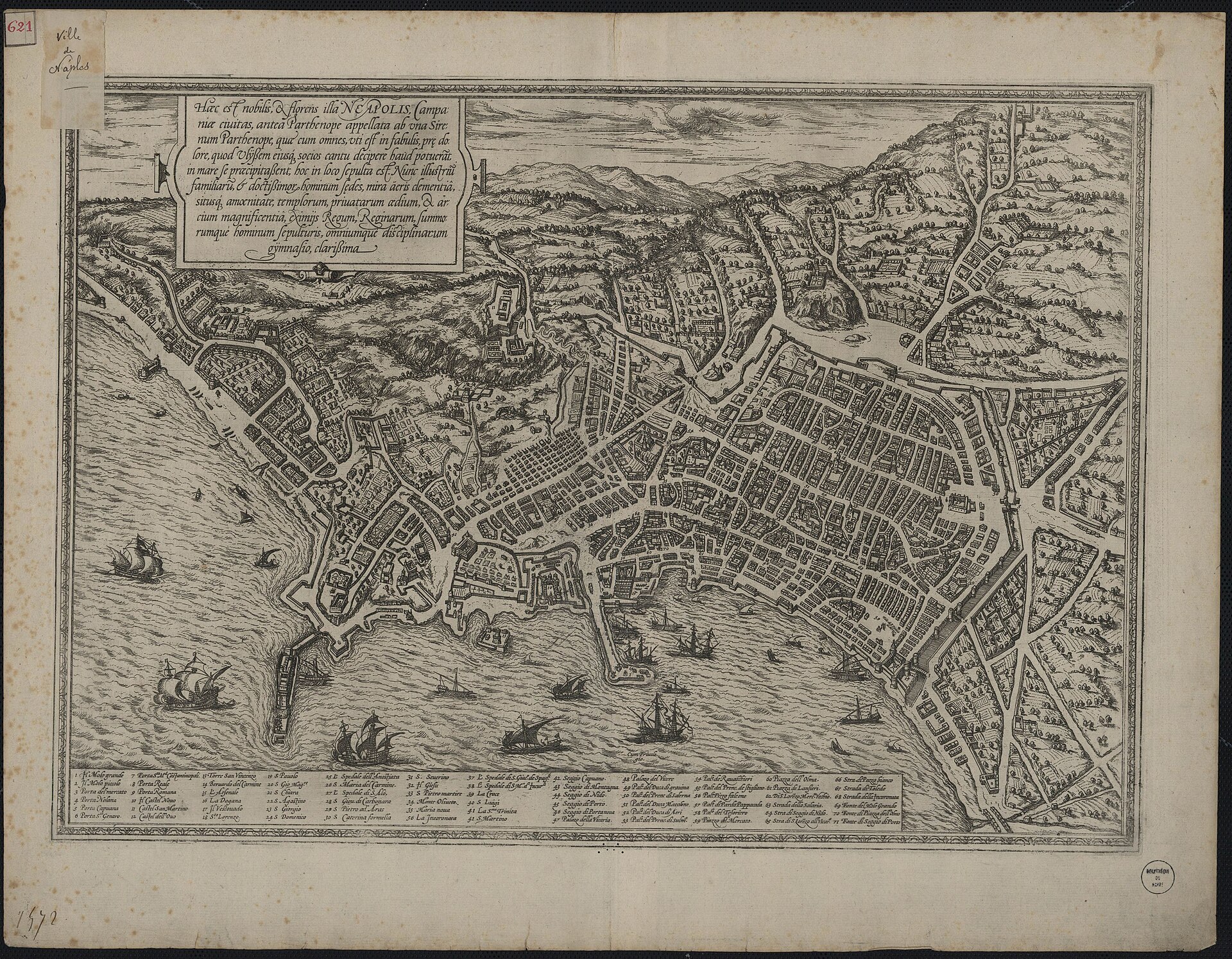
Engraving
Naples in 1572
The crowded port city, under Spanish rule, where Caravaggio fled after the killing.
Georg Braun and Frans Hogenberg, Civitates Orbis Terrarum, 1572 (public domain)
Caravaggio has crossed the border out of the Papal States, into the Spanish-ruled Kingdom of Naples.
From here, the Pope's death sentence can't touch him.
Naples is three times the size of Rome. It's crowded, filthy and full of beggars and migrants who've poured in from the countryside. Caravaggio feels right at home.
Within weeks he has more work than he can handle. A charity founded by a group of young Neapolitan noblemen, the Pio Monte della Misericordia, asks him for an altarpiece.
He paints it in about seven weeks.
It's called The Seven Acts of Mercy.
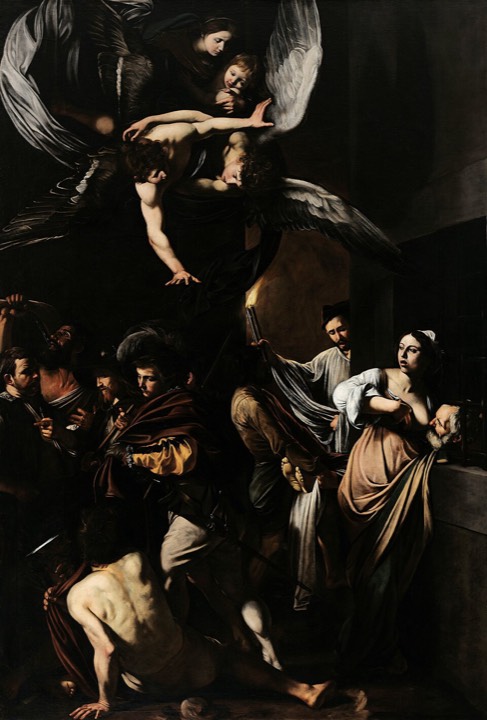
Painting
The Seven Acts of Mercy
Pio Monte della Misericordia, Naples
All seven acts of mercy on one Naples street corner at night.
Feeding the hungry. Giving drink to the thirsty. Clothing the naked. Visiting prisoners. Sheltering travellers. Caring for the sick. Burying the dead.
Other painters had shown them one at a time, in neat separate panels. Caravaggio crams all seven into one dark Naples street corner at night. A corpse being carried out feet first. A young woman breastfeeding an old man through the bars of a prison window. Angels tumbling down out of the dark above them.
Red was the colour of charity, of mercy itself.
The charity loves it so much that, years later, when collectors offer to buy it, they refuse to sell it at any price. It still hangs there today.
But Caravaggio can't stay a fugitive forever. He needs the death sentence and the bounty on his head lifted. And for that, he needs powerful friends. Friends who can protect him.
SFX: A Dublin street. Hooves. A motor car. A front door with a brass knocker.
Dublin, 1928.
Three hundred years later, Marie Lea-Wilson is starting again too.
She's a widow in her forties, starting out in a profession run almost entirely by men. And she's the widow of an RIC officer, in a new state that would rather forget the RIC ever existed.
She needs to find her place. And like Caravaggio, she'll find it under the protection of the Church.
SFX: Sea. Wind in sails. A ship's bell.
Malta, July 1607.
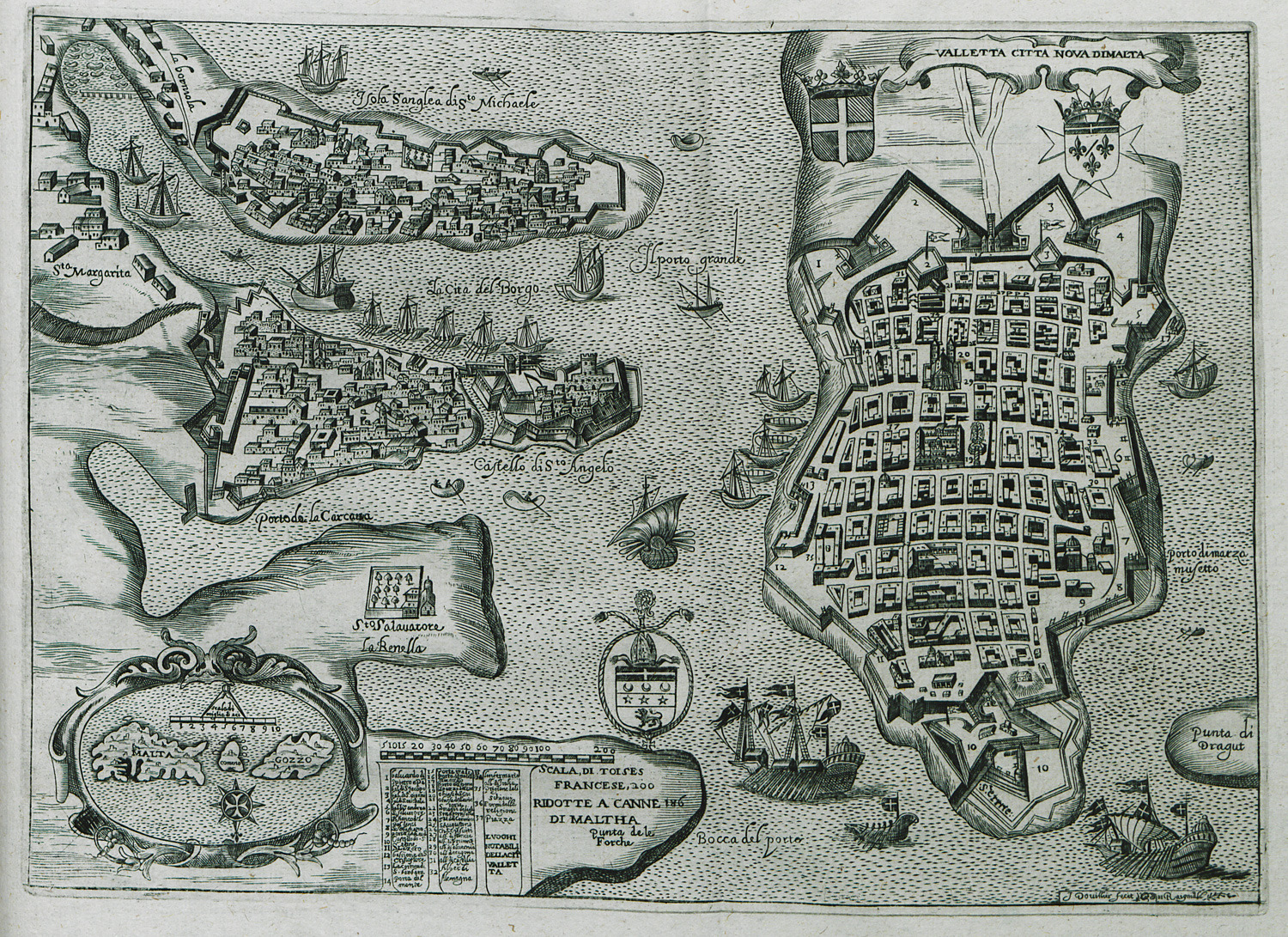
Engraving
Valletta, the new city of Malta
The Knights’ fortress city as it looked a generation after Caravaggio was there.
From Giacomo Bosio’s history of the Order of St John, 1629 (public domain)
It's almost certainly Costanza Colonna who arranges it. Her own son had once redeemed a disgrace the same way.
Malta is ruled by the Knights of St John. An order of warrior monks. Aristocrats who've taken vows of poverty, chastity and obedience, and who spend their lives fighting the Ottoman navy across the Mediterranean.
The idea is simple. If Caravaggio can become a Knight of Malta, he'll be under the protection of the Order.
There's just one problem. Knights are supposed to be noblemen. And they're certainly not supposed to be murderers. So Caravaggio does what he does best. He paints.
He paints a portrait of the Grand Master of the Order, Alof de Wignacourt, standing in his gleaming armour. He paints St Jerome, writing in his study.
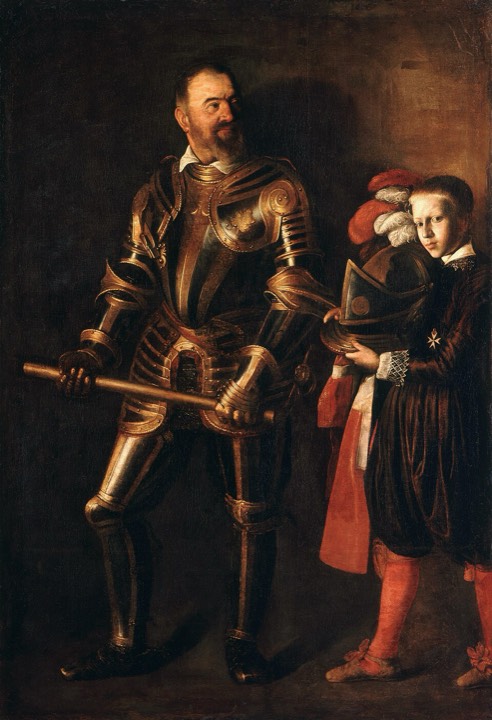
Painting
Portrait of Alof de Wignacourt
Louvre, Paris
The Grand Master of the Knights of Malta, in his armour.
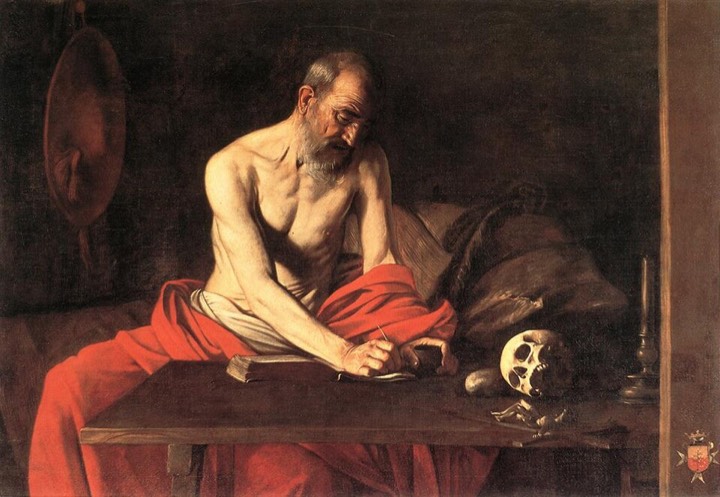
Painting
St Jerome Writing
St John’s Co-Cathedral, Valletta
And Wignacourt writes to the Pope, asking for special permission to admit a man who has committed homicide. He gets it.
SFX: A great hall. Footsteps. A Latin oath being sworn.
In July 1608, Michelangelo Merisi da Caravaggio is made a Knight of Malta.
His entrance fee is a painting. The largest he will ever make.
The Beheading of St John the Baptist. It's huge, more than five metres wide, for the oratory where the young knights trained.
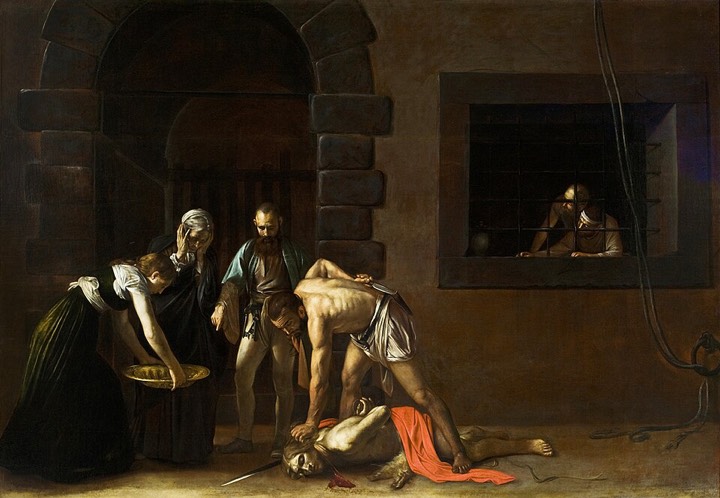
Painting
The Beheading of St John the Baptist
Oratory, St John’s Co-Cathedral, Valletta
His largest painting, and the only one he signed, in the saint’s blood.
The prison yard is almost all brown and black. The one patch of colour is a red cloth thrown over the saint, exactly where the killing happens.
The saint lies face down on the ground of a prison courtyard. The executioner has already cut his throat with a sword, and is reaching for a knife to finish the job. A young woman holds out a golden platter, ready for the head.
And spilling out from St John's neck, in the saint's blood, is the only signature Caravaggio ever put on a painting. "F. Michelangelo." The F stands for Fra. Brother. He's signing as a Knight.
For the first time in his life, the stonemason's son from Milan is a nobleman.
SFX: A large crowd. A choir. A bell ringing out over a city.
Dublin, 1932.
Marie is appointed assistant physician in paediatrics at the National Children's Hospital on Harcourt Street.
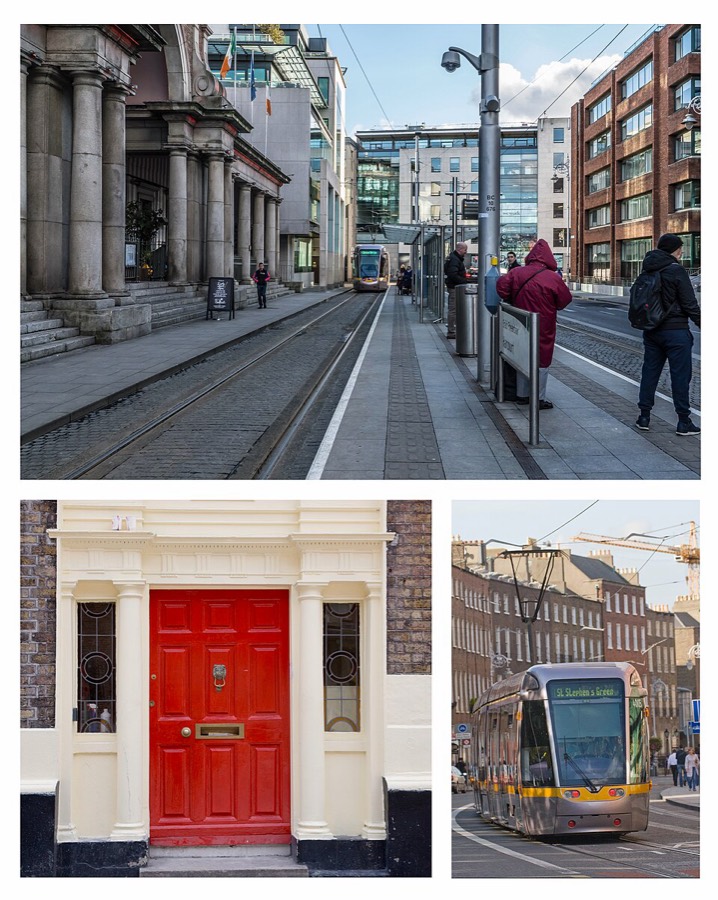
Photograph
Harcourt Street, Dublin, home of the National Children’s Hospital where she worked from 1932
She's forty-five years old, in her first hospital post, looking after the sick children of a poor city.
That same year, Dublin hosts the Eucharistic Congress. A vast international gathering of the Catholic Church. Cardinals and bishops arrive from all over the world. Hundreds of thousands of people kneel in the Phoenix Park for an open-air Mass, and the Irish Free State shows the world exactly what it has become. A Catholic country.
Marie is a devout Catholic. She goes to Mass every day.
In 1914 she'd married outside her faith, a Protestant policeman. Now the Church is the most powerful institution in the country she lives in. And she's firmly inside it.
SFX: Silence. Then a single drop of water.
In Malta, Caravaggio's place inside the Order only lasts a matter of weeks.
SFX: A door being smashed in. Shouting. Steel.
In August 1608.
Caravaggio and a group of other knights break into a house in Valletta and badly wound one of the Order's senior knights, Fra Giovanni Rodomonte Roero.
Nobody knows why.
The record of it was later painted over in the Order's archives. Historians only recovered it, with X-rays, in 2002.
Caravaggio is thrown into an underground cell, a pit cut into the solid rock of Fort St Angelo. Then, one night in October, he escapes. Somehow he gets out of the pit, out of one of the most heavily guarded fortresses in the Mediterranean, and onto a boat to Sicily.
In December, the Order meets to expel him in his absence.
They throw him out "like a rotten and diseased limb" - that's a direct quote from them. Translated from Latin.
The ceremony takes place in the oratory. Underneath his painting - the Beheading of St John.
The protection he'd bought with his best work is gone.
SFX: A Sicilian street. Heat. Cicadas. A dog barking.
Caravaggio flees to Sicily.
He moves from Syracuse to Messina to Palermo.
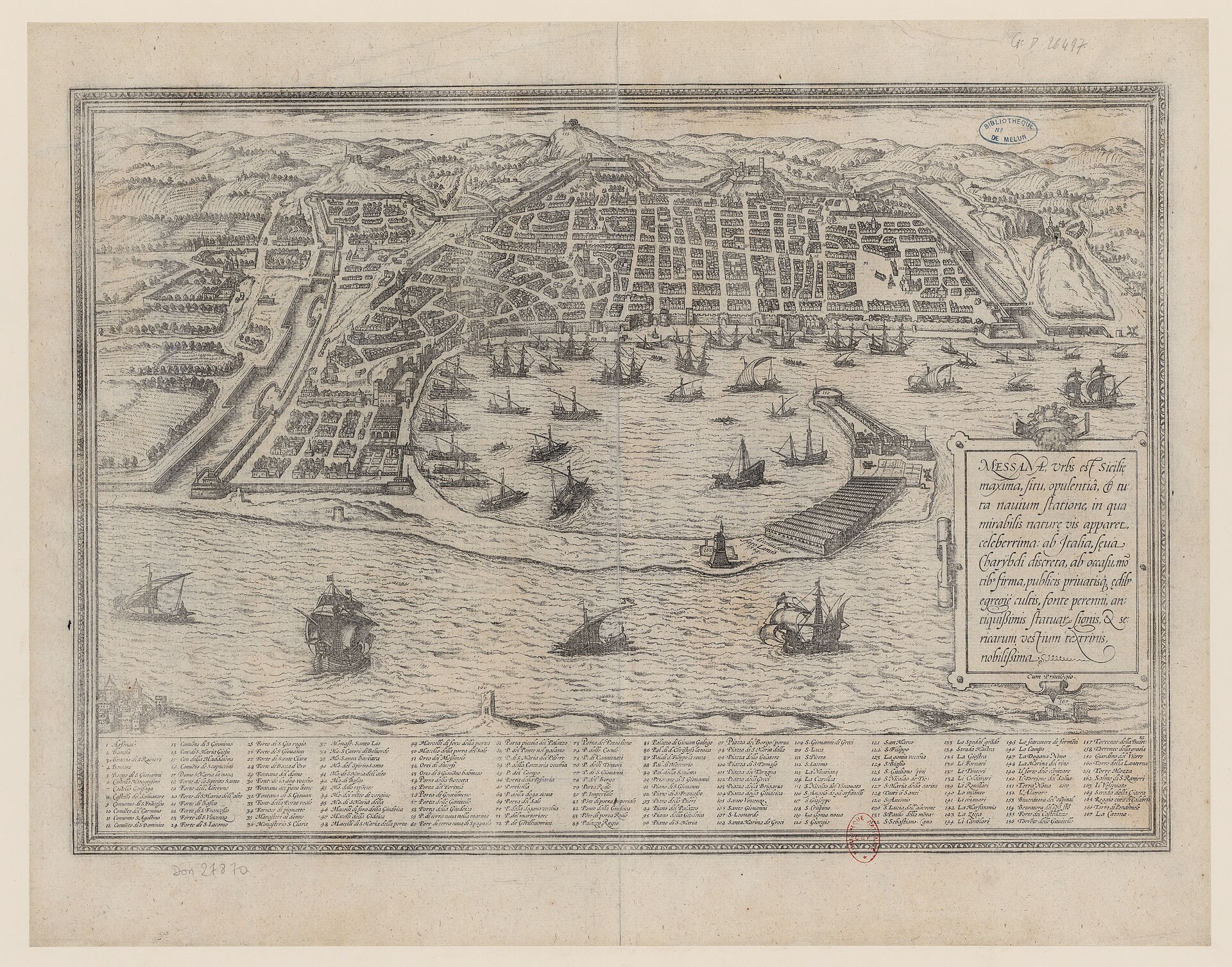
Engraving
Messina in 1572
Sicily’s great port, where Caravaggio worked in 1609.
Georg Braun and Frans Hogenberg, Civitates Orbis Terrarum, 1572 (public domain)
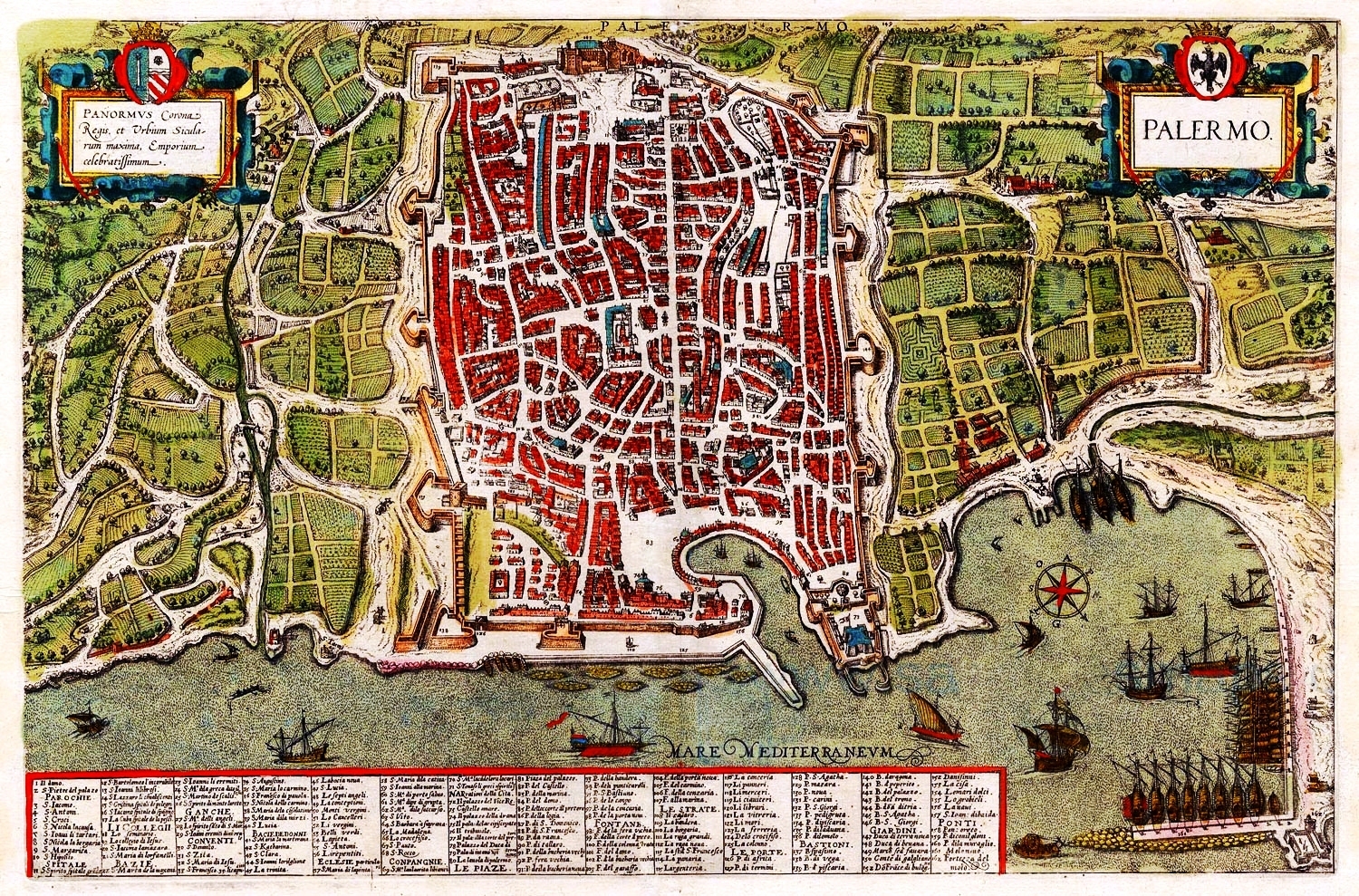
Engraving
Palermo, around 1590
The Sicilian capital, the last stop before he returned to Naples.
Georg Braun and Frans Hogenberg, Civitates Orbis Terrarum, 1588 (public domain)
He's still painting.
The commissions keep coming, even now. But people who met him in Sicily describe a frightened man. He sleeps fully clothed, with a dagger at his side.
He has a black dog he's trained to do tricks, he calls it Crow.
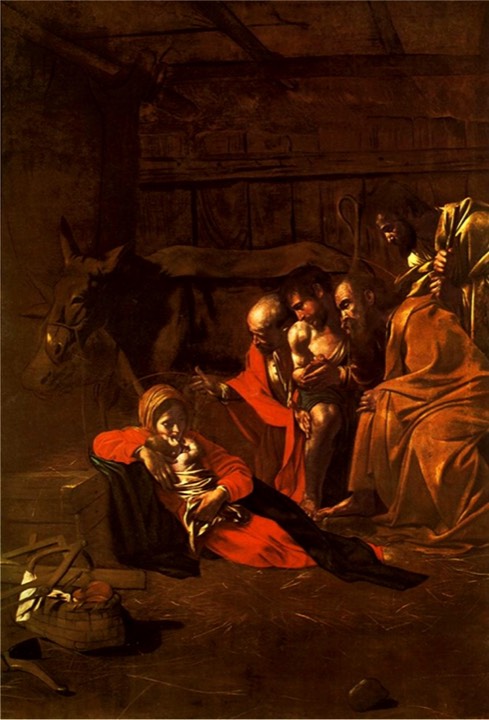
The paintings change too. They get emptier. Darker. In The Burial of St Lucy, tiny mourners are dwarfed by two huge gravediggers and a great bare wall. In The Adoration of the Shepherds, Mary lies exhausted on the ground beside the manger, and the shepherds can't quite reach her.
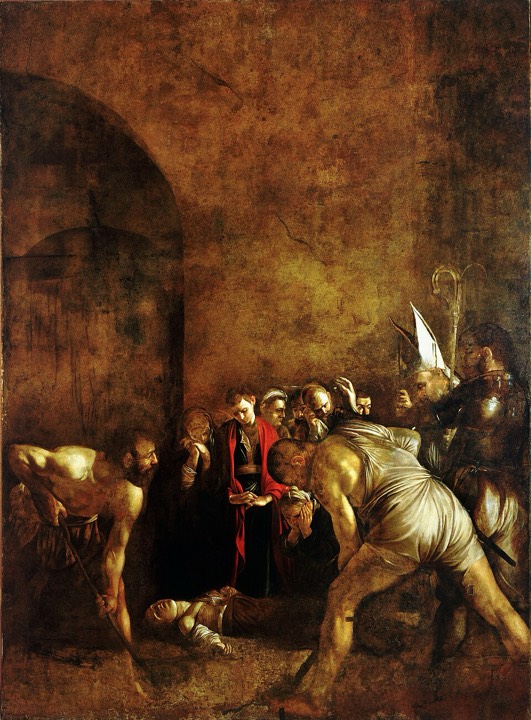
Painting
The Burial of St Lucy
Syracuse, Sicily
Tiny mourners under a great bare wall.
Painting
The Adoration of the Shepherds
Museo Regionale, Messina
Mary lies exhausted on the ground beside the manger.
Often the only bright thing left in them is a single red cloth.
Graham-Dixon calls it the saddest of nativities.
SFX: A quiet room. A clock ticking. Pages turning.
Dublin.
Marie's protection doesn't come from a Grand Master. It comes from an old Jesuit priest.
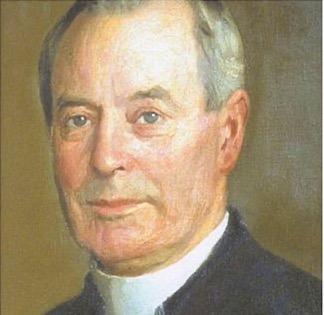
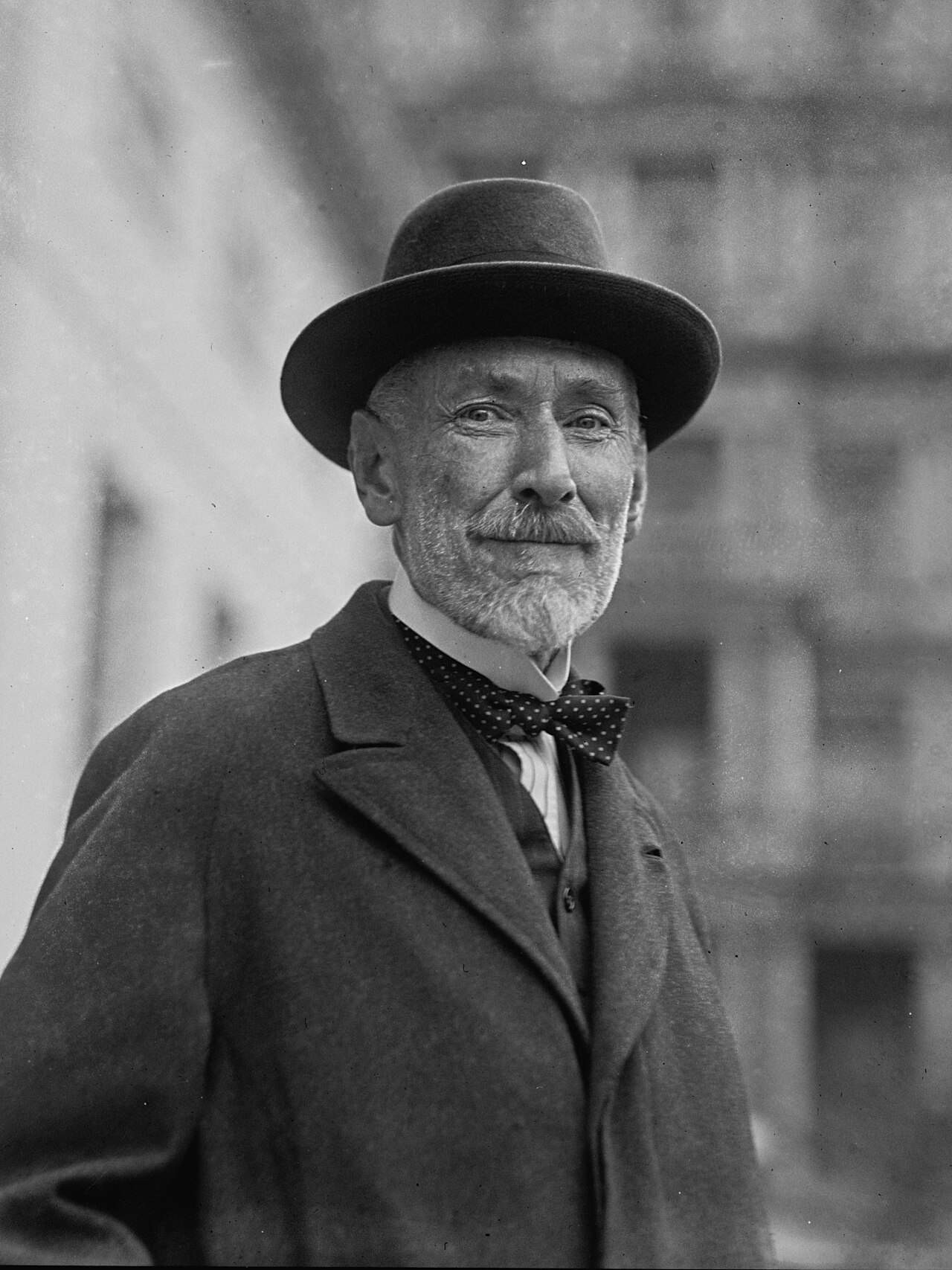
Father Thomas Finlay is one of the best-known clergymen in Ireland. A professor of political economy at University College Dublin. One of the founders, alongside Horace Plunkett, of the Irish co-operative movement, which helped small farmers band together to buy and sell. A writer, an editor, a teacher. By the early 1930s he's in his eighties.
Painting
Father Thomas Finlay SJ
Portrait from the cover of Thomas J. Morrissey’s biography of him.
Photograph
Sir Horace Plunkett, 1923
Founder, with Father Tom Finlay, of the Irish co-operative movement.
Photo: National Photo Company, Library of Congress
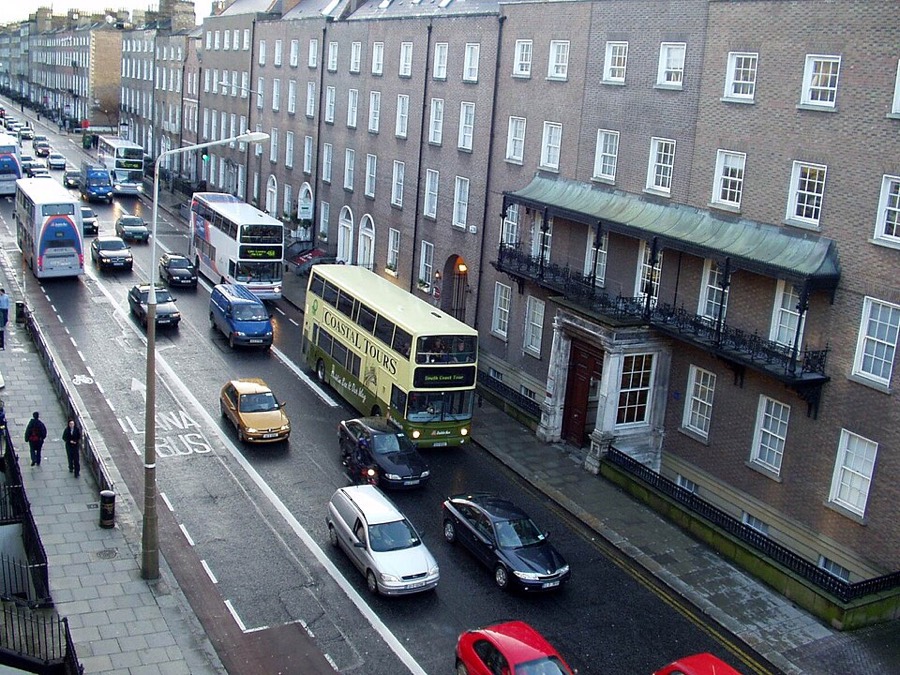
He lives with the Jesuit community at 35 Lower Leeson Street, a few minutes' walk from Marie's front door.
Photograph
Leeson Street, Dublin
The painting hung in the dining room of the Jesuit house at No. 35 for about sixty years
And he's been her spiritual adviser and friend since the darkest days of her life. It was Father Finlay who comforted her after Percival was killed.
SFX: A tavern at night. Raucous laughter. Then a scuffle. A scream.
By the autumn of 1609 Caravaggio is back in Naples, under Colonna protection again, waiting for news of a pardon.
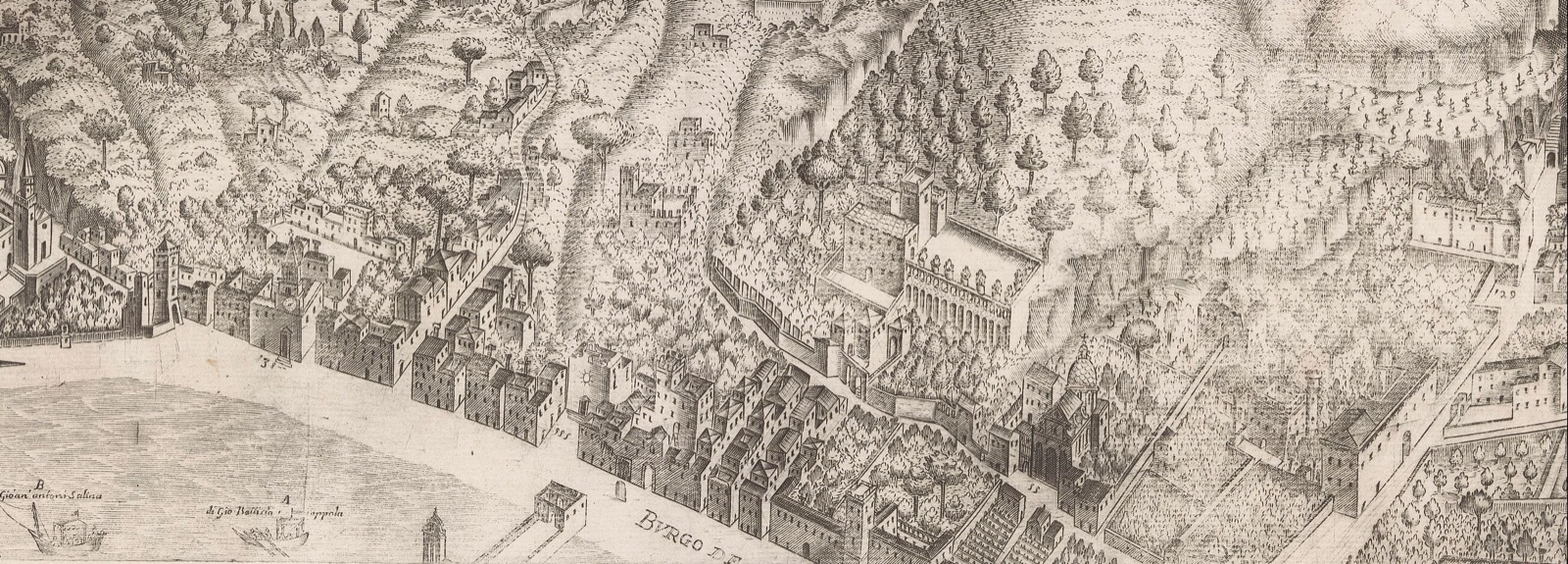
Engraving
Chiaia, Naples, 1629
The Colonnas’ Naples residence, Palazzo Cellammare, stood on the hillside above the Borgo di Chiaia.
Alessandro Baratta, Fidelissimae urbis Neapolitanae, 1629 (detail). Rijksmuseum, CC0 ↗
One night, outside a notorious tavern called the Osteria del Cerriglio, four men grab him and hold him down. And they slash his face.
In this world, that's a very particular punishment. It's called a sfregio. You don't just kill a man who has insulted your honour. You mark him, so that everyone who ever looks at him knows what he did.
Word reaches Rome that he's been killed, or at least badly disfigured. He survives. But he never fully recovers.
Graham-Dixon believes the men were sent by the knight he'd attacked in Malta. Roero had waited a year. And then he'd come to collect.
SFX: Low drone.
In the months that follow, Caravaggio paints The Martyrdom of St Ursula. It's probably his last picture.
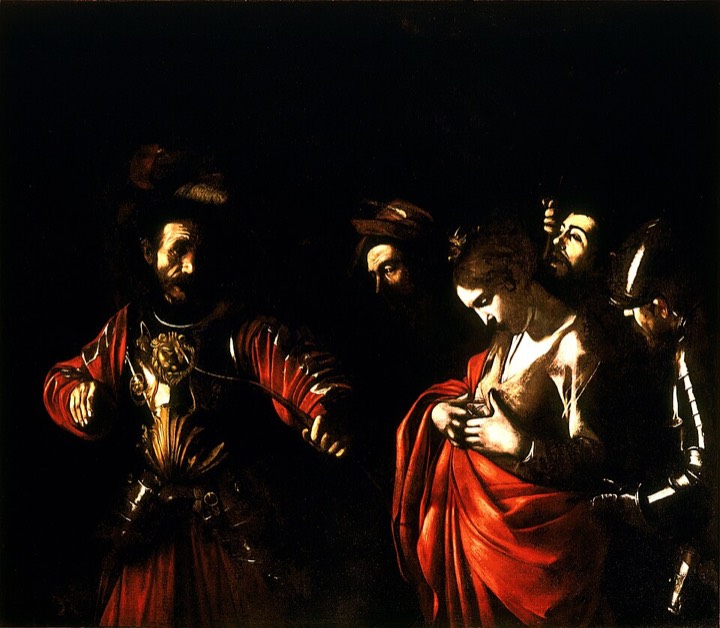
Painting
The Martyrdom of St Ursula
Gallerie d’Italia, Palazzo Zevallos, Naples
Probably his last painting. His face looks out of the dark behind Ursula, with no lantern this time.
Ursula is a saint who was shot with an arrow by a king she'd refused to marry. Caravaggio paints the moment the arrow hits her, at point-blank range. She looks down at the wound in her chest, almost calmly, as if she can't quite believe it.
And behind her, squeezed into the darkness, is Caravaggio's own face. Mouth open, as if he's gasping. Close enough to feel the arrow.
Eight years earlier, in The Taking of Christ, he'd painted himself at the edge of the arrest, holding up a lantern.
Now there's no lantern. He's looking out of almost total darkness.
SFX: Sea. A small boat creaking. Oars.
July 1610.
The pardon is finally being arranged, through Cardinal Scipione Borghese. And it has a price. Paintings.
Caravaggio boards a small boat in Naples and sails north up the coast towards Rome, with three paintings meant for the Cardinal.
At a little port called Palo, he goes ashore and is arrested, over some kind of dispute. We don't know what.
While he's being held, the boat sails on without him. With the paintings still on board.
By the time he's paid his way out, it's gone. So he sets off after it, up the coast, to Porto Ercole, where the boat is headed.
SFX: Heat. Cicadas. Waves on a beach.
It's the middle of a Tuscan summer. He's still recovering from the attack in Naples. He's exhausted.
At Porto Ercole, he falls ill with a fever.
He dies there, probably on the eighteenth or nineteenth of July, 1610. He's thirty-eight years old.
There's an old romantic story of him running frantically along a beach, chasing a boat on the horizon. Graham-Dixon doesn't believe it, or the theories that he was murdered. The best account comes from a letter written by the Pope's representative in Naples, and seems to have come from the boatman himself.
Caravaggio is buried in an unmarked grave. Nobody knows exactly where.
The Knights of Malta seize his last paintings, claiming they belong to a dead knight.
SFX: A Dublin drawing room. Rain on tall windows. A picture being lifted down from a wall.
Dublin, the early 1930s.
Marie Lea-Wilson takes the big, dark painting down from her wall on Fitzwilliam Place.
The one she'd brought back from Scotland. The one she believes is a Honthorst.
And she gives it to the Jesuits at Leeson Street. A gift, in thanks to Father Finlay for everything he's done for her.
Why that painting? She never said.
But it shows an innocent man, betrayed in plain sight and seized by armed men, on his way to his death. Just like the husband she always believed was innocent.
The Jesuits hang it in the dining room of their house at 35 Lower Leeson Street. Over the years it grows darker under layers of grime. Generations of priests eat their dinners beneath it.
Nobody looks too closely.
And nobody notices that on the far right, holding up a little lantern, is the face of the man who painted it.
SFX: Music sting.
Act 6
SFX: A grand library. Pages turning. A quill scratching.
Rome, 1672.
Sixty years after Caravaggio's death, a scholar called Giovanni Pietro Bellori publishes a book of lives of the great artists.
Caravaggio is in it. But not as a hero.
Bellori is the voice of the art establishment. He believes painting should show nature as it ought to be. Noble, beautiful, ideal. And Caravaggio painted nature exactly as it was. Dirty feet. Wrinkled faces. Swollen corpses.
To Bellori, that's not genius. It's a lack of taste. He admits Caravaggio had talent, but says he had no judgement, no decorum and no imagination. He just copied whatever was in front of him.
The great French painter Nicolas Poussin, who lived in Rome, goes further. He's reported to have said that Caravaggio had come into the world to destroy painting.
And the man who wrote one of the very first biographies of Caravaggio? That was Giovanni Baglione. The rival who'd sued him for libel.
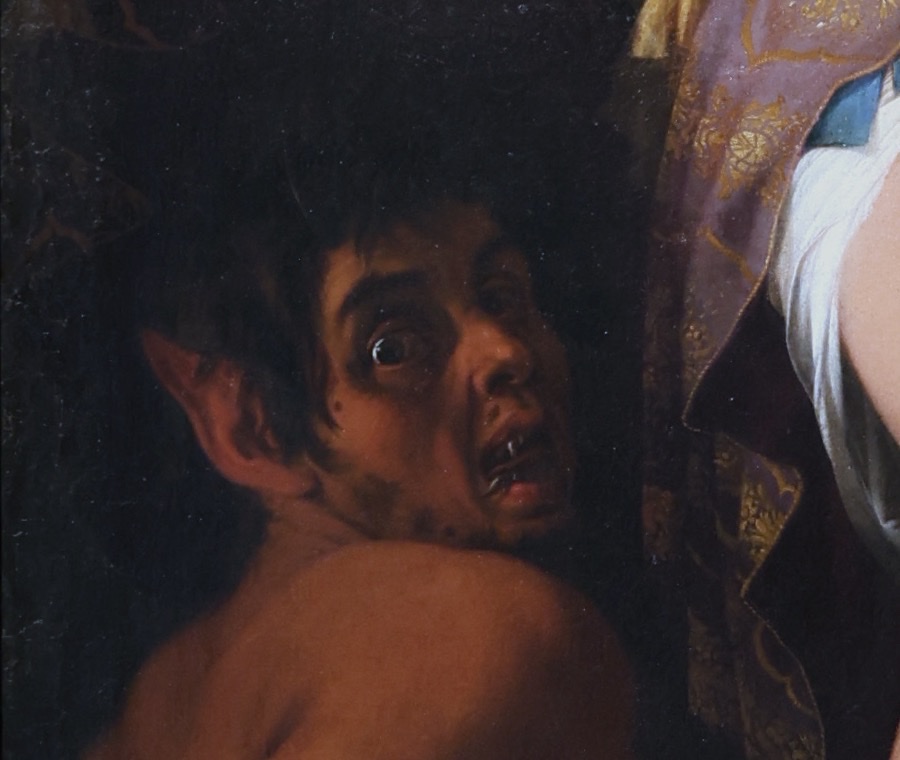
Detail
Caravaggio as the devil
Sacred and Profane Love, Palazzo Barberini, Rome
The devil Baglione gave Caravaggio’s face.
SFX: Low drone.
So the story of Caravaggio gets written by his critics and his enemies. Brilliant, but a vulgar brawler.
His followers fade out of fashion. Some get credited to other painters.
Including one in particular.
SFX: A palace interior. A clock ticking. Dust sheets being pulled off furniture.
The Palazzo Mattei.
The Taking of Christ stays where Ciriaco Mattei hung it, in the family palace, for nearly two hundred years.
But somewhere along the way, it loses its name.
In the 1780s, when the family's paintings are listed in an inventory, The Taking of Christ isn't recorded as a Caravaggio at all.
It's put down as a work by Gerrit van Honthorst. A Dutch painter who came to Rome around the time Caravaggio died.
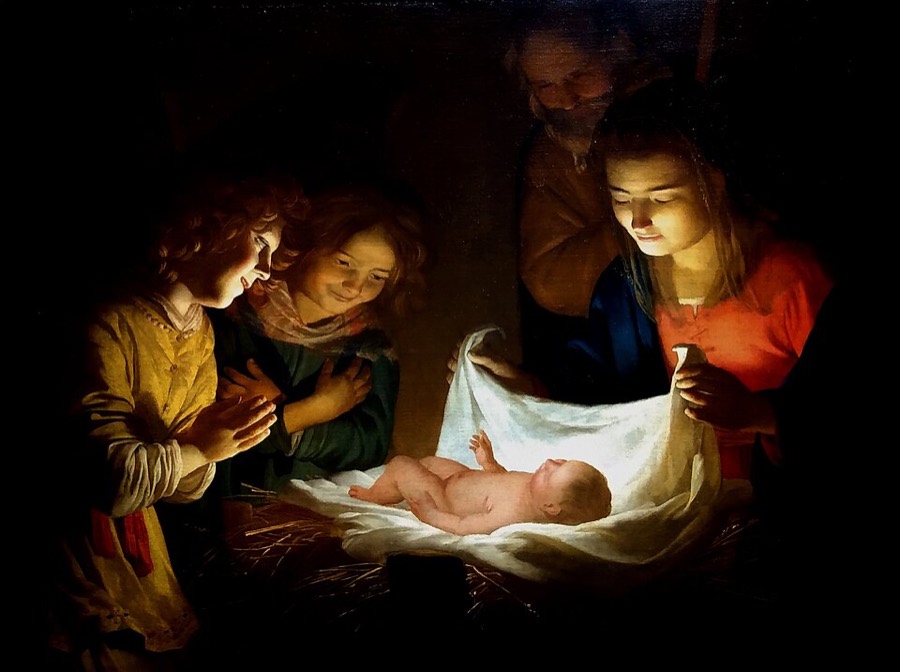
Painting
Gerrit van Honthorst, Adoration of the Child
c.1619–20. Honthorst was known in Italy as Gherardo delle Notti. Uffizi, Florence.
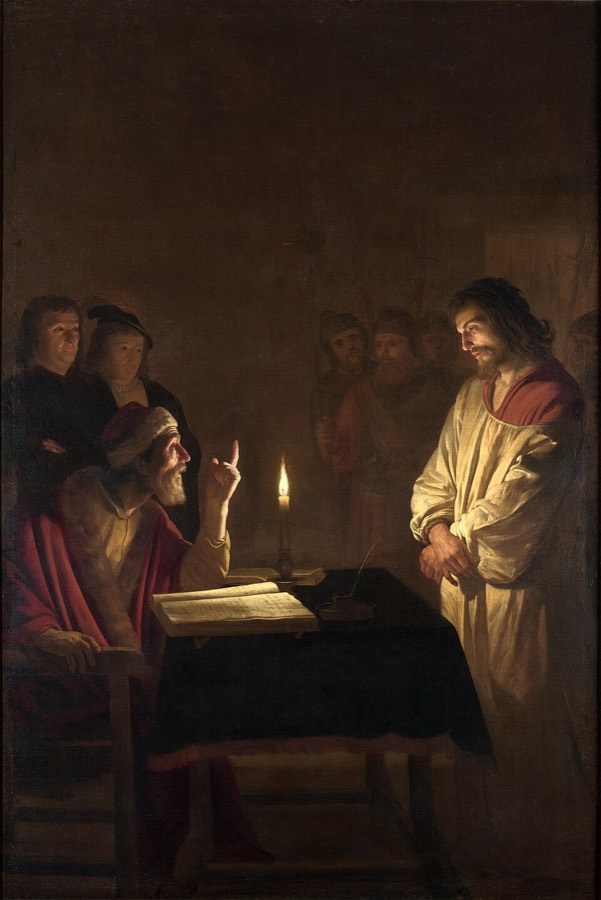
Painting
Christ before the High Priest
National Gallery, London
The kind of candlelit night scene that earned Honthorst the nickname Gherardo delle Notti, the name later put on The Taking of Christ.
Honthorst was definitely inspired by Caravaggio's style.
Honthorst started painting night scenes lit by candles and torches.
The Italians gave him a nickname for it: Gherardo delle Notti. Gerard of the Nights.
By then Caravaggio's name means very little.
A dark, dramatic night scene in his style looks, to whoever's making the list more like a Honthorst.
SFX: A quill scratching. Coins. A carriage pulling away.
In January 1802, the Duke Giuseppe Mattei sells it.
The buyer is a Scottish collector, William Hamilton Nisbet. He takes it home to his family seat, Biel House, in East Lothian, near the coast east of Edinburgh.
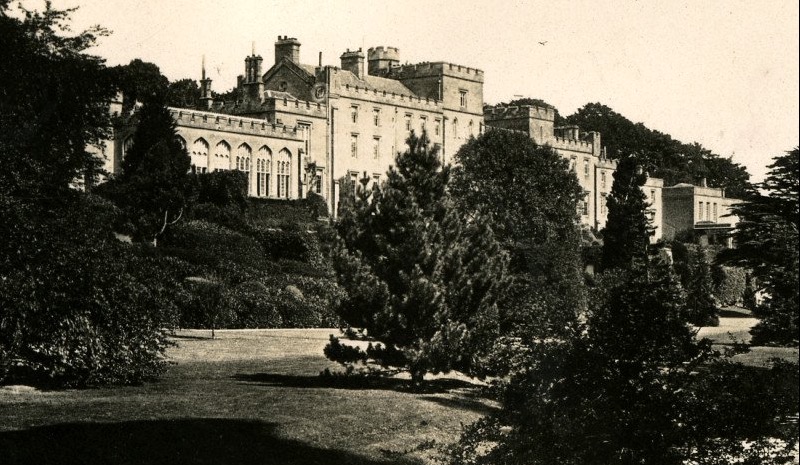
Photograph
Biel House, East Lothian
Seat of the Hamilton Nisbet family, where the painting hung from 1802 to about 1920.
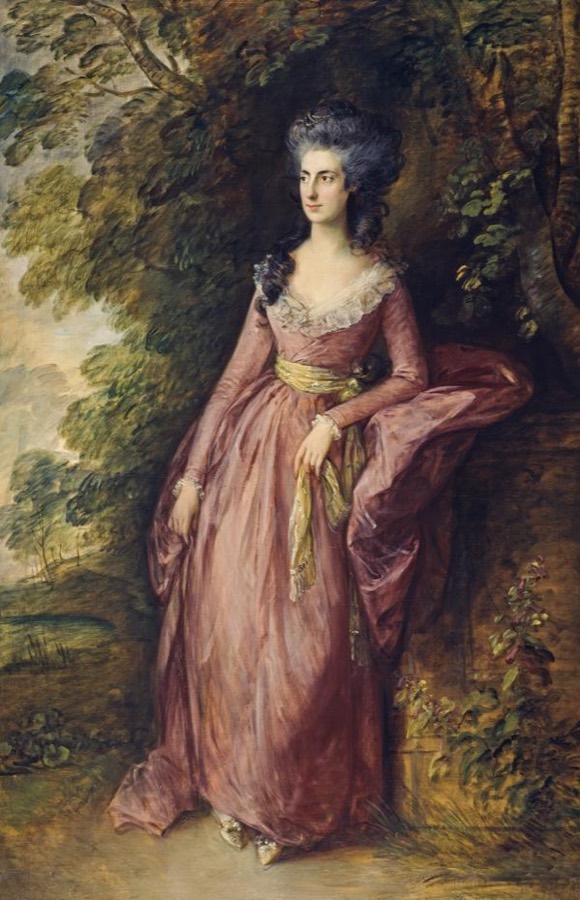
Painting
Thomas Gainsborough, Mrs Hamilton Nisbet
Mary Hamilton Nisbet was the wife of William Hamilton Nisbet, who bought the painting in Rome in 1802. National Galleries of Scotland
Nisbet's daughter, Mary, had married Lord Elgin. The same Lord Elgin who was, at that very moment, having the marble sculptures stripped off the Parthenon in Athens and shipped back to Britain.
SFX: A Scottish country house. Rain. A fire crackling.
The Taking of Christ hangs at Biel House for more than a hundred years.
Generations of Nisbets walk past it on the way to dinner.
As far as anyone there knows, it's a nice old Dutch painting.
SFX: Rain on tall Dublin windows. A clock ticking.
Dublin, 1940.
Two things happen in Marie Lea-Wilson's world.
In January, Father Tom Finlay dies, at the age of ninety-one. The man she'd given the painting to.
And at the end of the year, a new Archbishop of Dublin is appointed. John Charles McQuaid.
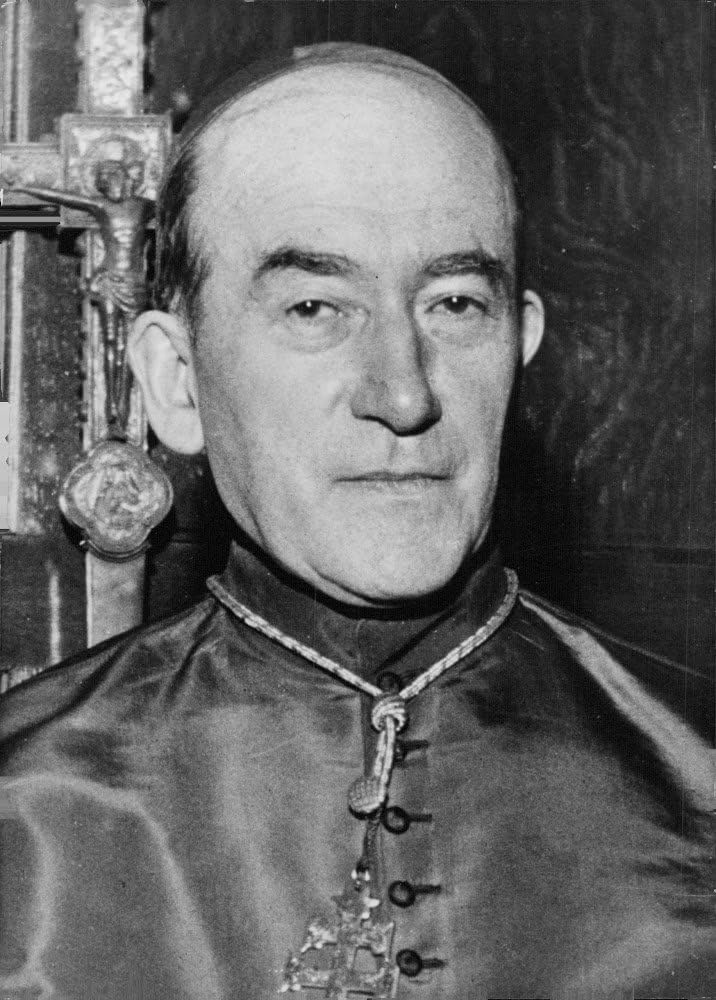
Photograph
Archbishop John Charles McQuaid, around 1950
Archbishop of Dublin from 1940 to 1972, and one of Marie Lea-Wilson’s strongest supporters.
Photo: Camera Press, public domain
McQuaid will run the Catholic Church in Dublin for more than thirty years. He's austere, controlling and enormously powerful. Very little happens in the hospitals, schools and charities of the city without his say-so.
And in time, Dr Lea-Wilson becomes one of the doctors he trusts.
SFX: A hospital ward. Children's voices, quiet. A nurse's shoes on a polished floor.
By now, Marie has made her name in one disease in particular. Rheumatic fever.
It mostly strikes children. It starts as a sore throat, a strep infection, and it can go on to attack the joints and, worst of all, the heart. In the overcrowded tenements of Dublin, it's everywhere. Some children are left with damaged hearts for life. Some die.
At the National Children's Hospital on Harcourt Street, Marie takes charge of its rheumatic fever clinic. Her colleagues later said she'd lobbied the hospital board hard for the job, ahead of doctors with more experience.
And her treatment of choice is bed rest.
The old thinking was that a child with rheumatic fever should be kept completely still in bed, to protect the heart. Marie believes in it absolutely. And she keeps her patients in bed for far longer than most doctors would. Months. Sometimes more than a year.
SFX: An Edinburgh auction room. A gavel. "Lot thirty."
Back in Scotland, in 1920, the last of the Nisbet family line dies, and the contents of Biel House go to auction.
On the twenty-fifth of June 1921, at Dowell's auction rooms in Edinburgh, lot 30 is knocked down for eight guineas.
Eight guineas.
For a painting Ciriaco Mattei had paid a hundred and twenty-five scudi for, and that would one day be called priceless.
Less than a year later it's back at Dowell's, and sells again, this time for five guineas.
And then, a couple of years later, it's in Dublin. The National Gallery of Ireland says Marie bought it on a holiday in Scotland, around 1924. How much she paid, nobody knows.
What we do know is that in 1924 she paid a Dublin restorer called James Hicks twenty pounds to repair its frame. The receipt turned up among her papers in 2016.
Twenty pounds for the frame. Quite possibly more than she'd paid for the painting.
SFX: A crowded gallery. Footsteps on parquet. Murmuring voices.
Milan, 1951.
An Italian art historian called Roberto Longhi puts on an exhibition of Caravaggio's work at the Palazzo Reale.
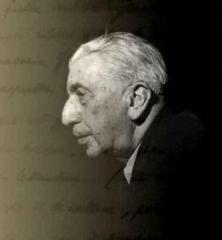
Photograph
Roberto Longhi (1890–1970)
The art historian whose 1951 exhibition in Milan made Caravaggio famous again.
Public domain
Longhi has spent decades arguing that the largely forgotten Caravaggio is actually one of the most important painters who ever lived. That without him there's no Rembrandt, no Velázquez, no Rubens as we know them.
Huge crowds come. And almost overnight, after three centuries in the shadows, Caravaggio is famous again.
Scholars start hunting for his missing paintings. There are plenty of them. Pictures that are known to have existed from the old biographies and inventories, but that nobody can find.
One of them is The Taking of Christ, painted for Ciriaco Mattei. Some people think it's lost. Others think one of the copies that turn up over the years might be it.
Nobody thinks to look in a Jesuit dining room in Dublin.
SFX: A country house. Gravel drive. Birdsong. Children's voices in the distance.
Cabinteely, south County Dublin, 1951.
That same year, Marie becomes lead clinician at St Gabriel's Hospital. A hospital given over entirely to children with rheumatic fever.
It's her own domain now. And she runs it her way.
In 1956, Archbishop McQuaid appoints her to the planning commission for a brand new children's hospital, Our Lady's in Crumlin. She's at the heart of Catholic medicine in Ireland.
Colleagues remember her as stern. She goes to Mass every day. She belongs to a Catholic lay organisation called Regnum Dei.
She keeps four dachshunds.
SFX: A letter being opened. Paper rustling.
But the rest of the medical world is moving on.
By the 1950s, research in Britain and America is showing that long bed rest does little or nothing for children with rheumatic fever. And penicillin can now treat the strep infections that trigger it.
Specialists in North America and England write to Marie. They urge her to change her methods. They send her the latest papers.
She dismisses them.
The children at St Gabriel's keep lying in their beds. Some of them for more than a year.
And there are worse complaints. Of misdiagnosis. Of children kept in a hospital for a disease they may never have even had.
Years later, a review of the hospital's records would find no evidence of active rheumatic fever in a substantial number of her inpatients.
So how did it go on for so long?
The Women's Museum of Ireland, which has written about her life, suggests her closeness to McQuaid shielded her from scrutiny. In the Dublin of the 1950s and 60s, very few people were willing to take on a doctor who had the Archbishop's backing.
St Gabriel's closes in 1970.
SFX: A church. A single bell tolling.
The following year, 1971, Dr Marie Lea-Wilson dies in Dublin, she was in her eighties.
She's buried in Deansgrange Cemetery.
SFX: Low drone. A dining room. Cutlery on plates. Quiet conversation.
And across the city, in the dining room at 35 Lower Leeson Street, the Jesuits are still eating their dinners under a big, dark painting.
As far as anyone in the house knows, it's a Honthorst.
SFX: Music sting.
Act 7
SFX: A Dublin street. Traffic. A heavy front door. Footsteps in a hallway.
Dublin, August 1990.
The Jesuits at 35 Lower Leeson Street were renovating their building. They had to take down all their paintings to carry out the works
So their newly appointed Superior Father Noel Barber, decides, if they have to take them down they might as well get them looked at, cleaned and valued maybe. He calls the National Gallery of Ireland, a few streets away, and asks if someone could come over and give the collection the once-over.
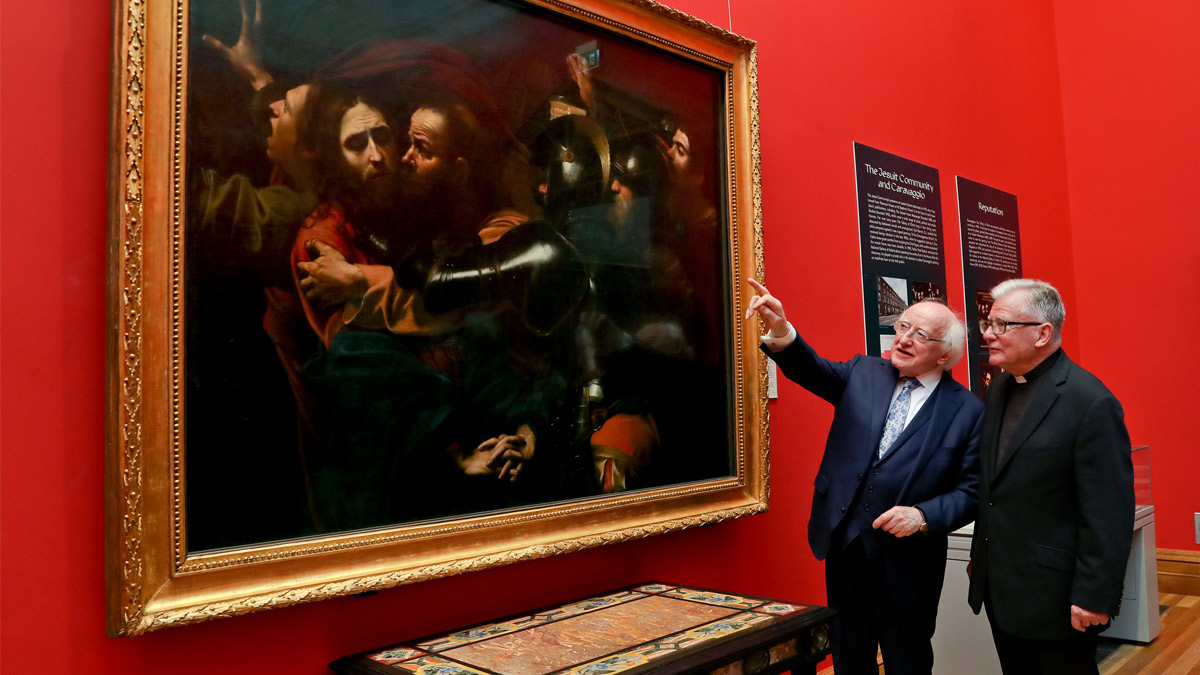
Photograph
Father Noel Barber SJ, 2018
On the right, with President Michael D. Higgins in front of The Taking of Christ at the National Gallery of Ireland.
The Gallery sends its senior conservator. An Italian called Sergio Benedetti.

Photograph
Sergio Benedetti
The Florentine conservator who recognised the painting in 1990. He worked at the National Gallery of Ireland for 30 years and died in 2018.

Photograph
Benedetti restoring The Taking of Christ
Working on the painting in the Gallery’s conservation studio.
SFX: A dining room. Quiet. A chair scraped back. Footsteps on floorboards.
Benedetti is shown around the house. Portraits. Religious pictures. The kind of thing you find in any old Jesuit house.
Then he walks into the parlor.
On the wall is a big, dark painting, almost black with sixty years of grime and old varnish.
On the frame there's a small gilt tablet with a name on it. Gherardo della Notte. Honthorst.
ARCHIVE: RTÉ, 20 August 1993. Fr Noel Barber.
"Well, I was under the impression that this painting, which was in the community since the early '30s, was by Gerrit van Honthorst, a good second division Flemish painting."
Benedetti looks up at it.
He can just about make out the shapes. A soldier in black armour. A man running away to the left, with a red cloak flying out behind him. A kiss.
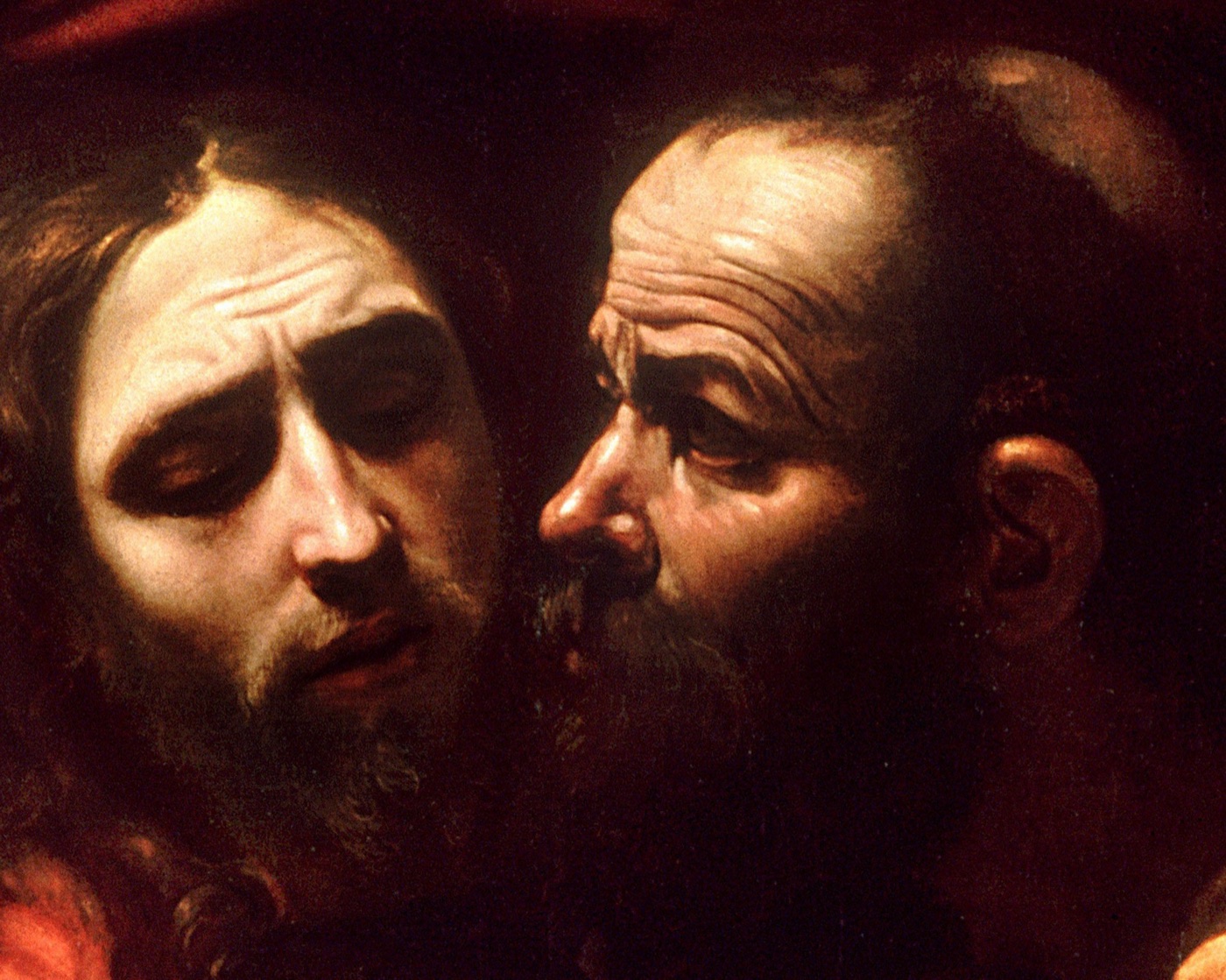
Close-up
The kiss
What Benedetti could just make out under sixty years of grime: Judas leaning in to kiss Jesus.
He knows the composition. Every Caravaggio specialist does. The Taking of Christ is famous, from the old biographies and its copies. The original has been lost for centuries.
But something about this one doesn't look like a copy.
SFX: A low drone.
He doesn't say so. Not yet.
He tells the Jesuits the painting needs cleaning, and asks if he can take it back to the Gallery.
SFX: A conservation studio. The hum of a lamp. A cotton swab dabbed on canvas.
What follows is done in secret.
For the next three years, Benedetti works on the painting in the Gallery's conservation studio. Only a handful of people know what he suspects.
He cleans it a few centimetres at a time. Swab by swab, layers of dirty varnish come away. Underneath, the colours are still there. The red of John's cloak. The black armour. The pale face of Jesus.
His reds were vermilion and red lake, laid over a dark ground so they glow. Red lake was one of the most expensive colours a painter could buy.
The Gallery X-rays it.
X-rays show what's underneath the paint. In a copy, there's usually not much to find. A copyist knows exactly what the finished picture should look like, and paints it straight.
But this canvas is full of changes. Places where the painter moved something, painted over it and tried again. Judas's ear has been moved. Painters call these changes pentimenti, from the Italian for repentance.
They're the marks of an artist working the picture out as he goes. Exactly the way Caravaggio worked, straight onto the canvas, from models posed in front of him, with no drawings.
Benedetti is now almost certain. But he can't prove it.
To prove it, he needs paperwork.
SFX: A small Italian town. Church bells. Swallows. A heavy wooden door creaking open.
Recanati, Italy.
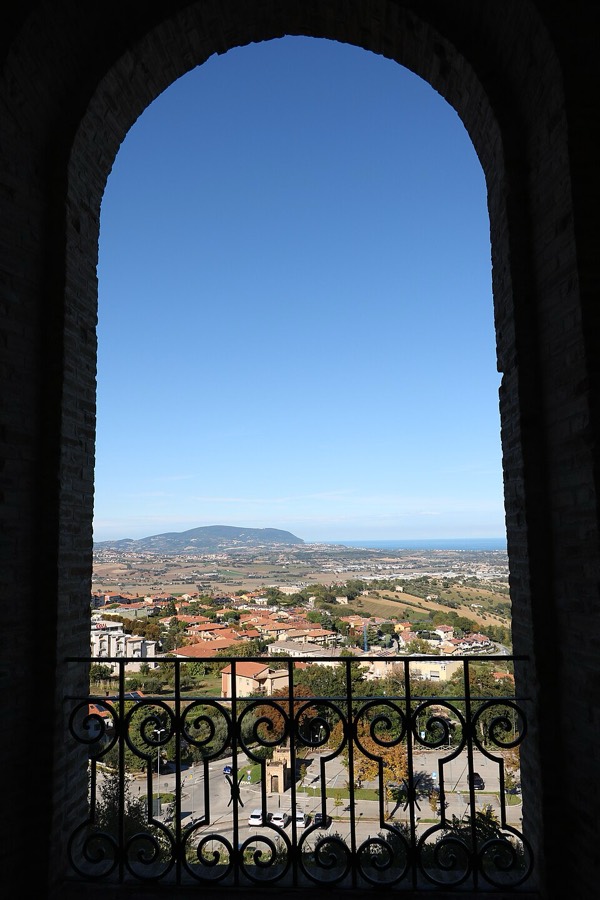
Photograph
Recanati, in the Marche
The Mattei family archives kept here held the payment records that proved the attribution
A hilltop town in the Marche, near the Adriatic coast, on the other side of Italy from Rome.
In the palace of a branch of the Mattei family is the old family archive. Boxes and bundles of papers that have barely been touched in centuries.
And two young Italian art history graduates, Francesca Cappelletti and Laura Testa, have been working their way through it. They're researching the Mattei family's collection. What the brothers bought, when, and from whom.
Photograph
Francesca Cappelletti, 2021
As a young graduate she found the Mattei payment records in Recanati. Here, as director of the Galleria Borghese, she shows Jill Biden round the museum.
Photo: The White House, public domain
They don't know anything about Dublin.
SFX: Old paper being unfolded. A magnifying glass set down on a desk.
In the account books of Ciriaco Mattei, they find the entries.
January 1602. A payment to Caravaggio for The Supper at Emmaus.
And the second of January 1603. One hundred and twenty-five scudi, frame included, for a painting of the taking of Christ.
They trace it forward through the family inventories. From Ciriaco to his heirs, generation by generation.
And then they find where the name changes. In the later records, the painting is no longer listed as a Caravaggio. It's put down as a Honthorst. With his nickname misspelt. Gherardo della Notte.
And they find the sale. The twenty-seventh of January 1802. To a Scotsman called William Hamilton Nisbet. Eighty scudi, at a time when a real Caravaggio in the same family inventories was valued at five hundred.
SFX: A phone ringing in an office. Picked up.
Back in Dublin, Benedetti has been working the other direction.
From the painting on his bench. Back to Marie Lea-Wilson. To Scotland. To the auction rooms in Edinburgh. To the Nisbets of Biel House.
The two trails meet in Scotland.
The painting the Mattei sold to Nisbet in 1802, as a Gherardo della Notte, is the painting that hung at Biel House for more than a century. The painting sold at Dowell's for eight guineas. The painting Marie Lea-Wilson brought home to Dublin. The painting with "Gherardo della Notte" on its frame, in the Jesuits' dining room.
It's the Caravaggio.
SFX: A newsroom. Typewriters. A studio door closing.
On the twentieth of August 1993, the National Gallery of Ireland makes the announcement.
That day, Father Noel Barber is interviewed on RTÉ.
ARCHIVE: RTÉ, 20 August 1993. Fr Noel Barber.
"And then we handed it over, and then some, quite later, a year or so later, we got this extraordinary news that it wasn't a Honthorst, but it was almost certainly a Caravaggio."
ARCHIVE: RTÉ, 20 August 1993. Interviewer, then Fr Noel Barber.
"And what was your reaction when you heard that?"
"Well, it was rather stunning. It took some while to catch one's breath and to realise the full impact of what had actually been in our possession, unknown, for the best part of fifty, sixty years."
The Gallery's assistant director, Dr Brian Kennedy, is asked what it's worth.
ARCHIVE: RTÉ, 20 August 1993. Dr Brian Kennedy.
"Oh, lots of things are possible, of course, yes. I mean, it's worth many, many millions. Valuations have been put on it, between 25 and 50 million, and they would not be out of order."
The painting still belongs to the Jesuits. They could sell it.
They decide not to. Instead, they leave it with the National Gallery of Ireland on indefinite loan, so anyone can come and see it.
ARCHIVE: RTÉ, 20 August 1993. Interviewer, then Fr Noel Barber.
"Do you have any regrets at all that you didn't hang on to it, or that you're not going to hang on to it?"
"Well, it would mean that it would have hung in our house for the foreseeable future as van Honthorst. Now, we have the satisfaction of participating in the action that has revealed that we in Ireland have a Caravaggio, and I think all of us in Ireland must rejoice greatly in that."
SFX: A crowd gathering. Camera flashes. Murmuring.
The sixteenth of November 1993.
The National Gallery of Ireland opens an exhibition. Caravaggio: The Master Revealed.
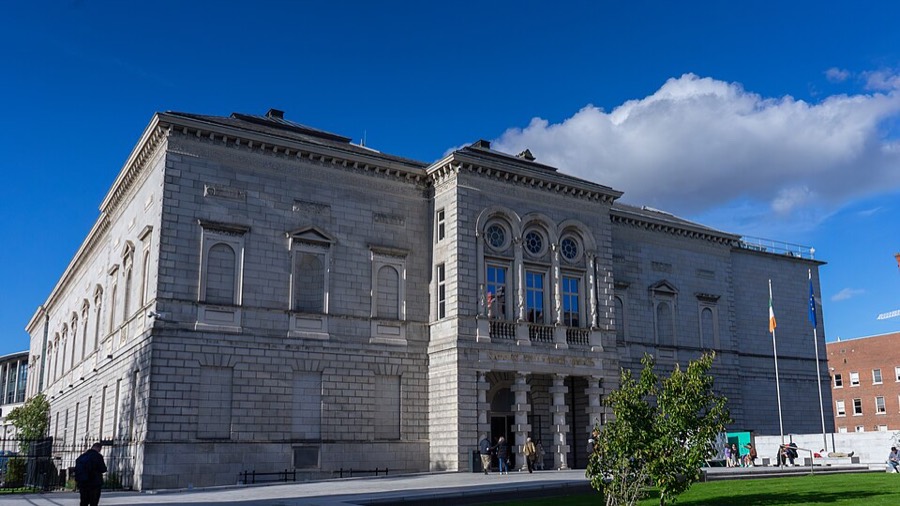
Photograph
The National Gallery of Ireland
On Merrion Square, where the painting was unveiled on 16 November 1993.
At the centre of it is The Taking of Christ. Cleaned, and catalogued as a Caravaggio.
The Gallery's director, Raymond Keaveney:
ARCHIVE: RTÉ, 1993, as replayed in RTÉ News, April 1997. Raymond Keaveney.
"I think there isn't a gallery in the world who would give its eye teeth for a painting of this calibre. It's of world importance, not just national importance."
The news goes around the world. A lost Caravaggio, found in a Dublin dining room.
If you look at the little label beside the painting, it just states;
“On indefinite loan from the Jesuit Community, Leeson Street, who acknowledge the kind generosity of the late Dr Marie Lea-Wilson.”
But now you know the full story.
SFX: Music sting.
Coda
SFX: A museum at night. A security light humming. Glass cracking.
July 2008.
In the middle of the night, thieves break into the Museum of Western and Eastern Art.
Photograph
The Museum of Western and Eastern Art, Odesa
Where the copy of The Taking of Christ was cut from its frame in 2008.
Photo: We Art Museum, Wikimedia Commons, CC BY-SA 4.0
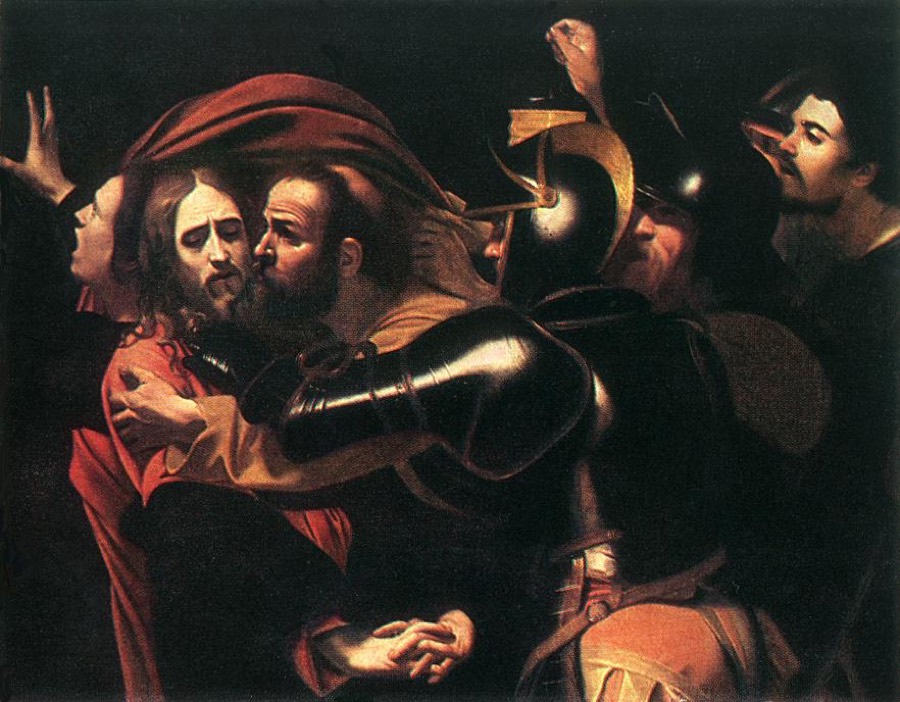
Painting
The Taking of Christ, Odesa version
Museum of Western and Eastern Art, Odesa
Cut from its frame by thieves in July 2008.
They go straight for one painting.
The Taking of Christ.
The thieves don't bother with the frame. They cut the canvas out of it with a blade and roll it up.
SFX: A blade slicing canvas.
For six years, nobody knows where it is.
Then in November 2014, four men try to sell it to a buyer in Berlin.
The buyer is working with the police. German special forces move in and arrest them.
The painting is badly damaged. It takes restorers years to repair the canvas.
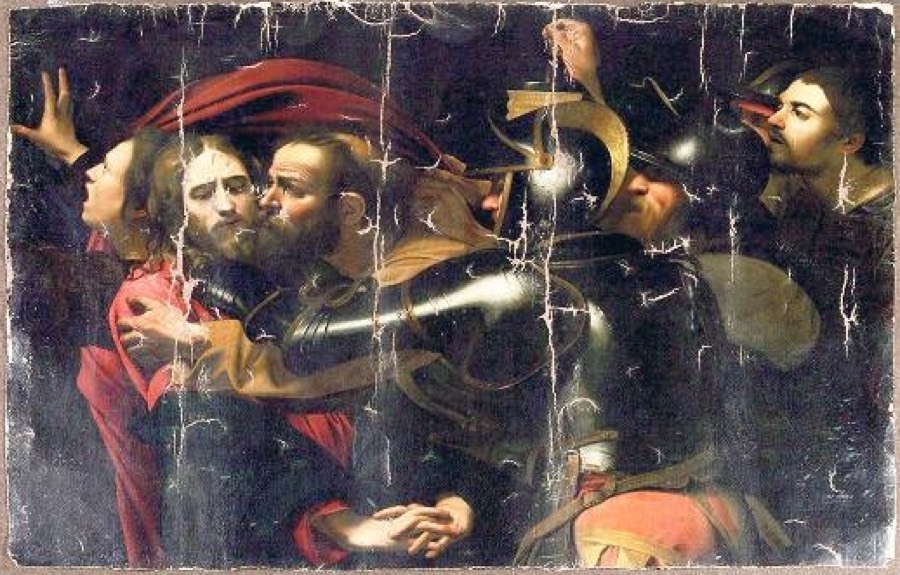
Painting
The Odesa version after its recovery
Recovered in Berlin, November 2014
The damage from being cut out of the frame.
Lucky for us this is not the Dublin Taking of Christ painting.
This is one of its copies on display in Odesa, Ukraine.
It was made not long after Caravaggio painted the original. Some scholars had once wondered whether it might be the original itself.
SFX: A gallery. Quiet footsteps. A visitor's voice, low.
As far as anyone knows, nobody has ever tried to steal the Dublin painting.
Except in the movies.
SFX: A cinema. A projector whirring.
SFX: audio clip trailer for ordinary decent criminal.
In 2000, Kevin Spacey stars in a film called Ordinary Decent Criminal, as a charming Dublin gangster loosely based on the real crime boss Martin Cahill. At the climax of the film, his gang steals a painting from the National Gallery of Ireland.

Film still
Ordinary Decent Criminal, 2000
Lynch’s gang carries The Taking of Christ out of the National Gallery, under a banner for the exhibition.
The Taking of Christ.
In real life though, the only real threat to the Taking of Christ comes from some beatles.
Not the bandmembers. Actual beetles.
SFX: A gallery. Quiet footsteps.
Dublin, April 1997.
ARCHIVE: RTÉ News, April 1997. Reporter.
"This is where the Caravaggio hung, until last week that is, when a member of the public noticed a strange little insect peeping out from the back of the painting."
The Gallery takes the painting down straight away.
When they turn it over, they find the beetles have been living in the lining canvas, the extra layer of cloth glued to the back of an old painting to hold it together. The Gallery's director, Raymond Keaveney, is asked where they came from.
ARCHIVE: RTÉ News, April 1997. Raymond Keaveney.
"Well, they're airborne, they can appear out of nowhere. They're not unlike woodworm, and they essentially have the same life cycle."
ARCHIVE: RTÉ News, April 1997. Reporter, then Raymond Keaveney.
"And they will eat the painting, will they?"
"No, it's like, you know, woodworm eats wood. These particular insects are interested, we believe, in the glue that was used to stick the lining canvas."
The painting itself isn't damaged. The lining is treated, repaired, and the picture goes back on the wall.
SFX: A busy Italian street. Scooters. A café.
And there's another version.
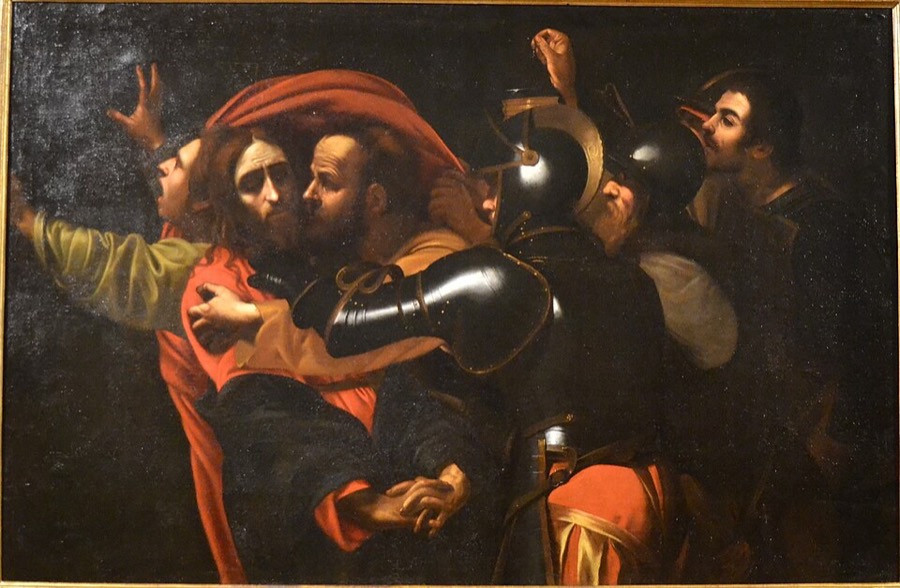
Painting
The Taking of Christ, Ruffo (Sannini) version
Private collection (Mario Bigetti); on loan to Palazzo Chigi, Ariccia
The rival version its owner believes is the original. Photo: IlSistemone, Wikimedia Commons, CC BY-SA 4.0.
It hangs today in Palazzo Chigi, in Ariccia, a hill town just south of Rome. It once belonged to the Ruffo family, and later to a Florentine lawyer called Sannini. Roberto Longhi, the man who brought Caravaggio back to fame, saw it in 1943 and thought it was a good copy.
Its owner, a former antiques dealer called Mario Bigetti, believes it's the real thing. That it's the painting Ciriaco Mattei paid for, and that the one in Dublin is the copy.
He isn't alone. Sir Denis Mahon, one of the great Caravaggio scholars of the twentieth century, thought Caravaggio may have painted the picture twice. In 2023, a former director of the Galleria Borghese in Rome, Anna Coliva, went further. She argued that the Dublin painting should be given back to Gerrit van Honthorst.
Photograph
Sir Denis Mahon, 1980
The Caravaggio scholar who thought the painter may have made the picture twice.
Photo: Paolo Monti, BEIC, CC BY-SA 4.0
The National Gallery of Ireland says it's confident.
SFX: A gallery. Footsteps on a wooden floor.
Today, it's still owned by the Jesuits. It's still on indefinite loan.
In 2025, it went back to Rome for a few months, for a Caravaggio exhibition at the Palazzo Barberini. Then it came home to Dublin.
SFX: A quiet office. A clock ticking. Rubber stamp on paper.
Liam Tobin, the man who made a vow on the grass outside the Rotunda, left the army after leading a mutiny in 1924. He ran a car-hire business. He worked for the Irish Hospitals' Sweepstake.
And from 1940 to 1959, he was in charge of security for the Irish parliament, at Leinster House, just next door to the National Gallery of Ireland.
He died in Dublin in 1963.
The patch of grass outside the Rotunda where he lay with a cramp in his legs is now the Garden of Remembrance. It was opened in 1966, for the fiftieth anniversary of the Rising, in memory of everyone who died for Irish freedom.
SFX: Low drone.
If the RIC man, Percival Lea-Wilson hadn't been shot on the road outside Gorey, it's hard to see how The Taking of Christ would ever have come to Ireland.
His death is what indirectly sent Marie to Scotland. Percival's death is what brought her to Father Tom Finlay, the Jesuit who comforted her after his killing and it's the Jesuits who alerted the National Gallery to the painting.
In 1993, An RIC widow's painting was unveiled in the National Gallery of an independent Ireland. One of the speeches that night was made by its Minister for Arts, Michael D. Higgins.
Percival is remembered by the men who killed him for his brutality outside the Rotunda.
Marie is remembered by some for St Gabriel's. For children kept flat in their beds for a year or more, some of them for a disease they never even had. For the specialists' letters she ignored.
They were both highly flawed and problematic characters, not unlike Caravaggio.
But they all played their part in bringing a great work of art to the National Gallery, for the people of an independent Ireland to enjoy. Even if none of them ever knew what their part in it would be.
 CaravaggioPercival Lea-WilsonMarie Lea-Wilson
Portraits
Caravaggio, Percival and Marie
This has been a story for Yarn podcast dot com.
Written and narrated by me, John Roche.
Music by Alex Holmes
This episode is dedicated to my secondary school art teacher: Michael Kelleher at St Kieran’s College, Kilkenny, who first got me interested in Caravaggio.
Listen to more Yarn podcast episodes at:
yarnpodcast.com
SFX: Music. Yarn outro.
Sources
Books
- Andrew Graham-Dixon, Caravaggio: A Life Sacred and Profane (Allen Lane, 2010)
- Jonathan Harr, The Lost Painting: The Quest for a Caravaggio Masterpiece (Random House, 2005)
Bureau of Military History witness statements (Military Archives, Dublin)
- Seán Whelan, WS 1,085: the shooting of District Inspector Lea-Wilson, Gorey, June 1920
- Liam Tobin, WS 1,753
- Joseph Hyland, WS 644
- Michael Cremin, WS 563
- Patrick Caldwell, WS 638
- Patrick Carton, WS 1,160
- Eamon T. Dore, WS 153
- Frank Henderson, WS 249: Easter Week 1916, Fairview and the GPO
- Bureau of Military History online collection. https://www.militaryarchives.ie/online-collections/bureau-of-military-history
- Military Service Pensions Collection: Killing of RIC District Inspector Percival Samuel Lea-Wilson. https://www.militaryarchives.ie/en/online-collections/military-service-pensions-collection-1916-1923/brigade-activity-reports/operations/killing-of-ric-district-inspector-percival-samuel-lea-wilson
Newspapers (via the British Newspaper Archive)
- Belfast Telegraph, 28 January 1921 (compensation award, Gorey Quarter Sessions)
- Sunday Independent and Sunday Tribune, 18 April 1993 (the discovery revealed)
- Irish Independent, 21 August 1993; Sunday Independent, 22 and 29 August 1993
- Sunday Independent, 28 November 1993 (Joe Sweeney's account of Michael Collins and Lea-Wilson)
- Irish Independent, 17 November 1993; Belfast Telegraph, 6 December 1993
- Irish Independent, 17 February 2004 (the Rome claim)
Archive audio
- RTÉ News, 20 August 1993: Caravaggio painting authenticated (Fr Noel Barber, Dr Brian Kennedy). https://www.rte.ie/archives/2013/0820/469160-caravaggio-painting-authenticated-1993/
- RTÉ News, 22 April 1997: Beetles chewing on Caravaggio (Raymond Keaveney). https://www.rte.ie/archives/2017/0422/865972-beetles-chewing-on-caravaggio/
- RTÉ News, 17 February 2004: Dublin Caravaggio is the original. https://www.rte.ie/archives/2014/0217/504860-dublin-caravaggio-is-the-original/
The painting
- National Gallery of Ireland, Caravaggio's The Taking of Christ: 25 years on display. https://www.nationalgallery.ie/art-and-artists/exhibitions/past-exhibitions/caravaggio-25-years-display/caravaggios-taking-christ
- National Gallery of Ireland online collection. https://onlinecollection.nationalgallery.ie/objects/2882
- Jesuits in Ireland, Rediscovering a Caravaggio masterpiece. https://jesuit.ie/news/rediscovering-a-caravaggio-masterpiece/
- The Irish Times, Betrayed with a kiss: how Caravaggio's The Taking of Christ made its way to Ireland (14 June 2025). https://www.irishtimes.com/culture/art/2025/06/14/betrayed-with-a-kiss-how-caravaggios-the-taking-of-christ-made-its-way-to-ireland/
- Finestre sull'Arte, The man of the two Caravaggios: Mario Bigetti and the debate over the Capture. https://www.finestresullarte.info/en/news-focus/the-man-of-the-two-caravaggios-mario-bigetti-and-the-debate-over-the-capture-and-the-st-francis
- The Irish Times, The mystery of Ukraine's Caravaggio (24 December 2023). https://www.irishtimes.com/culture/2023/12/24/the-mystery-of-ukraines-caravaggio-the-second-taking-of-christ/
- Associated Press, Police seize stolen Caravaggio painting in Germany (17 November 2014)
- Hot Press, National Gallery of Ireland marks 25th anniversary of the unveiling. https://hotpress.com/culture/national-gallery-ireland-marks-25th-anniversary-unveiling-caravaggios-taking-christ-22762197
Percival and Marie Lea-Wilson
- Women's Museum of Ireland, Dr Marie Lea-Wilson. https://www.womensmuseumofireland.ie/exhibits/dr-marie-lea-wilson
- The Irish Times, RIC officer shot dead in revenge for treatment of republican prisoners. https://www.irishtimes.com/culture/heritage/ric-officer-shot-dead-in-revenge-for-treatment-of-republican-prisoners-1.4036228
- The Irish Times, Retribution and attribution: An Irishman's Diary on the assassination of Percival Lea-Wilson and a Caravaggio masterpiece. https://www.irishtimes.com/opinion/retribution-and-attribution-an-irishman-s-diary-on-the-assassination-of-percival-lea-wilson-and-a-caravaggio-masterpiece-1.4278831
- National Museum of Ireland, The Intelligence War: The Squad, Percival Lea-Wilson. https://museum.ie/ga-IE/Collections-Research/Collection/The-Intelligence-War-The-Squad/Artefact/Percival-Lea-Wilson
- The Irish at War, Captain Percival Lea-Wilson RIC District Inspector assassinated by Collins' Squad 1920. https://theirishatwar.com/2020/06/15/captain-percival-lea-wilson-ric-district-inspector-assassinated-by-collins-squad-1920/
- HeadStuff, Sympathy for Mr Collins: The assassination of Captain Percival Lea Wilson. https://headstuff.org/culture/history/michael-collins-lea-wilson/
- Irish War Memorials, Lea-Wilson Memorial Windows, Christ Church, Gorey. https://irishwarmemorials.ie/wp-content/uploads/pdf/866.pdf
- Roaring Water Journal, Transcending Violence: Harry Clarke's Sublime Lea-Wilson Window. https://roaringwaterjournal.com/2020/06/13/transcending-violence-harry-clarkes-sublime-lea-wilson-window/
- Patrick Comerford, Christ Church, Gorey. https://www.patrickcomerford.com/2022/03/christ-church-gorey-church-in-co.html
- Find a Grave, Zenaide A. Bashkiroff Burke (1908–1996). https://www.findagrave.com/memorial/161514067/zenaide_a-burke
Other
- Liam Tobin, Wikipedia. https://en.wikipedia.org/wiki/Liam_Tobin
- Garden of Remembrance, Dublin, Wikipedia. https://en.wikipedia.org/wiki/Garden_of_Remembrance_(Dublin)
- Ordinary Decent Criminal (2000), Wikipedia. https://en.wikipedia.org/wiki/Ordinary_Decent_Criminal